
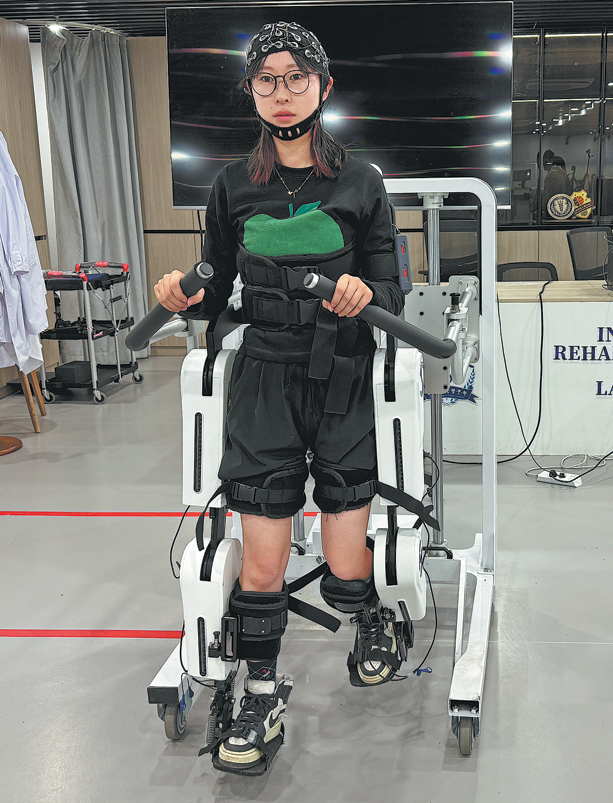
A laboratory member of Tianjin University debugs a brain-computer interface lower-limb wearable device designed to assist in stroke patients' recovery in Tianjin on April 1. ZHANG YUQI/XINHUA
Imagine this. Ten years from now, on a quiet morning, an elderly man wakes up to the soft pulse of sound waves from a smart pillow. He puts on a lightweight headset that reads brain signals.
With just a thought, he sends a signal to his home appliances to begin the day: curtains glide open and the kettle starts boiling automatically. His cognitive assessment results appear instantly on a health terminal worn on his wrist. Thanks to a brain-computer interface (BCI) intervention, his memory remains preserved at middle-age level, keeping Alzheimer's at bay.
Once confined to science fiction, scenes like these may become increasingly plausible as China accelerates the development and real-world application of BCI technologies.
China is already moving fast in clinical trials, evidenced by a breakthrough procedure in Shanghai in March where a man who lost all four limbs 13 years ago successfully received the country's first invasive BCI implant.
Developed through a collaboration between the Center for Excellence in Brain Science and Intelligence Technology at the Chinese Academy of Sciences and Huashan Hospital, affiliated with Fudan University, the device has operated stably without infection, enabling the patient to play chess and racing games using only his mind.
This milestone positions China as the second country, after the United States, to advance invasive BCI technology to the clinical stage, with researchers aiming for market approval by 2028.
At the 2025 World Internet Conference in Wuzhen, Zhejiang province, Lu Lin, an academician at the Chinese Academy of Sciences and director of the National Center for Mental Disorders, offered one of the clearest glimpses yet into how quickly such a future may arrive.
"In the next five to 10 years, ordinary people may be able to afford BCIs," Lu said, adding that the technology is proving promising "in treating emotional disorders, sleep problems and severe neurological diseases".
"Through BCI technology, we are attempting clinical trials that may help prevent dementia or restore memory," Lu said. "For vegetative patients who cannot communicate with the outside world, it does not mean that all brain functions are lost — we hope BCI technology can stimulate the intact parts of the brain and help them recover. We hope BCI technology can help vegetative patients wake up as soon as possible."
Lu described brain health as "the most important part of health", adding that unlike organs such as the kidney or heart that can be treated through transplantation, effective replacement or repair for the brain remains elusive. "BCI is opening a new pathway to address this challenge."
Globally, brain science has become a strategic frontier.
The US launched its BRAIN Initiative in 2013, while the European Union and South Korea have also invested heavily, pursuing their own large-scale programs. China has built a research framework focused on "understanding the brain, repairing the brain and simulating the brain", encouraging cross-disciplinary collaboration among life sciences, medicine and artificial intelligence.
This ecosystem is increasingly reinforced by policy tailwinds. In August, seven ministries jointly issued guidelines to strengthen the BCI industry, outlining five primary tasks and 17 detailed measures, from foundational hardware research to high-performance products and commercialization. In September, medical regulators released China's first BCI medical device terminology standard, offering a clearer roadmap for quality control and approvals.
The recently released recommendations for the 15th Five-Year Plan (2026-30) formally designated BCIs as a forward-looking future industry, stating that China aims to "recreate a new high-tech industry in the next 10 years".
Commercialization is beginning to accelerate as well.
In November, an implantable wireless BCI system from Shanghai-based StairMed was accepted into the National Medical Products Administration's innovative medical device fast-track review process. This makes it China's first invasive BCI product to access this "green channel", an important milestone in its path from clinical validation to market approval.
The global BCI market is rapidly expanding.
According to market intelligence, research and consulting firm Precedence Research, the BCI market, valued at $2.62 billion in 2024, is expected to reach $2.94 billion in 2025 and expand to $12.4 billion by 2034.
With the market taking shape, major Chinese cities are racing to build industrial hubs. Shanghai released its action plan for cultivating the brain-computer interface future industry (2025-30) in January, outlining a comprehensive roadmap to integrate cutting-edge technologies like embodied artificial intelligence with BCI systems, targeting both medical and consumer applications. Beijing has launched its first brain science and BCI industrial base in Changping district, while Shenzhen, Guangdong province, has established a national innovation center integrating AI with brain science. New application scenarios and business models are emerging across the country.
Looking ahead, Lu envisions BCIs as tools for deep cognitive enhancement. "Could we someday store all knowledge in a chip, implant it into the brain and let people master years of education in a short time?" Such ideas are still exploratory, he acknowledged, but "not unreachable".
BCI-enabled consumer products may also become commonplace.
Lu envisions mattresses and pillows behaving like ambient AI companions, quietly monitoring sleep patterns or emitting scents to help users fall asleep. He even described future concepts where, "if an elderly person's heart rate drops during sleep, the pillow could immediately trigger emergency alerts or perform mechanical chest compressions", though such hardware remains in the concept phase.
However, he stressed the need for ethical safeguards. "Artificial intelligence must have boundaries. It must operate under strict ethical, privacy and medical supervision to serve humanity." He warned that some AI systems have been found to provide dangerous advice to people with suicidal tendencies.
Still, Lu believes the integration of AI and BCIs will push healthcare into a new era. "Artificial intelligence cannot replace doctors in the short term — but doctors who do not use AI will be eliminated," he said.
