
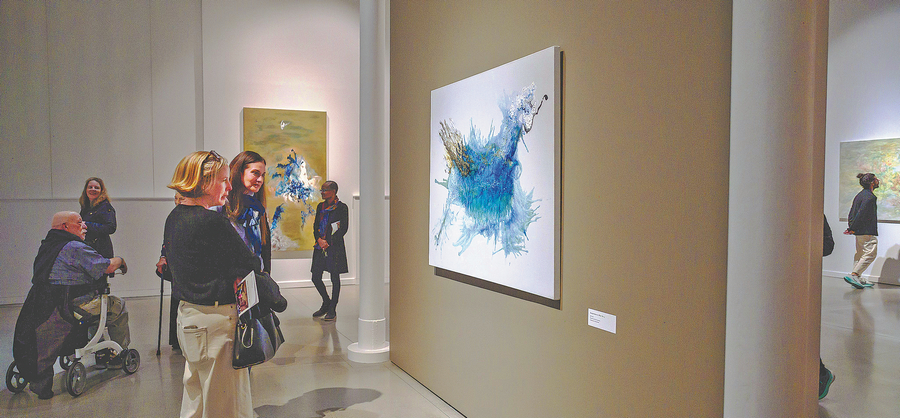
Shen Wei's recent works are on show at the Pocantico Center of the Rockefeller Brothers Fund in New York. COURTESY OF SUSA DESIGNS
Fifty years have passed since Chinese artist Shen Wei first put a brush to paper while learning traditional Chinese painting in Hunan province, when he was 7 years old.
Now, on an autumnal day in New York, Shen watches as four American dancers move across an enormous canvas, their bodies becoming brushes in motion. Through his choreography, they trace their movements in paint on the canvas floor, each flow and turn becoming vast strokes that merge dance and painting into one living artwork.
A choreographer, dancer, director and visual artist, Shen is weaving his diverse artistic identities through a joint exhibition by the Katonah Museum of Art in New York and the Pocantico Center of the Rockefeller Brothers Fund.
The joint show will last until April 18, 2026 at the Pocantico Center of the Rockefeller Brothers Fund and through April 19 at the Katonah Museum of Art.
Shen studied traditional Chinese culture for decades, including Chinese opera, painting and calligraphy, followed later by dance.
"Chinese culture has its own beauty and civilization that have been passed down for thousands of years," Shen says.
"After coming to the West, I began to understand Western civilization, its aesthetics, painting, dance, music, film and opera. I love both cultures deeply. They are both humanity's shared pursuit of beauty expressed through sound, sight and movement in different ways. I find both profoundly beautiful, creating a new artistic identity of my own that deeply relates to my Chinese roots, as well as Western culture," Shen says.
The two exhibitions, named Shen Wei: Still/Moving, show Shen's work primarily from his earlier Music and Movement, the Calligraphy Brush series, which is more abstract — exploring the flow of the body's inner qi energy, and the depiction of music and movement, through brush or body, on the canvas. The work deeply relates to his own experiences of dance and Chinese calligraphy.
Some of the paintings have a code that can be scanned, so you can listen to the specific music that inspired him to create the painting.

Shen Wei (middle) and members of Shen Wei Dance Arts after performing at the exhibition opening at the Katonah Museum of Art in New York. COURTESY OF THE KATONAH MUSEUM OF ART
The selections at the Pocantico Center focus on Shen's recent works, which portray the spiritual and the mind in an abstract landscape, and share elements of traditional Chinese shanshui landscape painting.
"We are delighted to have this opportunity to collaborate with the Pocantico Center of the Rockefeller Brothers Fund," says Michelle Yun Mapplethorpe, director and chief curator of the Katonah Museum of Art.
This exhibition and partnership have been many years in the making, and it feels like a natural fit, she says.
Beyond their shared interest in Shen's visual art, the Rockefeller Brothers Fund and the Pocantico Center are also hosting Shen for a special dance residency, during which he is creating a newly commissioned work for the American Dance Festival.
"We thought it would be the perfect opportunity to have a dual-venue exhibition that really showcases the breadth of Shen Wei's artistic practice, both between visual and performing art," says Mapplethorpe.
On display at the exhibition at the Pocantico Center of the Rockefeller Brothers Fund, a nonprofit organization housed on the Rockefeller Estate, Shen's new Suspension in Blue series (2017-2020), painted in acrylic, was inspired by a movement from his dance technique "natural body development".
The newest watercolor series, MindScape, from 2023, unfolds across the bright, high-ceilinged gallery. The Reflected Elements series of eight paintings was created while Shen spent much of his time in Paris during the COVID pandemic, where he developed a new technique with abstract natural forms in a golden glowing brown, inspired by landscape paintings from the Northern Song Dynasty (960-1127).

he Shen Wei: Still/Moving exhibition at the Pocantico Center of the Rockefeller Brothers Fund in New York includes Reflecting Elements series (left) and Untitled No 31. COURTESY OF SUSA DESIGNS
The most recent MindScape works reveal a softer color palette and a more delicate sensibility in watercolor, says Katrina London, curator of the Pocantico Center.
"Pretty much all of his paintings at the Pocantico Center reference abstract landscapes in some way, but at the same time they speak to the choreography of dance. You can see the movement in them, and so they're kind of like these dream-like spaces that are in between a landscape and a dance and just the interior of his mind, his feelings and thoughts," she says.
"When I think about Shen Wei, I also really think about him as a global ambassador. I really feel that his practice, both across dance and also the visual arts, transcends cultural divides," says Mapplethorpe.
She notes that from a young age, Shen was immersed both in traditional Chinese gongbi painting and calligraphic practices, and also began studying Western portrait and figurative art.
"I do feel that when Western visitors come to see the exhibition, they will find a point of entry through their own experiences and knowledge, whether it's abstract expressionism, Chinese calligraphy or shanshui landscape painting. I think there are many different ways to appreciate and understand Shen Wei's paintings," she says.
Diverse experiences
Shen's lifelong fascination with art began at an early age, shaping the many facets of his artistic identity. "I have always pursued art and all things beautiful," he says. "It has guided my growth throughout my life."
Born in Hunan in 1968, by the age of 6, Shen was studying calligraphy and painting, and at 9, he started learning traditional Chinese opera. Years of practice deepened his appreciation and skill. Later, Shen discovered Western oil painting and murals. He also began studying dance, and in 1996, one year after moving to the United States, he began to explore film.
In 1989, Shen began studying modern dance through the American Dance Festival's program in collaboration with the Guangdong Dance Academy in China. Three years later, he became a founding member of the Guangdong Modern Dance Company, the first contemporary dance company in the country.
In 1995, after winning the first prize for choreography and performance at China's National Modern Dance Competition, Shen moved to New York on a scholarship from the Nikolais/Louis Dance Theater Lab. There, he expanded his artistic practice to include film, while continuing to explore new directions in dance theory, choreography and painting throughout the 1990s. In 2000, he established his own company, Shen Wei Dance Arts.

The Shen Wei: Still/Moving exhibition at the Pocantico Center of the Rockefeller Brothers Fund in New York includes Reflecting Elements series (left) and Untitled No 31. COURTESY OF SUSA DESIGNS
"All the things I am curious about and love, I try to learn," Shen says. Over time, these diverse experiences, from Chinese traditional arts to Western contemporary arts, from opera to painting, from dance to film, have shaped not only his perception but also his creations.
"I never intentionally tried to combine them," he says, "but my senses and understanding have evolved. Each medium opens a different perspective, allowing me to see a work of art more comprehensively, not just from an Eastern or Western viewpoint, but from a human civilization perspective."
Shen's recent abstract landscape paintings continue his dialogue with traditional Chinese shanshui painting and the natural world. Monumental in scale, the works carry a cinematic quality that draws viewers in, encouraging them to engage physically with the canvases and to reflect deeply on the relationship between nature, movement and perception, according to the introduction to the dual-venue exhibition.
One example of this is the large brown-toned painting that greets visitors upon entering Shen's exhibition at the Pocantico Center. One of his recent works during the pandemic, Shen pushed the limits of brown oil paint with a work using only browns, but with different layers and difficult techniques, created while he was reading Dante's Divine Comedy.
Shen was thinking not only about landscapes, but also about spiritual journeys, says London the curator, adding that the work was technically very complex, and what he was able to achieve with just that one color on linen is remarkable.
The commonality of art
Shen says he hopes his exhibition allows people to feel something universal, from shared human sensitivity and the beauty in nature, to the invisible essence of the natural world and the sense of timelessness within it.
"This, I think, is a human commonality. In Chinese culture, this feeling is especially strong, and it can be expressed through traditional Chinese artistic forms. At the same time, you can present it in a more direct and contemporary way, which makes it deeply powerful and moving for audiences," Shen says.

Dancers perform excerpts from Shen's 2004 creation Connect Transfer. COURTESY OF THE KATONAH MUSEUM OF ART
Ben Rodriguez-Cubenas, program director at the Rockefeller Brothers Fund, says: "I think his aesthetic is beautiful because it brings together both Eastern and Western traditions, so everyone can connect to it. And that feels especially important today when the world is so divided. A cultural exchange like this really brings people closer. His work inspires people — many here have said how deeply moved they were by it."
Jose Gabriel Capaz, a Cuban painter who also received a residency from the Rockefeller Brothers Fund, says he sees a universal combination in Shen's work.
"I love when an artist works in a more complete, universal way, not limited to the canvas. In this case, it's amazing, and I really enjoy it. I think it's a mix of Western and Chinese art, not national, but something beyond that.
"I can see this fusion as something very much of the 21st century. For me, everything belongs to one world, one culture, not two separate ones. Sometimes people find it difficult to understand that, but I think the world is one now, and we all need to bring our energy together as one," Capaz says.
At the opening event at the Katonah Museum of Art, Shen Wei Dance Arts performed excerpts from the 2004 creation Connect Transfer. Dressed in blue, pink, yellow and purple, the dancers' bodies dipping in multicolored paint leave their marks on the canvas floor, creating a colorful abstract painting.
Chelsea Retzloff is a former dancer with Shen Wei Dance Arts who now serves as the company's administrator and education director. She has performed as a "stroke dancer "many times to transfer Shen's artistic ideas onto canvas.
"I have been completely covered in paint many times, and it takes many days to wash it off. But it is really fun. It's very cold, and it's very slippery, and it really tests your ability as an artist to make decisions quickly. It really challenges you in a different way than regular modern dance," she says.
Retzloff has performed in China many times while touring with Shen Wei Dance Arts. As an American performer, she says interpreting works deeply rooted in traditional Chinese art can be both challenging and rewarding.
"As an American performer, I'm very muscular, I'm very athletic, and it took so much work internally to be able to perform the Chinese elements of Shen Wei's work. I had to really change and develop my inner life, to be sensitive and to be able to have ... an inner mindscape that you can really use to transcend yourself to another place," she says, adding that it was one of her favorite things about working with Shen — how much it challenged her to "change and grow as a person and as an artist".
Shen's most famous work, Scroll Painting, was performed at the opening ceremony of the 2008 Beijing Olympics. The work demonstrated the close relationship between painting and dance, typical of Shen's approach to art: several dancers creating a huge Chinese ink painting with their bodies watched by the world.
The new works Shen is now creating, which combine dance, painting, writing and music, will tour in both the West and the East next year.
Contact the writer at minluzhang@chinadailyusa.com
