

Crew members collect the first ice cube during an ice collecting festival in Harbin, Northeast China's Heilongjiang province, Dec 7, 2025. Marking the beginning of Harbin's ice collecting season, the sixth ice collecting festival kicked off here by the Songhua River on Sunday, attracting lots of people with ice collecting ceremony and folk custom experience activities. [Photo/Xinhua]
HARBIN -- On a frozen stretch of the Songhua River, China's "ice city" Harbin opened its annual ice-harvesting festival on Sunday, signaling the start of a bustling winter tourism season for the northeastern city.
Wrapped in red cotton coats, dozens of ice harvesters worked in tight formation, their metal chisels cracking in steady rhythm until a perfect, glistening slab loosened from the river's surface. Hooking it with iron poles, they dragged it ashore, where sunlight caught its polished edge and turned the block into a beam of silver.
The ice chunks, typically 1.6 meters long and 0.8 meters wide, are prized for their uniform density and clear texture. They were then loaded onto trucks and transported across Harbin, where they will be carved into slides, castles and other landmarks in the capital of Heilongjiang province.
Over the next month, nearly 1,000 workers will carve, lift and haul up to 10,000 cubic meters of ice each day.
Sunday also marked Daxue, or Major Snow, the traditional Chinese solar term signaling the approach of deep winter. Local meteorologists say the river ice typically thickens to more than 30 centimeters after Daxue, meeting the ideal standard for harvesting.
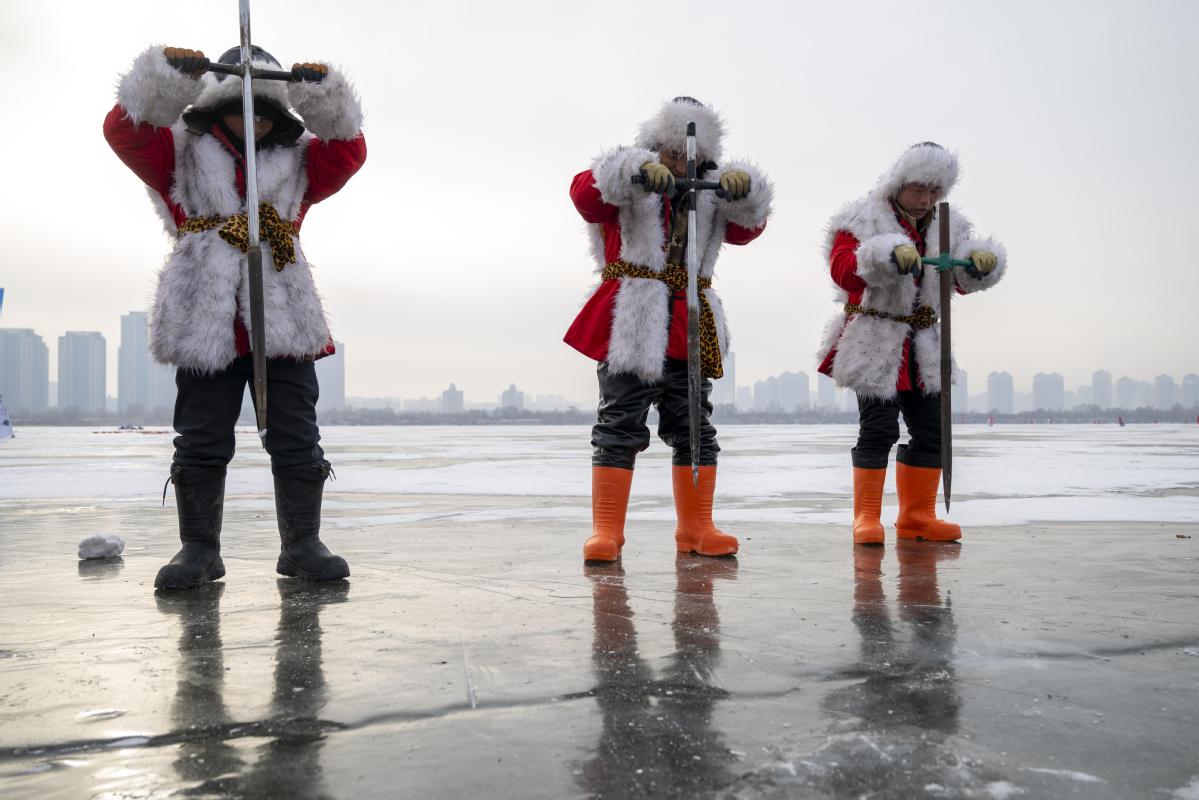
Crew members collect ice during an ice collecting festival in Harbin, Northeast China's Heilongjiang province, Dec 7, 2025. [Photo/Xinhua]
Crowds of residents and tourists lined the riverbank to film the ice-harvesting activities.
"The ice-harvesting ceremony was stunning," said Alina Dorokhina, a Russian student. "The ice and snow may be cold, but the people, the sounds and the rich folk traditions here are all warm and full of life."
The ceremony also marks the official start of Harbin's winter tourism push.
The ice slabs will form the backbone of the Harbin Ice-Snow World, the world's largest ice-and-snow theme park. This year's edition will expand to a record 1.2 million square meters and use 400,000 cubic meters of ice and snow, according to Sun Zemin, deputy director of the marketing department at Harbin Ice-Snow World Park Co., Ltd.
The park will roll out a slate of new attractions this year to draw visitors, such as hot spring camps, cross-country skiing tracks, themed parades and a variety of ice-and-snow activities. It will also enhance smart tourism services and accessibility facilities to better welcome global travelers.

Tourists pose for photos with a big snowman during an ice collecting festival in Harbin, Northeast China's Heilongjiang province, Dec 7, 2025. [Photo/Xinhua]
Harbin has leveraged its long winter to ignite the winter tourism fever in the past few years, with a record-breaking 90.35 million visitors last winter. The total tourist spending in the city amounted to 137.22 billion yuan (about $19.4 billion), up 16.6 percent year on year.
"This winter, Harbin will integrate ice and snow with study tours, sports and technology to build a high-quality winter tourism supply system," said Wang Hongxin, director of the city's culture, radio, television and tourism department. "We aim to make the city a top winter destination for more travelers and continue driving the growth of China's ice-and-snow economy."
China plans to develop its ice-and-snow economy into a new growth sector, targeting an economic scale of 1.2 trillion yuan by 2027 and 1.5 trillion yuan by 2030, according to guidelines issued by the General Office of the State Council in November 2024.
With its booming ice-and-snow tourism, Northeast China, including Heilongjiang province, has gained fresh appeal. Once known as the country's rustbelt, the region has long struggled with a painful economic transition and talent outflows.
Notably, the market size of the ice-and-snow economy in this province reached 266.17 billion yuan in 2024, with ice-and-snow tourism contributing 182.33 billion yuan, according to the provincial bureau of statistics.
