

Sean Stein, president of US-China Business Council, talks to media in Washington on Wednesday. [Photo by Zhao Huanxin/China Daily]
Despite talk of decoupling, United States companies are not pulling out of China, and many are deepening their partnerships with Chinese businesses, Sean Stein, president of the US-China Business Council, said in Washington on Wednesday.
"There's a myth out there — fed partly by the media and partly by the political mood — that American companies are somehow leaving the China market or stepping away from it. That is absolutely not the case," Stein told reporters ahead of a meeting with a Chinese business delegation.
There have been reports highlighting companies reducing exposure or rethinking their strategy in China. Media such as The Wall Street Journal, Reuters and Forbes have documented companies cutting investment plans, shifting some production to Southeast Asia, and slowing expansion amid costs, tariffs and geopolitical risk.
However, recent US media reports, including those from Bloomberg, Politico and the New York Post, have said that US companies will stay put despite tariffs, and that businesses continue operating because of scale, supply-chain depth and consumer demand.
Stein said US companies remain firmly rooted in China, noting that some of them "have been in China for 50 years, and they're not going anywhere" and, like businesses worldwide, they are reassessing supply-chain resilience.
"Companies are continuing to grow and invest in China," he said. "But they're also building options elsewhere in the region."
The 2025 Member Survey report, released by Stein's organization in July, found no exodus of US companies from China, with more than 80 percent continuing to invest to serve the local market and nearly all saying they cannot remain globally competitive without their China operations.
At the same time, some companies are recalibrating supply chains, pursuing "China-plus-one "strategies with expansion into Southeast Asia, India and Mexico, a shift driven by tariffs, higher input costs and the need for more resilient networks, according to the survey.
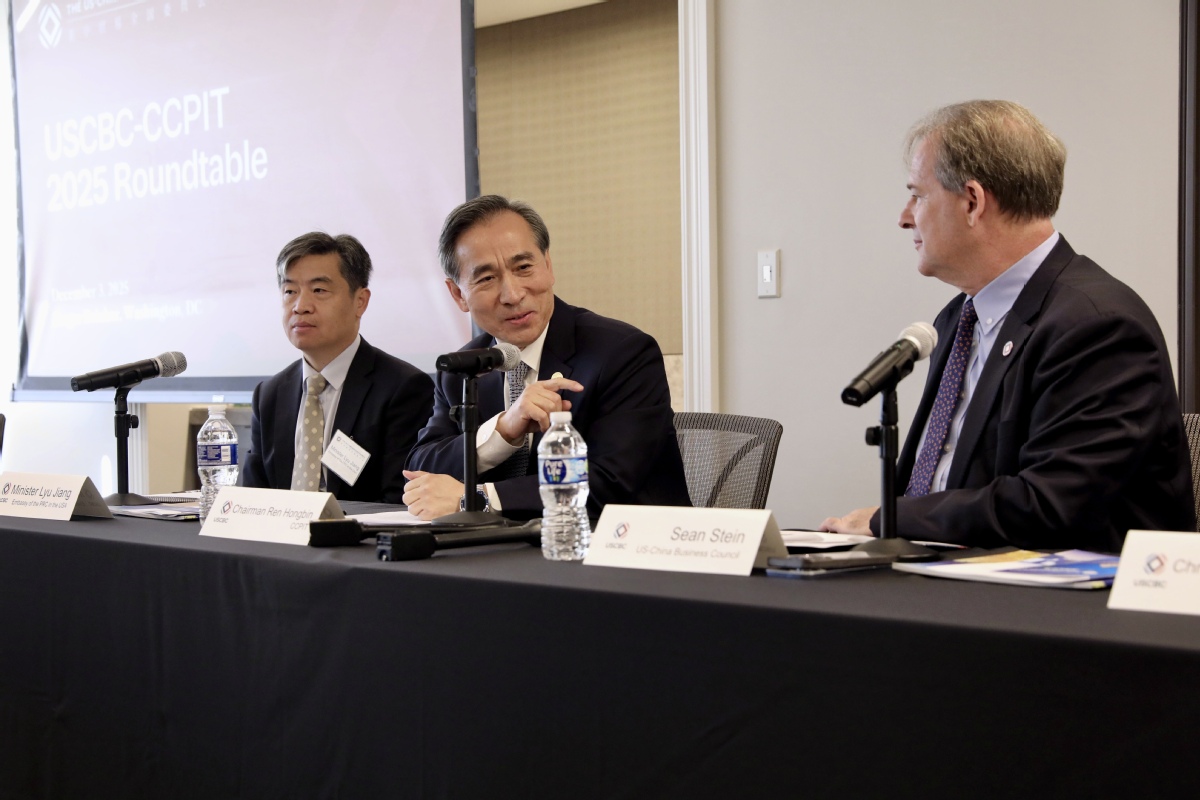
Ren Hongbin (center), chairman of the China Council for the Promotion of International Trade, addresses a roundtable attended by a delegation of Chinese executives and representatives of the US-China Business Council and its member companies, in Washington on Wednesday. [Photo by Zhao Huanxin/China Daily]
Stein explained the structural reasons why US companies are not leaving China, with some deepening their partnerships there.
"What I'm seeing now increasingly, though, is as China's economy has grown and as the private sector has become stronger, more companies are choosing to develop joint ventures and to partner very closely with Chinese companies — because they bring real value to the relationship," he said.
The shift reflects China's economic modernization, with Chinese enterprises now able to work with multinational companies, including US ones, on a more equal footing, he added.
In past decades, companies entering China were required to take a local partner, but over time, as China continued reform and opening-up, more wholly foreign-owned enterprises have been launched, meaning that companies have gained more flexibility.
Another reason that US companies are not leaving China is the fact that the nation's regulatory system "has improved greatly over the last decade", even if "there's still room for improvement", according to Stein.
New path for ties
He also said that the recent meeting between President Xi Jinping and US President Donald Trump in Busan, South Korea, set a new, much more pragmatic path for US-China relations, one that he said is applauded by the business community.
When asked about the US administration's moves imposing steep tariffs on imports from China, Stein said the US-China Business Council has long argued that tariffs do not strengthen the US economy or make US companies more competitive globally.
"That's a realization that's increasingly sinking in on the US side," he said.
Stein urged policymakers to learn lessons from the trade conflict, saying that costs are real, and "our hope is that lesson is much more widely learned within the policymaking circles".
Speaking at a roundtable discussion with representatives of the US-China Business Council and its member companies, Ren Hongbin, chairman of the China Council for the Promotion of International Trade, said that history has repeatedly shown that both countries benefit from engagement and suffer when tensions escalate.
"If China and the US cooperate, it will bring win-win outcomes. If they confront each other, it can only lead to lose-lose results," Ren said.
He added that despite ups and downs in the bilateral relations, the friendship between the two peoples and the business communities' desire to work together have remained unchanged and continue to give both sides the confidence to move forward.
50th anniversary of bond
This year marks the 50th anniversary of the first visit to the US by a delegation of the China Council for the Promotion of International Trade, and Ren is leading some 50 Chinese companies to Washington for the talks.
He said the delegation's chief aim is to carry out the consensus reached by the two nations' heads of state, who have already outlined the direction for the relationship.
The task now, especially for businesses, is to follow through and turn top-level agreements into reality. Though challenges exist, cooperation can lead to solutions, Ren said.
The CCPIT delegation visited Canada from Sunday to Tuesday before heading to the US.
huanxinzhao@chinadailyusa.com
