
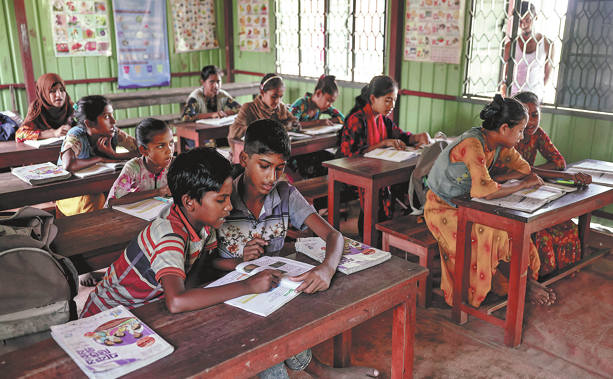
Children attend a class at the only school on Char Youthnet island in Kurigram, Bangladesh, on Oct 28. MOHAMMAD PONIR HOSSAIN/REUTERS
On an overcast morning, Nurun Nabi loads bamboo poles and tin sheets onto a wooden boat. His home, built just a year ago on a fragile island in the Brahmaputra River, is on the verge of being swallowed by water.
It is the second time the farmer and father of four has had to move in a year.
"The river is coming closer every day," Nabi said, his voice tight with exhaustion. "We are born to suffer. Our struggle is never-ending. I've lost count of how many times the river took my home."

People carry the roof of a house to load onto a boat after being forced to relocate to another island due to erosion in Kurigram on Oct 29. MOHAMMAD PONIR HOSSAIN/REUTERS
Nabi, 50, has no choice but to move to another char — a temporary island formed by river sediment. His rice and lentil fields are already gone, claimed by the advancing current of the Brahmaputra, which originates in the Himalayas and flows through China and India before reaching Bangladesh.
"I don't know what awaits us there in the new home," he said, looking toward the wide brown river. "If I'm lucky, maybe a few years. If not, maybe a month. This is our life."
Every year, hundreds of families in northern Bangladesh's Kurigram District face the same fate. As riverbanks collapse, people lose not only their homes but also their land, crops, and livestock. The Brahmaputra, Teesta, and Dharla rivers — once lifelines for millions — have become unpredictable, eroding land faster than ever before.
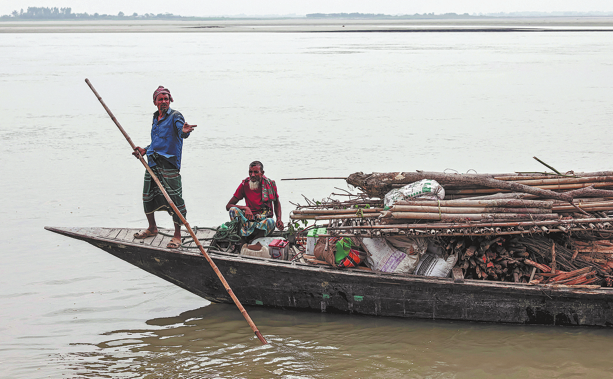
A man stands on a boat loaded with his house after being forced to relocate to another island due to erosion in Kurigram on Oct 29. MOHAMMAD PONIR HOSSAIN/REUTERS
The chars — sandy, shifting islands scattered across the country's northern plains — are among the most fragile places in Bangladesh. Families rebuild again and again, only for the river to take everything they have.
"The water comes without warning," said Habibur Rahman, a 70-year-old farmer who has lived on several chars. "You go to sleep at night, and by dawn, the riverbank has moved. You wake up homeless. There is no peace in our life."
As the world's eyes turn to Brazil, the host of the climate conference from Nov 10 to 21, Bangladesh's struggle offers a sobering message for global people.
The country is often praised as a model of resilience — building embankments, improving flood forecasting, and pioneering community-based adaptation. But without stronger international support and climate finance, those efforts will fall short.
"People here are paying the price for emissions they never made," said Ainun Nishat, a water resource and climate change specialist. "If COP30 means anything, it must deliver real funding for loss and damage and help vulnerable nations like ours protect lives and land before it's too late."

A man receives fish from a boy on Oct 29 on an island in Kurigram, Bangladesh, where he recently relocated his house due to erosion. MOHAMMAD PONIR HOSSAIN/REUTERS
Scientists say what is happening in Kurigram is climate change made visible, as the melting of the Himalayan glaciers that feed the Brahmaputra and Teesta rivers accelerates.
"We are seeing rapid glacial melt, almost double the rate of the 1990s. Extra water is flowing downstream, adding to the already swollen rivers," said Nishat.
At the same time, the monsoon has grown more erratic — arriving earlier, lasting longer, and falling in intense, sudden bursts. "The rhythm of the seasons has changed," Nishat said.
"When it rains, it rains too much, and when it stops, there are often droughts. This instability is making erosion and floods far worse."
He said Bangladesh contributes less than half a percent of global carbon emissions, yet suffers some of the most serious consequences of climate change.
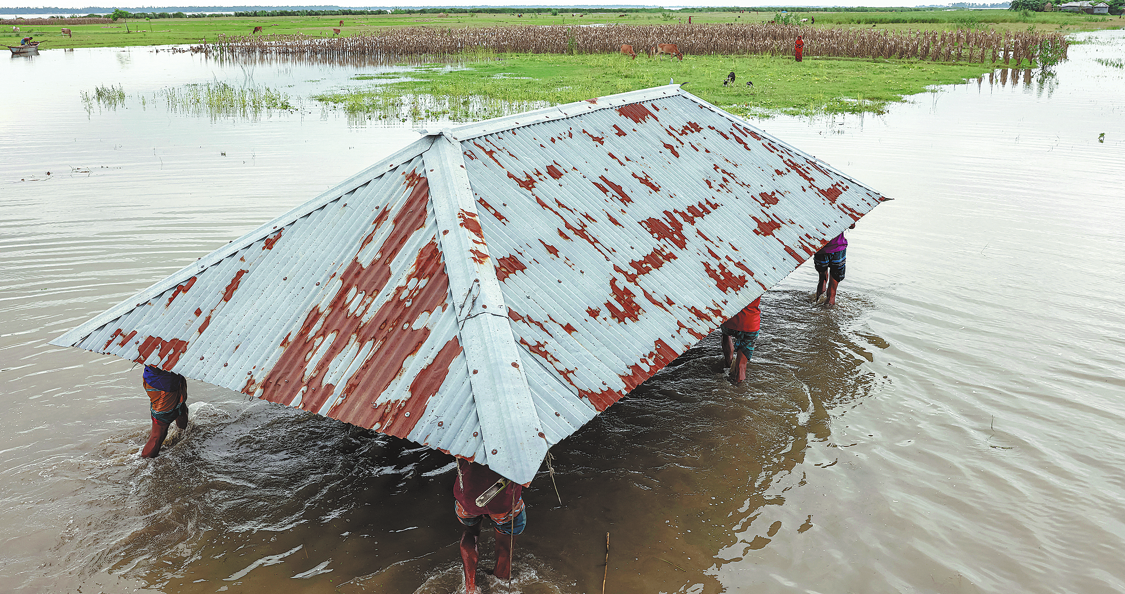
People move the roof of a house to another island in the Brahmaputra River, as the current one is on the verge of being destroyed by erosion, in Kurigram, Bangladesh, on June 20, 2024. MOHAMMAD PONIR HOSSAIN/REUTERS
Displacing people
The World Bank estimates one in every seven Bangladeshis could be displaced by climate-related disasters by 2050.
For Kosim Uddin, 50, a father of seven, moving has become routine. "In my life, the river has taken my home 30 or 35 times — maybe more," he said.
"Every time we rebuild, the river comes again," Uddin said, his eyes fixed on the water. "But where can we go? The whole world is water now."
Women carry much of the burden of the constant displacement. Shahina Begum, 30, a mother of two, recalled standing in waist-deep water as she cooked for her family during floods last year. "We moved six times in 10 years," she said. "Every time we start again, the river takes it back."

People sit near a shop on the bank of the Brahmaputra River in Kurigram on Oct 28. MOHAMMAD PONIR HOSSAIN/REUTERS
For Shahina, each move brings new hardships. "It is even more difficult for women and adolescent girls," she said. "We have to find dry ground, cook, take care of children — and there is no privacy or safety."
On Kheyar Alga Char, about 300 families have managed to stay put for three years after local groups installed geobags — large sand-filled sacks that strengthen riverbanks against erosion.
"Geobags have made a huge difference," said Johurul Islam, 39, who lost his home more than 10 times before settling here. "For the last three years, the river didn't take our land. For the first time, I feel a little confident about the future."
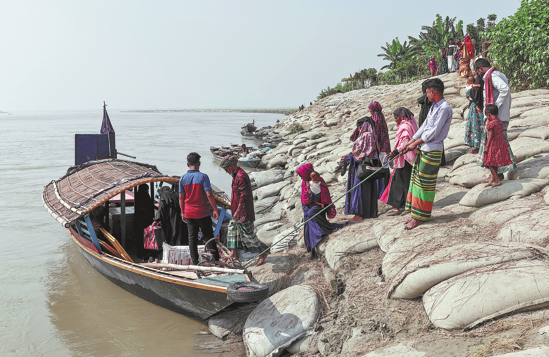
People board a boat to travel to another island in Kurigram on Oct 28. MOHAMMAD PONIR HOSSAIN/REUTERS
Local NGOs are also helping to build raised villages — clusters of homes elevated above the ground to withstand seasonal floods.
Standing by the riverbank that has held firm for three years, Islam struck a note of cautious optimism.
"Maybe the river will come again one day," he said, smiling faintly. Around him, children played on solid ground, their laughter carried by the evening wind. "This time, we'll be ready. For now, the land is holding — and so are we."
Agencies Via Xinhua
