
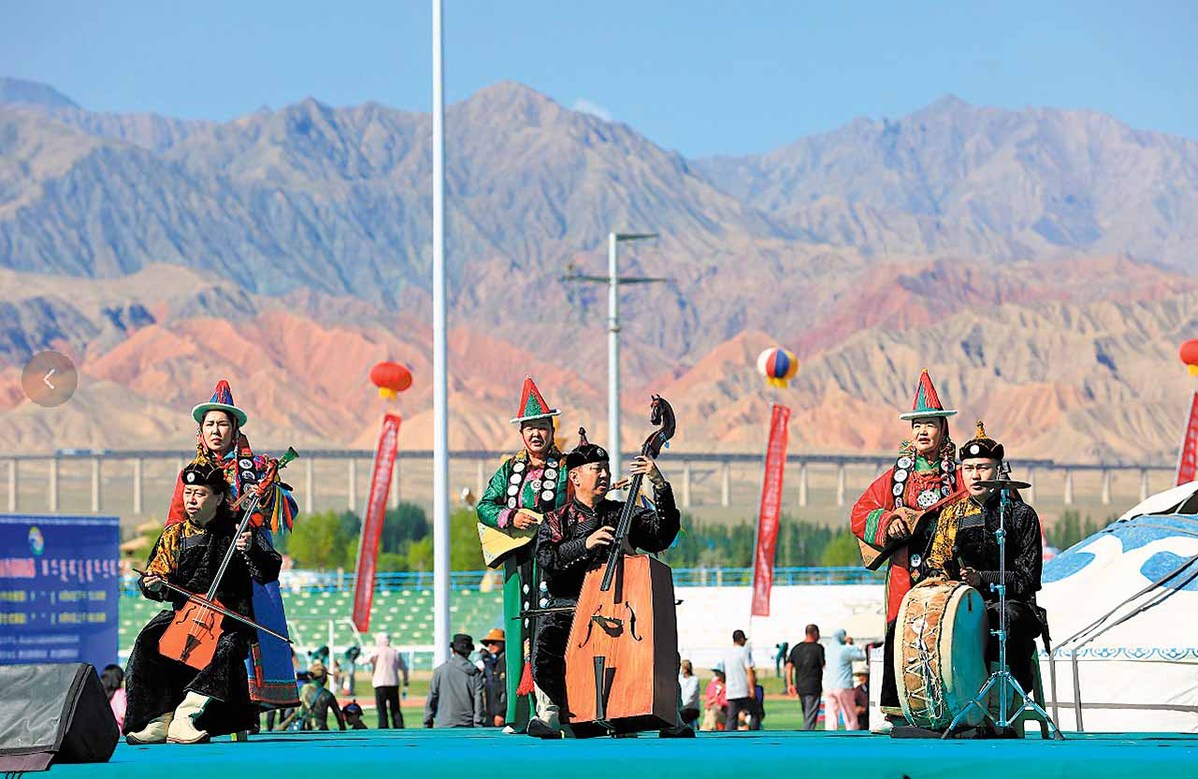
The Deji band performs at the Naadam Festival in August in the Subei Mongolian autonomous county of Gansu province. CHINA DAILY
The wind sweeps across the grassland, carrying the deep, resonant hum of throat singing and the melodic strain of a horse-head fiddle. Under a vast blue sky, a crowd of herders gathers around a makeshift stage — a patch of oasis dotted with grazing sheep in the Gobi Desert.
This is the stage for Qinbugele, 42, and his band, Deji, part of the Ulan Muqir troupe in Subei Mongolian autonomous county, Gansu province. They have taken a five-hour bus ride from the county seat to perform in Mazongshan town, located in the northernmost part of Subei.
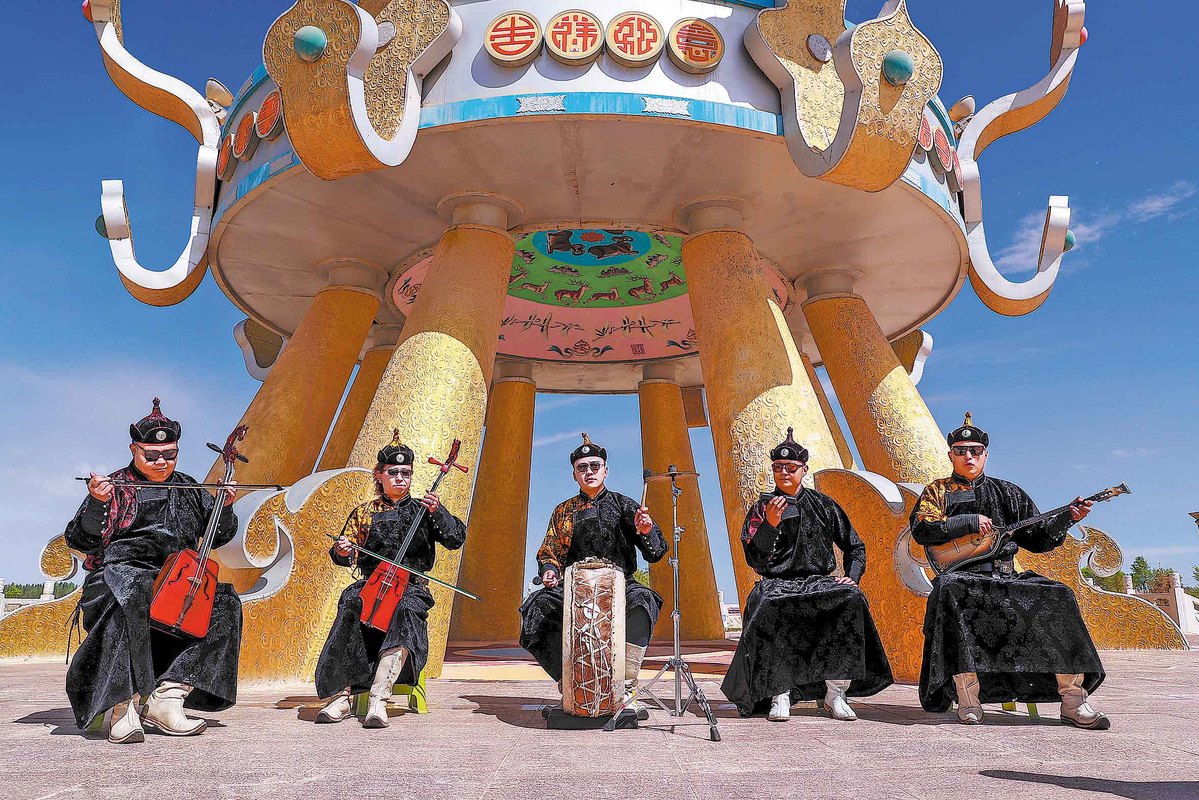
The Deji band, featuring Mongolian musical instruments, performs for the public in front of a square in Subei. CHINA DAILY
Qinbugele, a native of the Mongolian ethnic group in Subei, founded Deji a decade ago, forming an ensemble that uses only traditional instruments — the sheepskin drum, the horse-head fiddle, and others unique to the region.
His connection to the Ulan Muqir troupe runs deep: his aunt was a singer in the troupe during the last century, when performers traveled on horseback or in large trucks to reach pastoral areas. Back then, he dreamed of following in her footsteps to become a member. He fulfilled that ambition as an adult.
"We play where the people are, whether it's in large theaters, at music festivals, on the grasslands, in the desert, or near herders' yurts," he says,
Ulan Muqir, which means "red bud" in Mongolian, are the troupes originated in the vast grasslands. They travel from one encampment to another, performing for herders living in remote regions.
Subei county is predominantly inhabited by the Mongolian ethnic group, a population of less than 10,000. However, Subei covers a vast area, larger than some provinces, and is home to stunning natural landscapes, such as grasslands, snow-capped mountains, deserts, and lakes. Traveling to the farthest parts of the county can take five to six hours by car.
For the Ulan Muqir of Subei, it is common to spend a week traveling long distances to perform in different villages and towns.
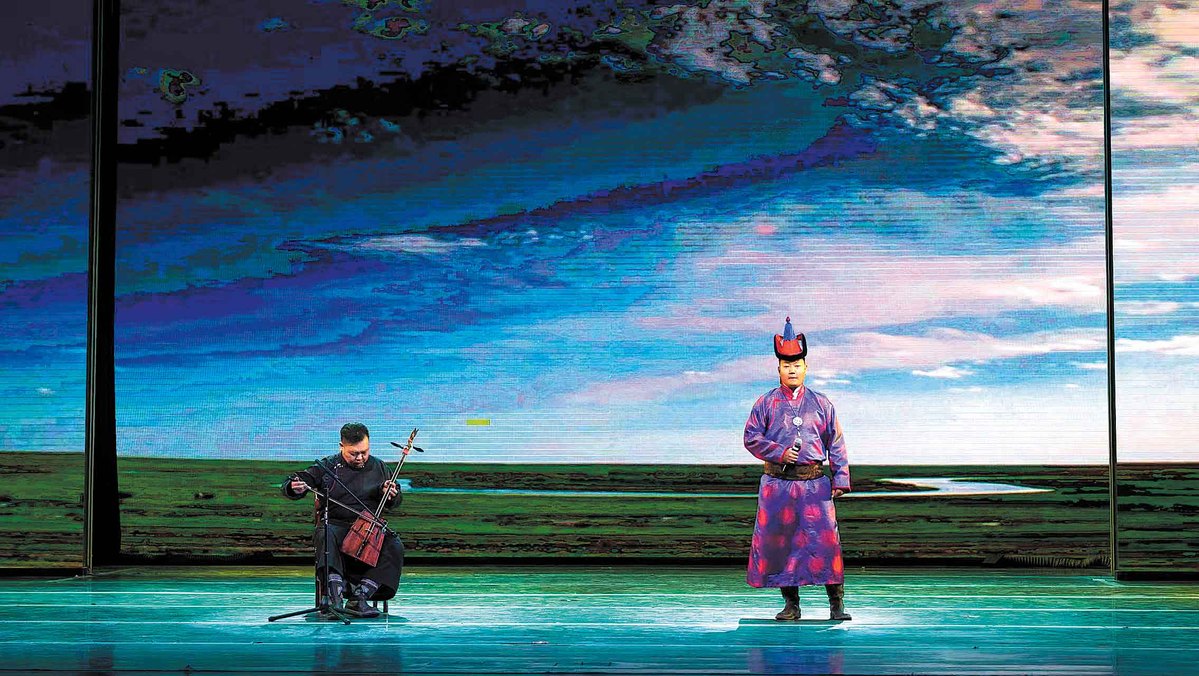
Long song singer Bulga, 25, performs at a theater in Dunhuang in Gansu province with members of their Ulan Muqir troupe. CHINA DAILY
The troupe performs over 100 times a year within the town, primarily in the summer, when herders are less busy. Winter is a hectic season for them, but summer brings traditional festivals, such as horse racing competitions, camel contests, and traditional Mongolian rituals, for which Deji also performs.
Compared to performing in theaters or music festivals, Qinbugele prefers to perform for herders in pastoral areas. In his own words, "it's like visiting family members".
"The herders know me and treat me like a brother. This warmth between people, the relaxation and freedom of performing, is completely different from stage performances," he says.
Qinbugele is skilled at playing the morin khuur (horse-head fiddle) and music arrangements. He often rearranges ethnic Mongolian folk songs, which the band brings new life to.
Growing up in pastoral areas with the vast Gobi Desert, he describes the local music as rugged and slightly desolate. On summer weekends, seeking inspiration for arrangements, he drives alone to the grassland, sets up a tent, plays recordings, and practices on his horse-head fiddle. At night, he lies on the grass to gaze at the stars, seeking creativity through solitude.
"I think my hometown is amazing. I am proud of our ethnic music," he says.
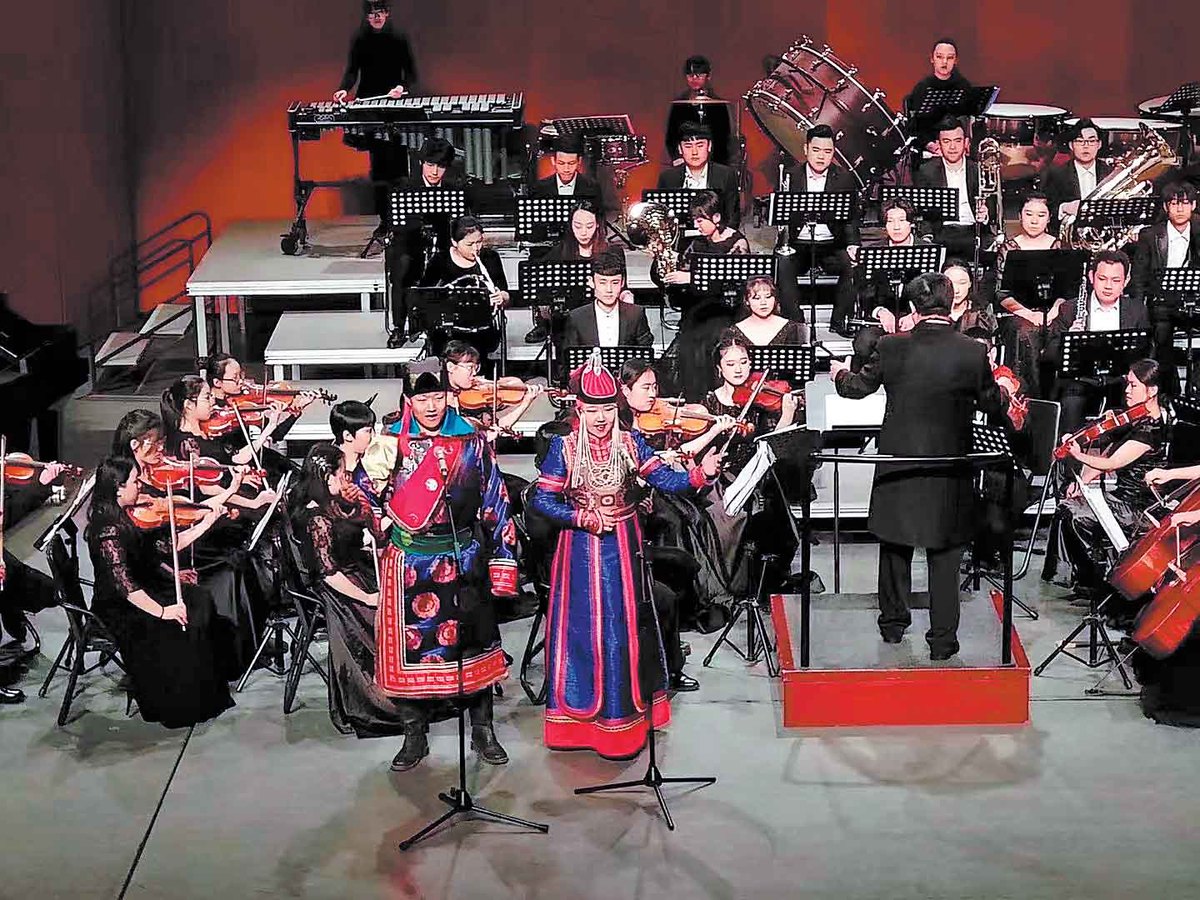
Bulga (front left) performs with a school orchestra at the theater of the Inner Mongolia Arts University in Hohhot, Inner Mongolian autonomous region. CHINA DAILY
Among the band members is singer Bulga, 25, who joined four years ago. He specializes in the long song, urtiin duu in Mongolian, a UNESCO-recognized art form characterized by its extended, ornamented vocals. This unique genre is an integral part of ethnic Mongolian cultural heritage and is often performed at important events, celebrations and festivals.
Growing up in Subei, he was drawn to the haunting beauty of the long song. He has studied the intangible cultural heritage intensely and sought out older generations to learn from, with the aim of preserving and promoting his ethnic music.
"I notice that not many younger people are familiar with the long song and prefer pop music instead. I feel it is my responsibility to preserve and pass on our ethnic music," says the 25-year-old.
As a child, Bulga often watched Ulan Muqir troupes' performances. Now, he is a proud member of the troupe.
He and his troupe frequently travels for several days by bus to perform in remote pastoral areas. Each performance lasts from one to several hours.
Sometimes, after their performances, he enjoys horseback riding, wrestling, and archery with the enthusiastic herders.
"Although the journey is quite exhausting, all my worries and fatigue disappear as soon as I arrive on the grasslands. The people are warm and hospitable. We often organize a tug-of-war competition together, which is fantastic," says the singer.
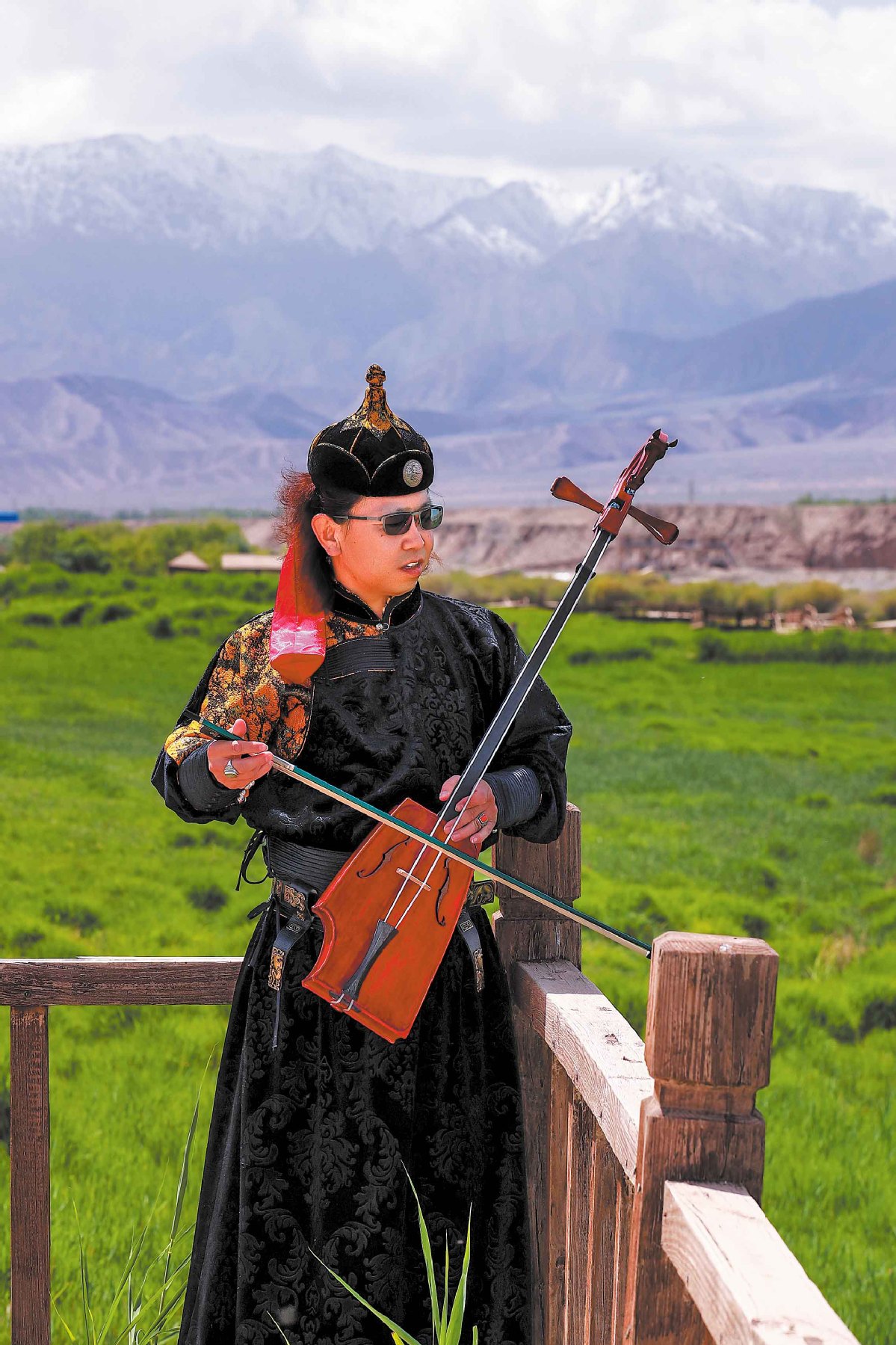
Qinbugele, a native Mongolian ethnic group in Subei, enjoys a moment of personal reflection after a performance on the grassland. CHINA DAILY
Unlike Qinbugele and Bulga, who both grew up immersed in the ethnic Mongolian culture, Tugqi, 28, the group's khoomei (throat singing) singer and drummer, took a different path. He studied saxophone and orchestral music in Henan province before moving to Shanghai, where he rediscovered his ethnic Mongolian roots.
"After graduating, something pulled me back. I suddenly developed a strong fondness for our traditional music," he explains.
Tugqi joined the Ulan Muqir troupe four years ago and is now skilled in several instruments. Here, everyone is a versatile talent, possessing a variety of musical skills.
For him, performing feels like "sweet torment". After several days of arduous travel, they arrive, greeted by the vast, endless grasslands or deserts. The warm and hospitable herders offer rich, creamy milk tea and authentic local delicacies, instantly washing away the fatigue from the journey.
After indulging in a feast, everyone gathers around, chatting about everything under the sun or in a yurt if there are not too many people. Before long, someone starts an impromptu performance. Tugqi thoroughly enjoys this relaxed, joyful and harmonious atmosphere.
In recent years, he has toured nationwide with the Deji band, being invited to perform at various music festivals and theaters, and even shared the stage with famous singers at their concerts.
"Performing in pastoral areas can be exhausting, but the connections between people are the most direct and genuine," Tugqi says.
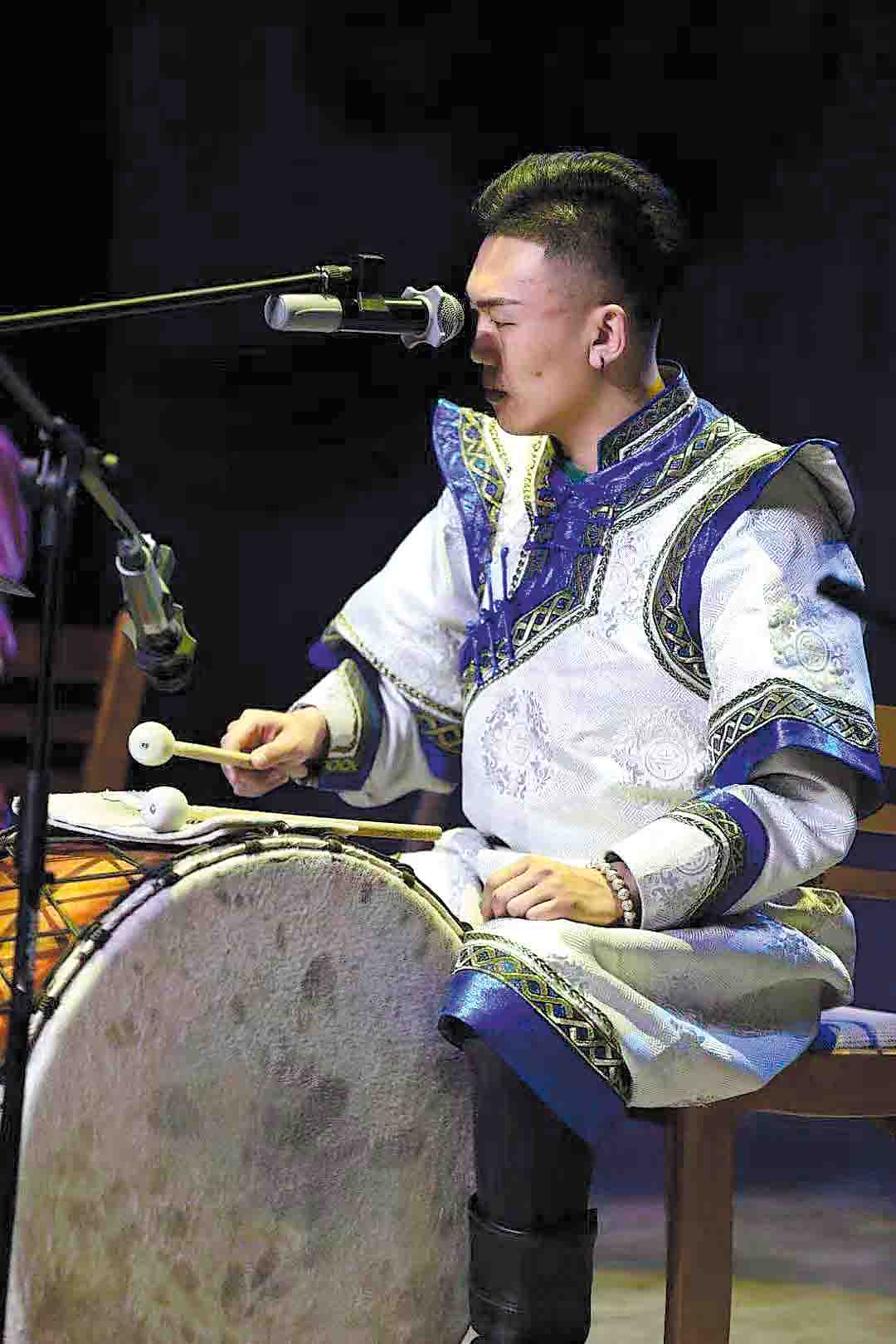
Tugqi, 28, Deji band's khoomei (throat singing) singer and drummer. CHINA DAILY
The Ulan Muqir in Subei was established in the 1970s to bring the arts to rural areas. Today, young people like members of the Deji band continue that task, traversing the grasslands with gear packed into dusty buses.
After completing their performance at a Naadam festival, a traditional ethnic Mongolian festival that holds competitions, such as wrestling, horse racing and archery, Qinbugele found an open field to lie down. The distant snow-capped mountains reflected the glow of the setting sun, creating a serene and beautiful scene.
"No theater compares to this," Qinbugele says, as the sun dips below the horizon.
