

Models display shoes, which drew inspiration from legends of China's Jingpo ethnic group, on the runway during Dusseldorf Fashion Days in Dusseldorf, Germany, in July. PHOTO PROVIDED TO CHINA DAILY
What is it like to dance with tens of thousands of people to the same rhythm?
The Munao Zongge Festival, celebrated by China's Jingpo ethnic group in the southwestern province of Yunnan, offers a glimpse into such a thing, with crowds of people dancing together for four consecutive days every year.
Back when humans were still far from fully knowing the science of cosmology, the Jingpo people first danced to worship the sun god.
The sun deity, they believed, invited all living creatures on Earth to a grand feast, and, according to the myth, the hornbills were appointed as the ambassadors of Earth. In the palace of the sun, birds and gods danced tirelessly, eventually passing the sacred movements down to humankind.
That euphoric dancing, with its sense of freedom and spontaneity, drawn from the Jingo legend, was the inspiration behind Chinese designer Liu Qiongying's Fall/Winter 2025 collection, which was unveiled on July 19 during Dusseldorf Fashion Days, or DFD.
The gathering, which ran from July 16 to July 23, featured open-air runway shows and trade shows and utilized more than 600 showrooms across the German city.
Dusseldorf, which is the capital city of Germany's most populous state, North Rhine-Westphalia, also considers itself the country's fashion capital, and its faith in the fashion businesses, from buying to merchandising, dates back to 1949 when the first fashion sales week landed there and took hold.
Fashion bloggers and loyal customers filled the front rows to see how Liu's brand — Sheme, which was the only Chinese brand invited to the DFD runway show — would perform.

From left to right: The "Rhythmic" series uses black to evoke nature strength. The "Fairy" series captures the grace of dance. The iconic platform heel from Liu Qiongying's "Ceremony" series. PHOTO PROVIDED TO CHINA DAILY
The collection's "Rhythmic" series used black to reflect the quiet strength of the natural land. The "Fairy" series made use of embroidered plumes and pearls on white uppers that symbolized the grace of birds from the legend, flapping their wings in dance. The bold red of the "Ceremony" series was all about the electric energy that the Munao Zongge Festival has inherited.
"The shoes are art. They are really art," said Kati Schoen, a German jewelry designer. "I was very impressed by the details of the shoes inspired by Chinese culture. They all have meanings."
Ingnahl Magadan, a Dusseldorf-based conceptual artist who owns at least 15 pairs of shoes from Sheme, highlighted not only their craftsmanship but also their comfort.
"You might never think you could walk in those high heels, but once you slip them on, they are fabulous, and that is the mark of true refinement," Magadan said.
The fresh release that shed light on Jingpo mythology was just one part of Liu's ambitious plan to feature all 56 of China's ethnic groups in her designs.

Models wear various pieces from Chinese designer Liu Qiongying's Fall/Winter 2025 collection, which was unveiled on July 19 during Dusseldorf Fashion Days, or DFD. The show also features a review of the designer's previous collections inspired by China's ethnic cultures. PHOTOS PROVIDED TO CHINA DAILY
The turning point came in 2021, during an interview, when the story of one of Sheme's embroiderers from China's Qiang ethnic group, whose life had been flipped for the better since joining the brand in 2011, sparked the project, Liu said.
The embroiderer had moved to Longquan, in eastern Zhejiang province, where Sheme is based, along with her two children. Through years of hard work, she was able to send them to better schools, and one is now studying nursery education and the other architectural design, Liu said.
"The whole family, coming from a small village in a remote area, now lives a more decent life. That prompted me to think, why not dream even bigger," Liu said. "So, starting in 2021, we planned a 28-year journey to honor all 56 of China's ethnic groups, dedicating each collection to one ethnic group. In a way, the brand cannot only continue creating designs that inherit Chinese culture but also support ethnic minorities by getting the world to truly know these artisans."
First attempt
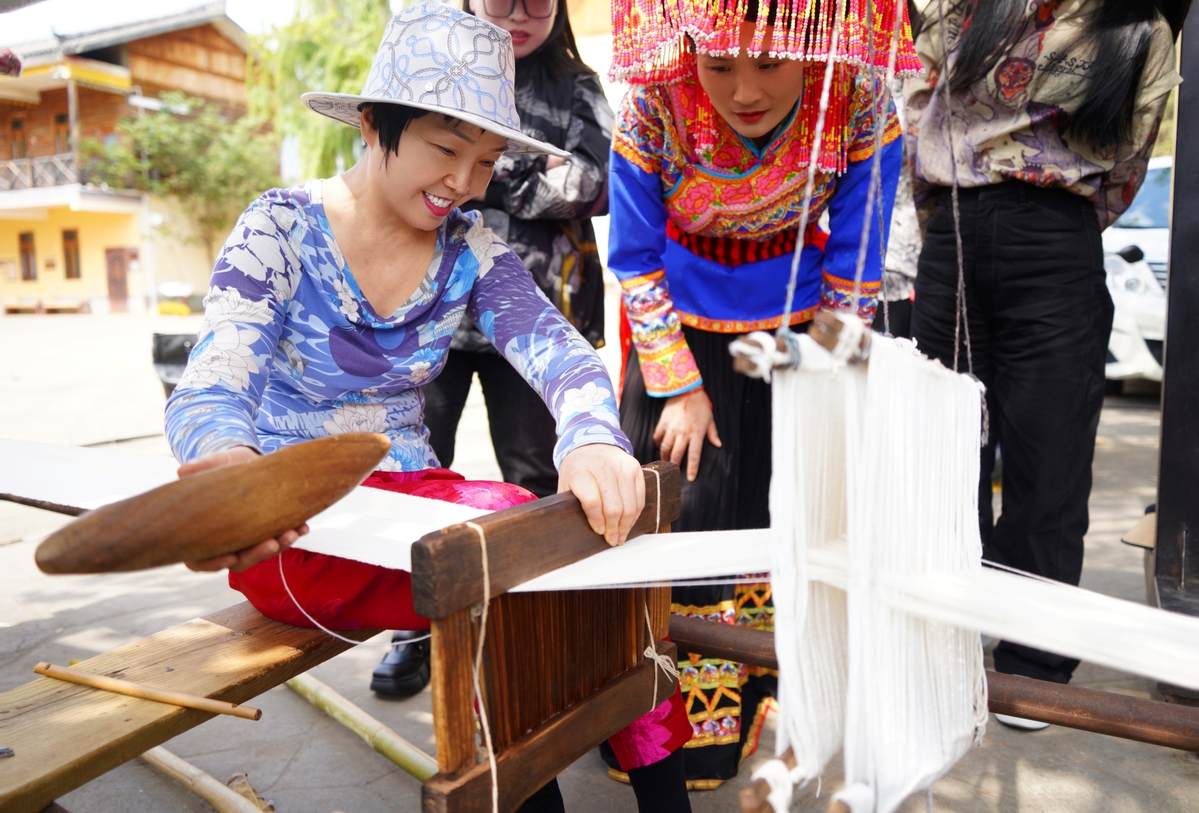
Designer Liu Qiongying studies the traditional weaving techniques of the Lisu ethnic group in Southwest China's Sichuan province last March. PHOTO PROVIDED TO CHINA DAILY
Yet, thinking big also means making extra effort and, every year, Liu will spend two-thirds of her time in China, setting foot in some of the most far-flung corners of the country, she said.
Liu recalled the very first attempt to showcase the Lhoba people from the Xizang autonomous region, which is often dubbed "the tribe of mystery", given that very few people knew much about them in the recent past. The Lhoba is one of the smallest among the 56 ethnic groups in China in terms of population.
The field trip left her with mixed feelings: although she found the Lhoba's weaving distinctively beautiful, it did not quite align with the typical materials used in shoemaking, such as sheepskin or cowhide.
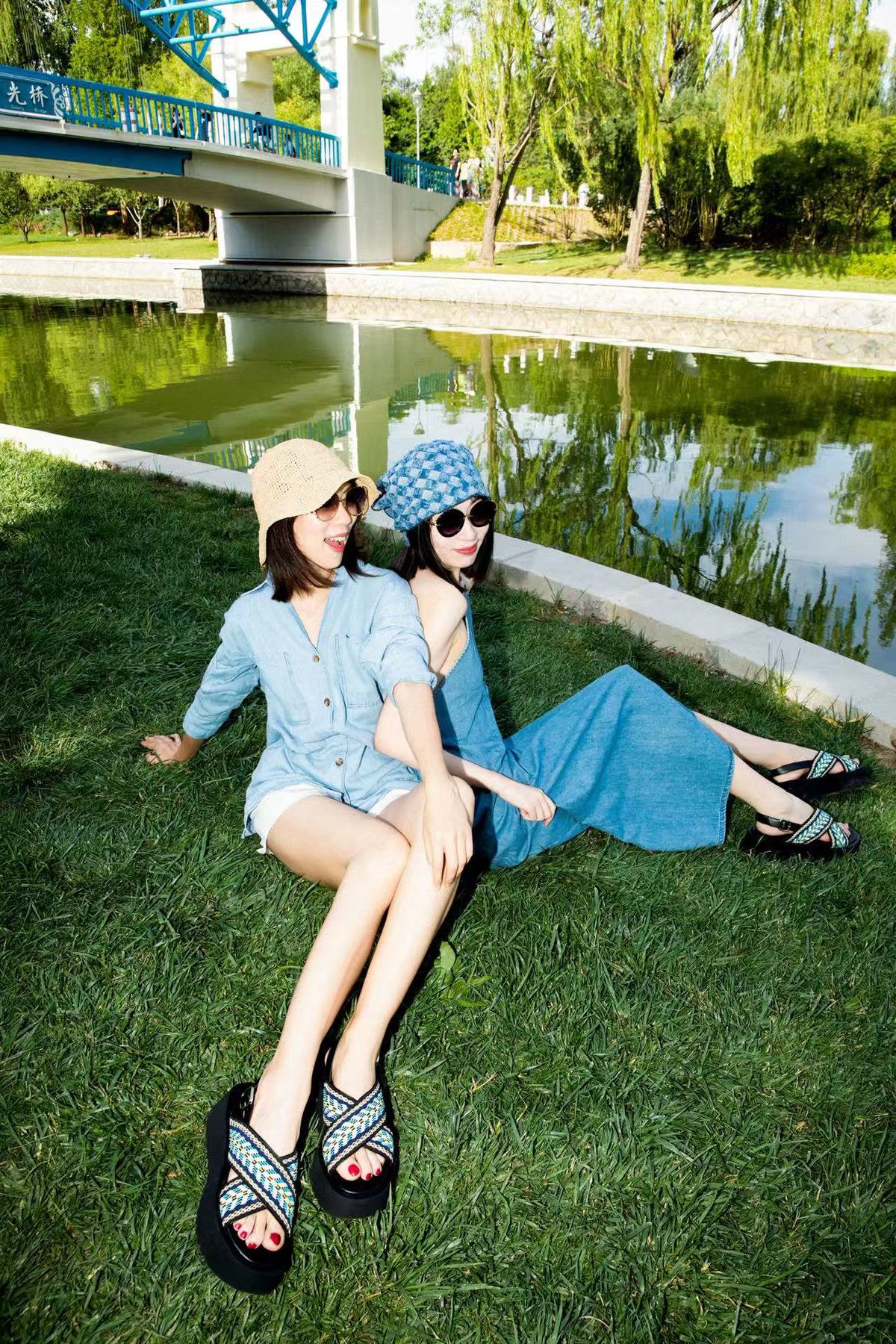
The "Fussbett" sandal features traditional Lhoba weaving. PHOTO PROVIDED TO CHINA DAILY
What she eventually gravitated to was the design of a "fussbett" sandal that featured Lhoba weaving crafted into its crisscross satin straps. The design, which she first produced four years ago, is still going strong, and the team updates it each season with new, on-trend colors that give it fresh life and continued relevance, Liu said.
"It helped us realize that traditional craftsmanship, ethnic legends, or local lifestyles can be the soul of one design, but the point here is really about how to reinterpret classics in a modern way, and present these elements to the global market," she said.
For Liu, China's time-honored cultural legacy can exist at a masterful level, be exhibited in museums, refined and elevated, but it can also become part of daily life, blending with the latest trends and existing as wearable, living art.
Andrea Greuner, interim manager of Fashion Net Dusseldorf e.V., a local fashion association that organizes and coordinates DFD, said Sheme's shoes are "unique" in their Chinese heritage, yet also "international".
"That is what we really need. We want to show that we are an international marketplace, but beyond presenting those already well-known brands," Greuner said.
Liu noted that she is by no means the only person offering a spin on her cultural identity, and that an increasingly expanding community of home-grown designers seeking to go global by looking inwards is palpable.
And it is not only happening in fashion. Chinese companies with cutting-edge technology and cultural exports, from BYD and DJI to DeepSeek and Labubu, are now global household names.
Liu has witnessed the decades-long, winding evolution of China's manufacturing industry. Back in the early 1990s, when she visited a footwear trade show in Europe, an exhibitor ushered her out of a booth, saying people with yellow skin were only there to steal designs, and that there was no way she could afford to spend hundreds of euros on shoes. She walked away, holding back tears, but the episode triggered a quiet resolve.
Twenty-nine years seem to have gone by in the blink of an eye since Liu founded her company in 1996. Back then, she had a small workshop and only 20 workers producing shoes for other labels. Today, she owns a Chinese brand that is proudly original and finely handcrafted, and some of the luxury items sell for more than 3,000 euros ($3,523).
The tomorrow she envisions remains promising.
"Original design with soul. Every-day products with real value. When something is truly beautiful, well-crafted, and unique, it knows no borders," she said.
Contact the writer at zhengwanyin@mail.chinadailyuk.com
