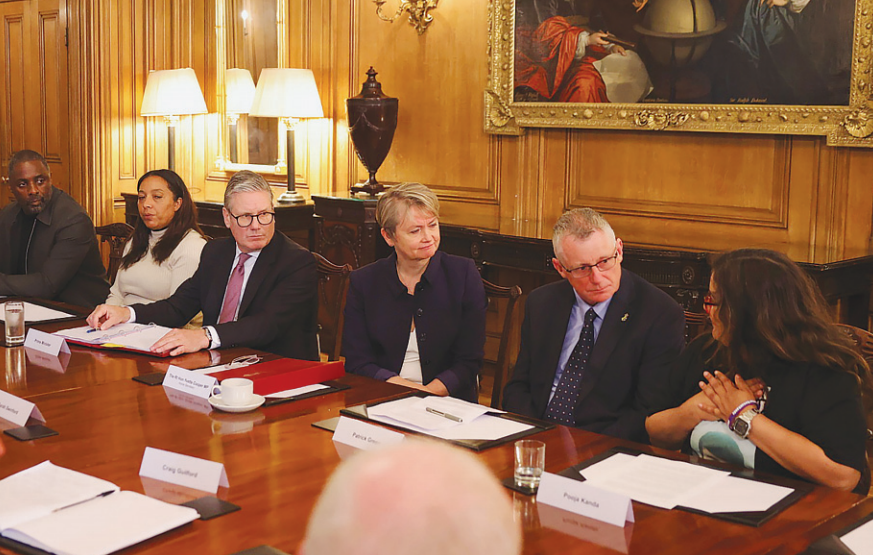
Representatives of the Ben Kinsella Trust in conversation with UK Prime Minister Keir Starmer and Home Secretary Yvette Cooper at Downing Street last September. PHOTO FROM BEN KINSELLA TRUST FACEBOOK
The killing of three young girls at a dance class in the northern English town of Southport in the summer of 2024 was an incident that left a deep mental wound on the entire country.
The circumstances, in such an innocent setting, had overwhelming shock value — but one of the least surprising elements was the weapon the killer used, a knife, because in many parts of the United Kingdom knife crime has become grimly common.
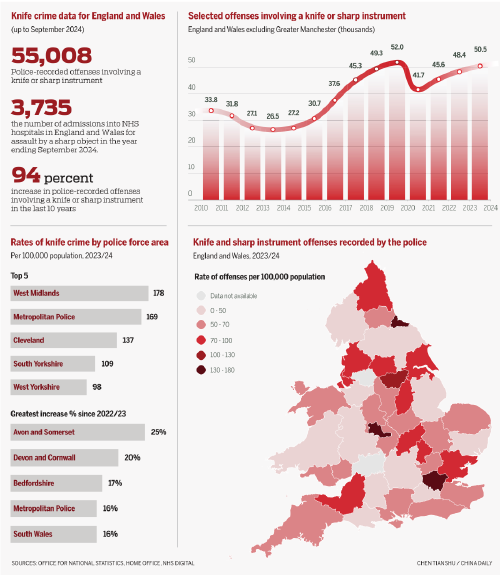
Data published in January 2025 by the Office for National Statistics, or ONS, showed that in the year ending March 2024, there were around 50,500 of fences involving a sharp instrument in England and Wales, excluding the Greater Manchester region, a rise of 4.4 percent on the year 2022-23.
According to The Daily Telegraph newspaper, in the year to September 2024 London and the area covered by the UK's largest police force, the Metropolitan Police, or Met, saw an 18-percent rise in knife incidents, to 16,521.That was more than 2,000 higher than the previous record year, 2019, and the January 2025 data saw the Met region surpass the West Midlands as the area with the highest knife crime rates, accounting for around 29 percent of all knife crime in the country.
It is not just an urban issue — rural areas are now also reporting increases in knife incidents, often linked to children being used to transport drugs.
A recent amnesty allowing for the anonymous, secure disposal of weapons held at St George's Hospital in South London illustrated the extent of the problem.
The hospital was chosen because last year its emergency department treated more than 500 people injured by knives and sharp objects. In six months, 87 knives and similar weapons were handed in.
Knife crime came into the life of South London community activist Anthony King in the most brutal fashion in October 2017, when driving home through Croydon, he saw a stabbed teenager dying in the street and used his shirt in an unsuccessful bid to stem the bleeding.
In the year 2023-24, Croydon had the second-highest rate of knife crime among London's 32 boroughs, and in 2021, London witnessed a record 30 teenage murders — five of them in Croydon, the most of any borough.
As the London borough with the largest number of children and young people, the largest number of careleavers, and also significant numbers of displaced people from other parts of London, King told China Daily it is no surprise knife crime has become such an issue in Croydon, especially when blades are so accessible.
"You can get a knife like you're buying a burger," said King, who is director of Majestic Community Care Services. "Young people can get them ordered online to one of the local boxes, or sent to a friends' house, or to a gang member's … they can obtain them left, right and center.
"There is also a challenge around young men who for many years have not had access to a male role model, so it's inevitable gang leaders target them. We have to treat it as a public health issue and see what we can do."

Jermaine Goupall was just 15 years old when he was killed in a random knife attack in south London in August 2017. PHOTO FROM JFJ WEBSITE
Tilisha Goupall is someone who lives with the consequences of knife crime every day. She founded the JFJ Foundation after her 15-year-old brother Jermaine was the victim of a random attack in Croydon in August 2017, stabbed seven times by three assailants, with three different knives.
A 12-centimeter-deep wound to his femoral artery meant he bled to death on the street, and she now talks in schools to make children aware of the reality of what knives can do.
"In 2019, after the court case was over, I started doing talks because I needed to find a way to grieve — I'd been too busy before," she said. "During my journey campaigning, I met a primary school teacher who gave me examples of what was already happening at that young age, so I realized I should start with early intervention.
"I was diagnosed with post-traumatic stress, so one of the things I tell children about is the ripple effect. We talk about consequences — the people who are caught, what they have to live with, and the shame it brings on their families, so they can understand the issue from all sides."
In a world where so many young people are increasingly desensitized to violence, she said, consequences need to be explained.
"When they were sentenced, all my brother's murderers were given jail terms longer than they had been alive", she added. "A lot of these young people who carry knives are unaware of the consequences until they're in the dock, or told they're guilty. That's when it hits them.
"It also reveals who your friends are. If you're in a group and something happens, people look out for themselves and turn on each other. That's what happened to my brother's killers, and that's what we talk about."

London's Metropolitan Police face a constant battle to keep dangerous knives off the streets. PHOTO FROM MET POLICE X ACCOUNT
Fear factor
Another group aiming to turn the knife crime tide is the Ben Kinsella Trust, founded in memory of 16-year-old Ben Kinsella, who was stabbed to death by three teenagers in an unprovoked attack in North London in June 2008.
Its mission is to "educate young people on the dangers of knife crime and help them to make positive choices to stay safe", through workshops that explain the link between choices and consequences, and promote the message that carrying a knife for safety is a tragic myth.
Trust CEO Patrick Green told China Daily that one of the biggest challenges is misinformation, often from social media.
"Something young people often tell us, as older people, is that their world is different and we can't understand it," he said. "They are genuinely scared, if not absolutely terrified, of knife crime.

Ben Kinsella was out in North London celebrating the end of his school exams when he was stabbed to death in June 2008, aged 16. PHOTO FROM BEN KINSELLA TRUST
"That fear is, in fact, hugely disproportionate to actual levels of knife possession or crime, but when there is a climate of fear, you try to dissipate it by doing something you think will keep yourself safe, like carrying a knife supposedly to help you get out of difficult situations. The reality is the complete opposite."
Although it is hard to make exact comparisons, Green said England has a much worse knife crime problem than other European countries, for several reasons.
"Austerity cuts brought in in 2011 had a well-acknowledged huge impact in terms of driving crime, particularly knife crime," he explained. "And 1.2 billion pounds ($1.5 billion) has been lost from youth services since 2010. They're vital in terms of putting positive role models and activities in front of young people, so lose them and you create a vacuum.
"Criminals, particularly in the drugs trade, exploit young people and often equip them with knives, not to protect themselves, but to protect the drugs."
The trust's interventions are a two-way street, because Green said the feedback received constantly reshapes its educational offerings.
"We have a purpose-built exhibition with a series of interconnecting rooms which tell the story of people directly affected by knife crime," he said. "In an immersive setting, we help young people to understand the reality of what happens when you carry a knife. It's very powerful and they find it relevant.
"Trusted adults should all be connecting with young people on this subject as they are making decisions on it, often based on what they see on their phones. It's important that we get a strong counter-narrative across so they can make better decisions."
Offering hope
Although the challenge facing anti-knife crime groups is daunting, results achieved in the Scottish city of Glasgow, once dubbed the murder capital of the Europe because of its violent reputation, offer hope.
Between 2006 and 2011, knife crime killed 15 children and teenagers in Scotland's largest city, but between April 2011 and April 2016, there were no such deaths.
This sharp decline, mirrored across the whole of Scotland, came after the establishment of the Scottish Violence Reduction Unit, or VRU, which treated the issue as a public health matter, identifying and treating the causes of crime before it happens. VRU's motto is "violence is preventable, not inevitable", a message about the possibility of a violence-free future that found a willing audience, and drew in people who may not previously have worked together, for a concerted, joined-up policy.
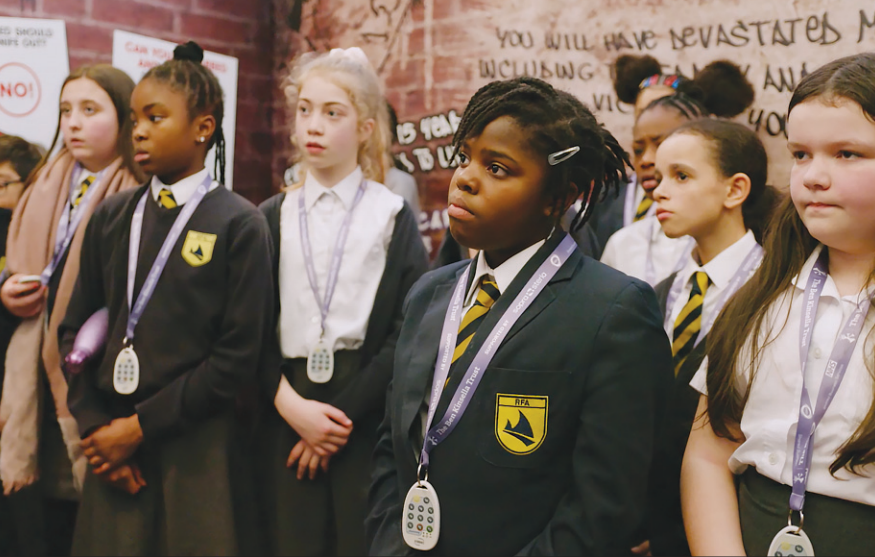
Schoolchildren learn about the dangers and consequences of knife crime at the Ben Kinsella Trust interactive exhibition in Barking, Essex. PHOTO FROM BEN KINSELLA TRUST YOUTUBE
VRU head Jimmy Paul told China Daily it was a facilitator for the hard work of many people and groups.
"Often, people look to us as having created this solution, but we were just a catalyst working with others to help make change," he explained. "There are a number of risk factors that present challenges, such as poverty, adverse childhood experience, the care system, exposure to addiction and a lack of role models. We focus on protective factors to give young people the best chance of growing up making healthy decisions; basically, a sense of hope."
Young people have, he said, helped lead the way and these days, people involved in knife crime in Scotland are more likely to be older.
"In the nine years from 2005 to 2014, there was a 60-percent reduction in homicides in Glasgow, and 52 percent across the rest of Scotland, and in the 20 years since the unit was founded, across all of Scotland, there's been a 58-percent fall."
Similar units have been set up across the UK, but steering vulnerable young people away from the world of knives is an endless task.
"In 2022, we had no teenage murders in Croydon, there were none in 2024 and up to March this year, there have been none," said King.
"For me to see young people provided with opportunities and aspirational things, and to see them take these chances, that's my reward. When I see a couple of years with no murders, that tells me what we're doing is positive. People smiling and lives being turned around — that's when I know things are going well."