
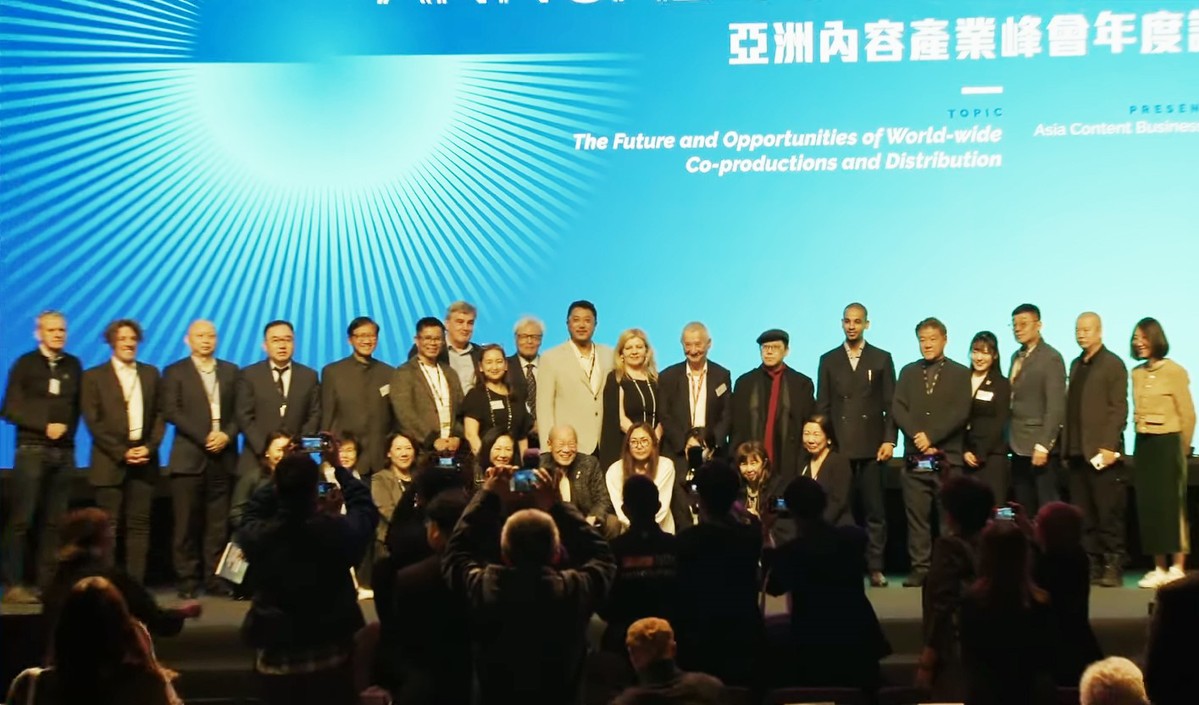
Speakers gather for Asia Content Business Summit, or ACBS, in Hong Kong on March 12. CALVIN NG / CHINA DAILY
Globalization has seen more international collaborations than ever before in the movie industry but experts believe that Asia will drive the next wave of co-produced content thanks to the region's diverse arts, culture, and opportunities.
Charlene Paling, deputy head and senior vice-president for entertainment and media at the United States-based Western Alliance Bank, told China Daily that the nature of funding production for movies has not changed in about 30 years, as there had been pre-sales, minimum guarantees, and equity investors.
However, in the last 20 years, there had been "a lot of government incentives, tax incentives", she said, and collaboration on that is an area where she sees change.
"You know, multiple governments are looking at ways to work together to help the dollars go further, in this environment. So I think that is something that we're going to see a little bit more of," said Paling.
When it comes to Asian film productions looking to Canada or the US, Paling noted that she has "seen some interest", but admits it was "not as much as I thought it would be", though she attributed some of that to the COVID-19 pandemic
"I've seen a lot more collaborations coming with Australia and New Zealand," she said. "I think the next evolution is probably going to go even further and go toward collaborations with Asia."

Charlene Paling, deputy head and senior vice-president for entertainment and media at the United States-based Western Alliance Bank. CALVIN / CHINA DAILY
Paling noted that Canada has treaties with many Asian countries, which could drive collaboration.
She noted that North American and European producers are also looking beyond their borders in search of funding so they are looking for opportunities to help get their stories told.
Paling said that summits such as FILMART are essential for producers, who take on many different roles, to find the right specialists in Asia to help them along the way.
"It is really important that producers, when they get involved in these kinds of international summits, you know, working together in co-productions (is) that they really do get to learn where they're going and who they're working with and spend time meeting their collaborators and the partners," said Paling.
"Because it really is going to be a business relationship that they need to enter into and they have to work together. It's a little bit like dating. You know, get to know each other because that's going to only make it better," she added.

Franco Della Posta, president of the Association of Italian Audiovisual Production Personnel. CALVIN NG / CHINA DAILY
Franco Della Posta, president of the Association of Italian Audiovisual Production Personnel and an experienced filmmaker, believes that and has returned to the region after many years.
The Italian was among the speakers at this year's Asian Content Business Summit at the Hong Kong International Film and TV Market (FILMART) and has recently collaborated with Asian producers from places like Japan, Saudi Arabia and the Hong Kong Special Administrative Region.
"They tell the story in their way," Della Posta said, noting that Asia has its own diverse arts and culture to match its large population. It is something he wants to see continue, he said, alongside collaboration.
"It's good if they (in Asia) continue to create summits and forums, where people have the possibility to talk, change and help with the content (development)," Della Posta told China Daily on the sidelines of FILMART on March 11.
The film industry is changing, Della Posta said, noting the example that streaming platforms have altered the relationship between content and users, and that this is all happening rapidly.
While technology is having an impact, including on how movies are shot, he said that the human interaction of cross-cultural collaboration was also driving change, with people learning from each other.
Della Posta said that future content and collaboration, especially in arts and culture, could come from China's Belt and Road Initiative, or BRI. He said that he believes the BRI's structure and infrastructure will open up seamless horizons for the co-production space.
According to the Green Finance and Development Center at Fudan University's Fanhai International School of Finance, 150 countries have signed Memorandums of Understanding with China on the BRI, including many in South Asia, Central Asia, Southeast Asia, and East Asia and the Pacific.
"If we're thinking (from) the historical part, we have the Silk Road where the people a long time ago moved their manufacturing from one nation to another. And the last town to arrive was Rome," said Della Posta.
He praised "the people who are working to create a Belt and Road" today as it creates a new opportunities for cooperation, coproduction and the younger generation because it allows art and culture to move openly.
The Italian said that his current collaborations see him working with experienced producers and young people across Asia, including Japan, Saudi Arabia, and the Macao and Hong Kong SARs.
Della Posta noted that content producers have often been influenced by different countries and cultures, pointing to the example of Hollywood director Quentin Tarantino's early inspiration from Hong Kong and Italian movies.
He also cited South Korea's Parasite, which garnered a list of accolades at the 92nd Academy Awards in 2020, as showing the world how a story can be written and told in different ways.
