
The local environment, culture and technology combine in Games' vibrant graphic design schemes, Ma Zhenhuan reports
"Meeting the World" and "Harmony of Colors", the core graphics and color schemes of the 19th Asian Games, blend elements of silk and internet technology in a beautiful array of designs.
They convey a key message of unification for the Olympic Council of Asia members, as well as representing the vibrant, modern city of Hangzhou, according to the chief designers.
Incorporating elements of sports, Chinese culture, and Hangzhou with international aesthetics, the design of the core graphics and color schemes mirrors the visual signage of the Games' emblem, mascots, slogan, and sports pictograms. Altogether, they create the overall atmosphere and main aesthetic of the 19th Asian Games.
The core graphics scheme, "Meeting the World", draws inspiration from silk, a quintessential cultural element of host city Hangzhou. Hailed as a paradise on earth by Italian explorer Marco Polo, the city was a key link on the Maritime Silk Road.
"The idea is derived from mountains and rivers in Zhejiang, as well as smart-cloud computing, Hangzhou's backbone industry," said Cheng Zhaohui, designer of the core graphics and professor at the China Academy of Art.
With Hangzhou considered China's "internet capital", the design team added different-colored spots, which can be superimposed to create a surface similar to a visual representation of a cloud network, Cheng said.
Entitled "Harmony of Colors", the color system is dominated by Rainbow Purple and complemented by Glowing Red, Mist White, Laurus Yellow, Glimmering Blue, and Lakeand-Mountain Green. Varying hues not only merge into each other through juxtaposition and overlapping, but also add luster to Rainbow Purple.
Compared with the previous edition of the Asian Games, this time the colors are presented as a gradient, according to Guo Jinyong, the designer of the color scheme.
Guo said the colors appear to morph if viewed under different lighting.
"Poetry is the source of inspiration for our creation. The main idea of 'Harmony of Colors' comes from a poem by Su Shi, a poet of the Song Dynasty (960-1279). The poem reads: 'West Lake may be compared to Xi Shi (one of the "four beauties" in ancient China); Whether she is richly adorned or plainly dressed'," said Guo.
Each color was inspired by a poem describing Hangzhou.
Rainbow Purple was inspired by a line by Tang Dynasty poet Bai Juyi (772-846). "At sunrise riverside flowers more red than fire; In spring green river waves grow as blue as sapphire," the poem in question, Memories of Jiangnan, reads.
Glowing Red was inspired by the transient twilight described in The Lakeside Temple at Dawn, written by Song Dynasty poet Yang Wanli (1127-1206): "Green lotus leaves outspread as far as boundless sky; Pink lotus blossoms take from sunshine a new dye."
Glimmering Blue, the color of clear skies and water ripples, was inspired by the Su Shi line: "The brimming waves delight the eye on sunny days; The dimming hills present a rare view in rainy haze."
Laurus Yellow, representing the laurel flower and fragrance, was also inspired by Bai's poem.
Lake-and-Mountain Green was cited in a line from a poem penned by Gong Zizhen, a literary master in the Qing Dynasty (1644-1911).
Mist White was inspired by the poetry of Liu Yong (987-1053), from the Northern Song Dynasty (960-1127).
The color scheme with its silk-themed core graphics showcases time-honored Oriental aesthetics.
The designers also wanted people to consider the colors' impact in unity, hinting at the importance of solidarity during the Asian Games.
The core graphics and color system have been applied to venue decoration, TV broadcasts, ceremonies, cultural activities, urban landscaping, vehicles, uniforms, tickets and licensed products, according to the Hangzhou Asian Games Organizing Committee.
"Surging Tides" — The emblem
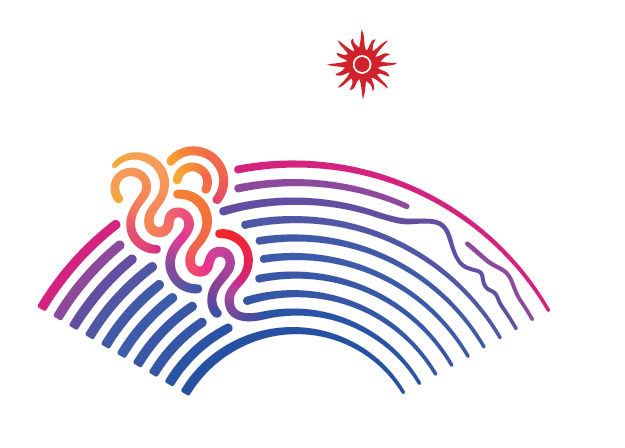
Designed by Yuan Youmin, a student at China Academy of Art, the emblem consists of six elements: a Chinese fan, the Qiantang River, a tidal bore, a running track, the Wi-Fi signal icon and the glowing red sun of the Olympic Council of Asia (OCA). The fan represents the cultural heritage unique to the southern regions of the Yangtze River. The Qiantang River and a tidal bore are the core elements of the emblem, showcasing the natural landscapes of Hangzhou and the courage of the people. The running track represents the sports themselves. The Wi-Fi signal icon illustrates that Hangzhou is a national hub for the digital economy.
The emblem symbolizes that the great cause of socialism with Chinese characteristics in the new era is gathering greater momentum and the unity of the OCA Family, marching forward, hand in hand. According to the Hangzhou Asian Games Organizing Committee (HAGOC), the emblem embodies the character of our times and the Olympic spirit. Original and highly recognizable, the emblem also underscores the host city's profound heritage and singularity, expressing people's aspirations for staging a successful Asian Games and building a community of a shared future for Asia and mankind.
[Photo/Xinhua]
"Eternal Flame" — The torch
The design was completed by a team led by Bao Tianqin, Chen Yunjia and Gu Conglian, teachers at China Academy of Art, and guided by Wang Yun, dean of the Industrial Design and Research Institute at the academy.
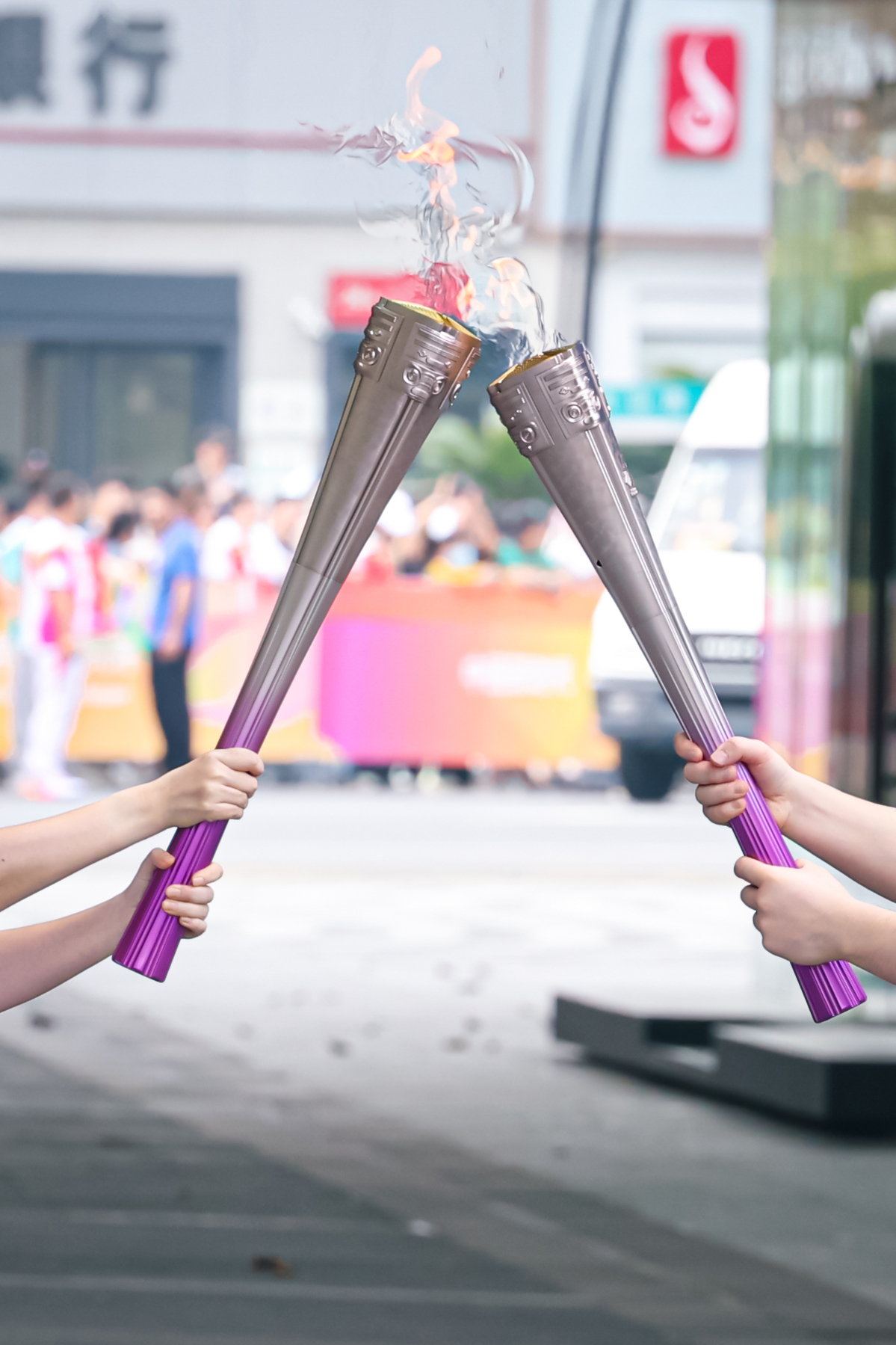
The torch for the 19th Asian Games was named "Eternal Flame "and its design was inspired by the Liangzhu Culture, dating back nearly 5,000 years, which is a testament to the longevity of Chinese civilization. The torch was shaped in a way that "grows" from bottom to top, with an overall height of 73 centimeters and a net weight of 1.2 kilograms.
The base of the torch is embossed with eight water veins symbolizing the evolution of civilization and representing the eight major river systems in Zhejiang. The torch body is designed based on the evolution of dermatoglyphic fingerprint patterns specific to the Liangzhu Culture, which are naturally intertwined and exquisite.
It is named "Eternal Flame" to illustrate how Chinese civilization has been passed on from generation to generation. The top of the torch is characterized by structural elements to emulate jade cong that was discovered at the Liangzhu site, and is threaded with Chinese heritage, natural scenery and local customs. This pays tribute to the inheritance of Chinese culture and simultaneously represents ancient, modern and future China. The design is intended to shine a brilliant light on this hollowed part in the history of Chinese civilization.
"Eternal Flame" also demonstrates the intelligent manufacturing capabilities of Zhejiang province. The raw materials are digitally mapped to the blockchain, and are fully traceable to ensure authenticity. For the metal part, the AA 1070 rotary-forming process was adopted with the surface being laser-engraved and anodized. The grip, made of recycled raw materials, is eco-friendly, light and easy to hold, and the fuel is heated with biomass gas, which is safe, clean and reliable.
"Shan Shui" — The medal
Designed by Zhang Junjie, director of the Industrial Design Department of the China Academy of Art, and led by Jiang Yuqin and other design teams, the medal of the 19th Asian Games takes its shape from ceremonial jade cong, representing the Liangzhu Culture. The traditional circular medal is encompassed by a rounded square border, making it truly unique and highly recognizable.
The design on the face of "Shan Shui" depicts the natural landscape of Hangzhou — protruding lines outline misty hills, a rippling lake and undulating mountains on the front, while the rear features the logo of the Olympic Council of Asia.
"Shan Shui" highlights Hangzhou's ecological importance, with its beautiful scenery, clear water and rolling hills. The depiction of mountains symbolizes the heights that athletes aspire to conquer. On the way to the summit, athletes strive and challenge themselves, and surmount one peak after another.
The ribbon is hand-stitched on both sides with a brocade pattern and features environmentally friendly printing techniques.
The bridge-shaped buckle at the top of the ribbon symbolizes the famous water towns of the Yangtze River Delta region.
[Photo/Xinhua]
"Memories of Jiangnan" — The mascots
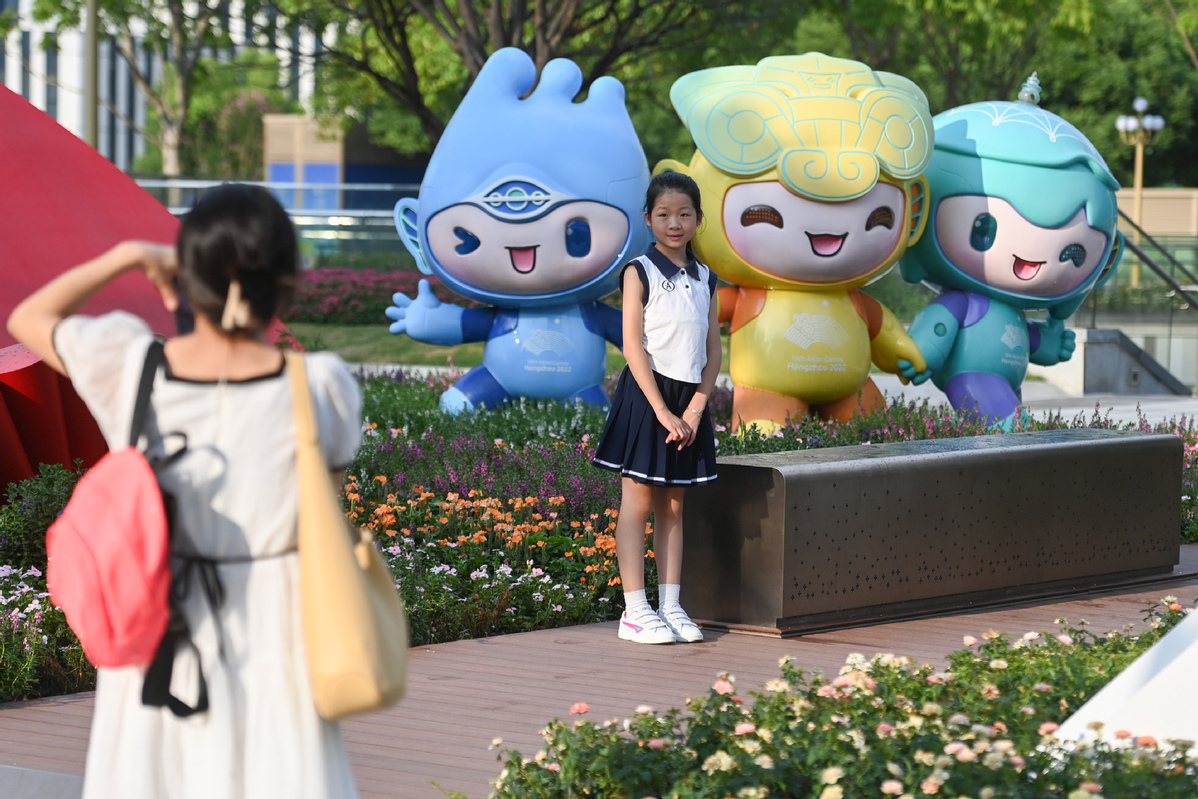
Designed by an art team led by Zhang Wen and Yang Yihong, two young teachers from the China Academy of Art, the mascots of the 19th Asian Games are a group of robots proclaiming the host city's profound heritage and contemporary vibrancy. The combination — Memories of Jiangnan — derives its name from a poem by Bai Juyi. This great Tang Dynasty (618-907) poet wrote, "When I recall Jiangnan, Hangzhou brings back most of my memories." The name itself speaks volumes about Hangzhou's heritage, scenic splendor and drive for innovation.
The event's mascots, Congcong, Lianlian and Chenchen, were designed with the cultural and technical prowess of Hangzhou in mind. Inspired by the host city's rich heritage, designers of the mascots for the Games made the trio of cute characters to represent the three UNESCO cultural heritage sites in Hangzhou, namely the Archaeological Ruins of Liangzhu Culture, West Lake and the Grand Canal.
The mascots, transcending time and space, are designed to inspire everyone to reach for their dreams. They stand for not only the joy of sports, but also the culmination of cultural and economic development, so much so, that they match with the character of Hangzhou and proudly join the ranks of the emblem and slogan of the 19th Asian Games. The trio of robots acts as an envoy of the Olympic spirit, peace and friendship. Together, they are calling out to Asia and the world, inviting everyone to meet in Hangzhou for the 19th Asian Games.
"Meeting the World" — The core graphics
Designed by Cheng Zhaohui, a professor of the School of Design Art, China Academy of Art, under the theme of "Meeting the world", the core graphics of the 19th Asian Games are inspired by silk, a quintessential cultural element of Hangzhou, representing its importance along the ancient Maritime Silk Road. The design incorporates both traditional and modern styles, with a combined approach of static and dynamic touches to depict the graceful yet flexible, fine yet smooth, gentle yet vibrant traits of silk unfurling in the air. It represents the artistic concept of "meeting the world".
The core graphics imagine the OCA family's reunion in Hangzhou and the diversified Asian sports culture to be showcased by the 19th Asian Games. Additionally, the silk unveils to reveal a modern version of the painting scroll Dwelling in the Fuchun Mountains, the traditional masterpiece depicting the oriental fascinations of the regions south of the Yangtze River. The interweaving elements, such as mountains and rivers in watercolor or ink wash, and smart cloud computing constitute an expansive space of visual delights and boundless imagination.
The five lines in the core graphics are superimposed to outline the dynamic movement of the ribbon. The softer part on the left represents the West Lake, the middle represents the surging water of Qiantang River, and the right hand side features the water of the Grand Canal.
Fang Xiaoying contributed to this story.
