
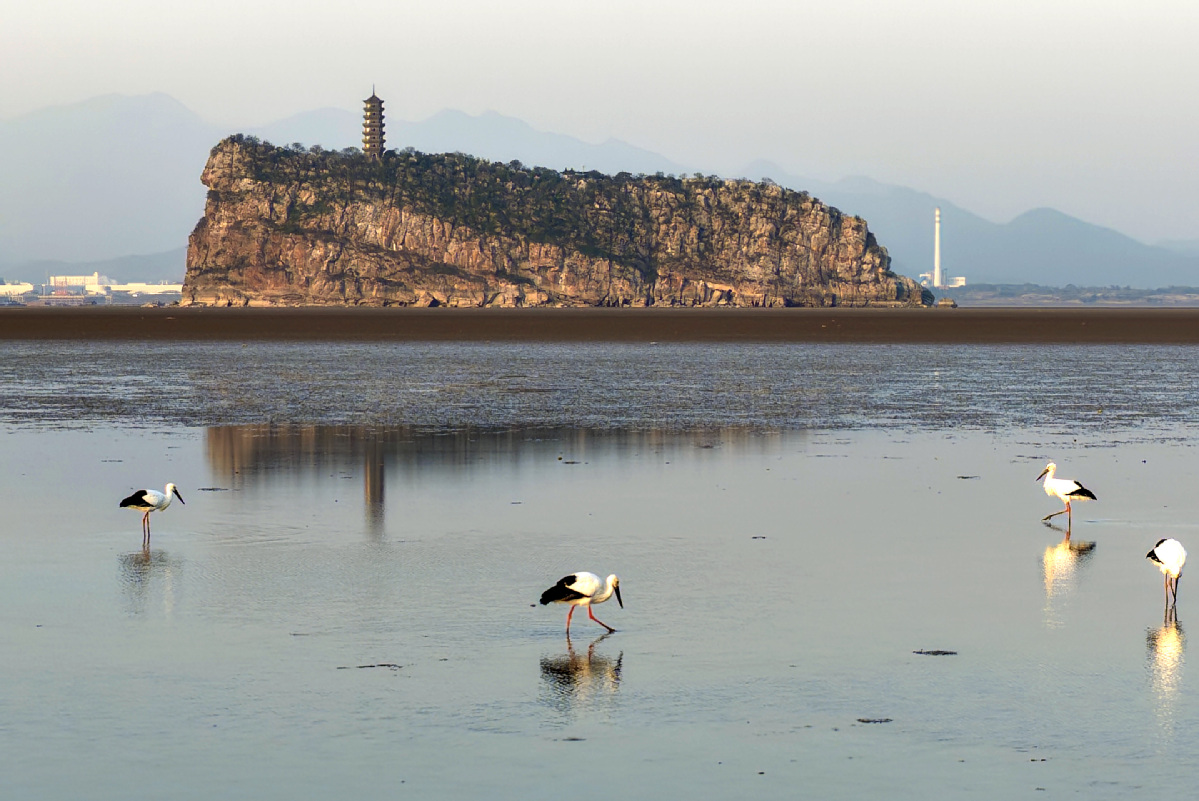
A drone photo taken on Nov 27, 2025 shows oriental storks resting on Poyang Lake in Hukou county, East China's Jiangxi province. [Photo/Xinhua]
Xingzi Station, a key hydrological station for Poyang Lake — China's largest freshwater lake — reported a significant drop in water levels at 6 am on Sunday. The water surface area connecting Poyang Lake to the Yangtze River has shrunk by 90 percent compared to its peak levels, with the water gauge showing an eight-meter reading, signaling a drop below the extreme low-water threshold.
This year, the water level at Poyang Lake fell below the 12-meter mark on August 8, 87 days earlier than the historical average. So far, the lake has spent 217 days below this threshold in 2023, with nearly two-thirds of the year characterized by low-water conditions.
In recent years, Poyang Lake has consistently set new records for low water levels, with trends indicating earlier onset, prolonged duration, and lower levels during these periods. In 2022, the lake's water level dropped to 4.6 meters, breaking historical records, while 2023 saw the lake enter its low-water period on July 20, the earliest onset on record. By 2024, the lake's transition from high to low water levels became more abrupt, with the rate of water level decrease reaching unprecedented highs, including a maximum daily drop of 0.45 meters and a weekly drop of 2.68 meters.
At the Guanhu Water Plant, located on the shores of Poyang Lake, all 10 water pumps are operating at full capacity to draw water from the outer lake to the intake area. Wang Chunhua, head of the production and operations department at Jiangxi Duchang Runquan Water Supply Co, said additional water pumps were installed on Tuesday to boost water extraction. The plant has also intensified inspections and water quality testing to ensure safe drinking water for the approximately 160,000 residents in the city and surrounding townships.
Experts warn that the ongoing trend of low water levels at Poyang Lake poses significant challenges to the wintering of hundreds of thousands of migratory birds, including white cranes, oriental storks, and white-naped cranes, as well as the breeding and survival of aquatic species like the Yangtze finless porpoise. In response, authorities are closely monitoring the situation, employing scientific and precise water management strategies, and implementing emergency measures such as dredging and ecological water replenishment to mitigate the adverse effects of prolonged low-water levels.
