
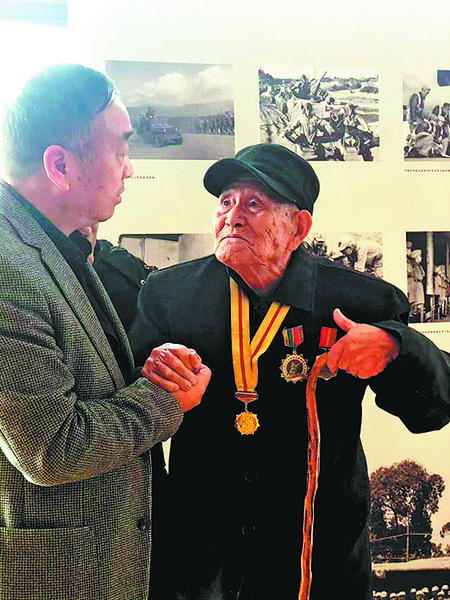
Chen Yongxin (left), organizer of an upcoming WWII-focused oral history conference to be held next Monday in Zhuji, Zhejiang province, pictured with WWII veteran Xu Yougen in 2020. [Photo provided to China Daily]
Lin Hui, who heads the Center for Oral History at the Beijing-based Communication University of China, says her entry into oral history happened unknowingly — through a World War II veteran who had fought the Japanese.
"He was in his late 80s. That first day, he narrated his life from enlistment onward, battle by battle, for two full hours," she recalls. "When I went back the next day, he started over from the beginning — and continued to do so each time. It felt as though his memories had to be accessed sequentially."
Lin found herself hearing the same stories on repeat. At times, she tried to gently nudge the veteran past sections he had already covered, hoping to help him move ahead. But she never cut him off.
"Listening lies at the heart of oral history — it is a profound intellectual and emotional journey to which the interviewer must fully commit," says Lin, 43, who at the time was working in television. "Unlike the scientists, cultural figures, and other luminaries I had previously interviewed, these veterans were unsung heroes, whose ordinary lives held extraordinary stories."
That was in 2011, a year before Lin joined the newly established Center for Oral History at the Communication University of China, where she and her colleagues have spent the past 15 years, "racing against time to preserve voices that might otherwise vanish, through means that are deceptively simple: listening attentively, asking questions, and recording", as she puts it.
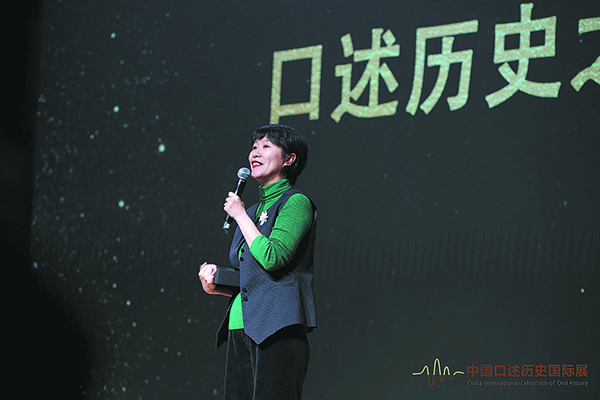
Lin Hui, executive director of the Center for Oral History at the Beijing-based Communication University of China. [Photo provided to China Daily]
While Columbia University's Oral History Research Office, founded in 1948, represents the earliest organized effort in capturing oral history in the United States, Lin notes that the institutionalization of the method in China owes much to Premier Zhou Enlai (1898-1976). In 1959, Zhou met with some senior political figures over the age of 60, urging them to record their firsthand experiences for posterity. This initiative led to the creation of a historical materials research committee, which systematically collected and preserved older members' recollections, laying the foundation for China's early oral history practice.
"The only regret is that their stories were preserved in writing rather than captured on tape, whereas oral history in its modern sense typically requires at least a primary audio recording," Lin says, emphasizing the distinction between humanity's long tradition of storytelling and oral history as a scholarly field.
"Another turning point came in 2004, when China Central Television aired a six-episode documentary about Deng Xiaoping, the statesman who guided China through the sweeping changes of the 'reform and opening-up'," Lin says. "By drawing extensively on interviews with people who had known or worked with Deng, the film introduced oral history techniques to a broader audience and became an early catalyst for the method's popularization in China."
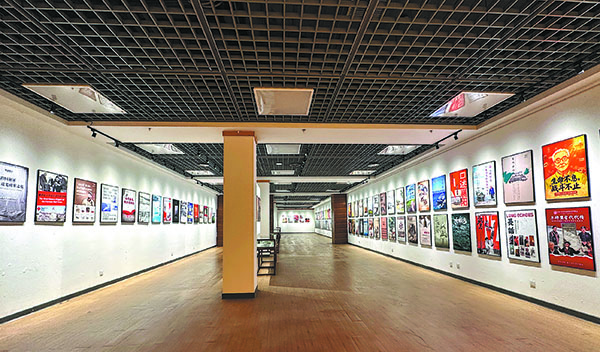
Posters for the participating projects of the China International Exhibition of Oral History line the walls at the Communication University of China's Center for Oral History. [Photo provided to China Daily]
In 2010 came another landmark: the 32-episode documentary My War of Resistance, which placed the voices of over 600 WWII veterans — most now gone — at the heart of the narrative, prioritizing their experiences over those of commanders and generals.
"My own interviews with the veterans, though conducted for a separate project, grew out of that same tradition," Lin says. "Together with those accounts, more than 3,000 additional oral history recordings formed the core collection on which the Communication University of China's Center for Oral History was built. Today, it ranks among the world's biggest oral history archives."
In 2015, Lin helped the center launch the China International Exhibition of Oral History, setting up a platform for exchange for people who rely on their "care and curiosity, patience and perseverance to accumulate materials that may one day illuminate forgotten lives and overlooked histories".
"Oral history is a long-term endeavor — the true value of an interview may surface only decades later, when those who shared their memories are gone. This delayed significance demands vision and dedication from everyone involved," Lin says.
She praises the "grinding, methodical, yet absorbing work" of the transcription and verification team behind every oral history project — a group that spends hundreds, sometimes thousands, of hours converting audio or video interviews into text without ever meeting the narrators.
"These specialists bring historical knowledge to their work: at times, a transcriber may flag and verify statements that a narrator sincerely believes to be true, but that do not align with established historical facts," she adds. "On such occasions, discrepancies are carefully annotated to prevent future misinterpretations."
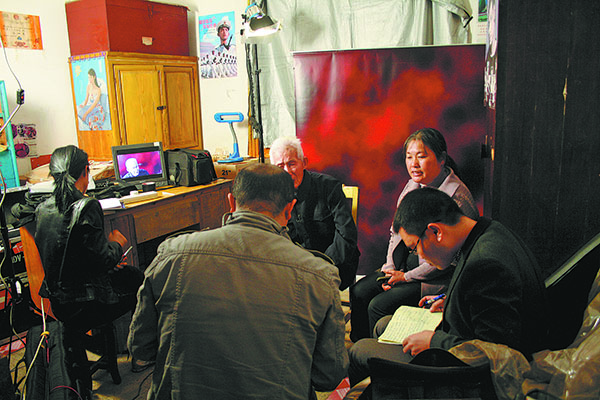
In November 2011, Guo Xiaoming (middle, back facing camera), an oral history interviewer documenting World War II veterans, interviews veteran Tan Zhaoxi (man with white hair). [Photo provided to China Daily]
Yet the work of oral historians goes even further, Lin notes. "Alessandro Portelli, an internationally renowned Italian scholar of oral history and literature, has argued that what people misremember — or even 'lie' about — can reveal deeper truths. Oral history is not only about factual accuracy but also about understanding how individuals perceive, interpret, and give meaning to their experiences. In this sense, the discrepancies and contradictions in a person's account often expose emotions, social memory, values, and subjective truths that official records cannot capture," she says.
"Reflection — that is the soul of oral history, a distant mirror to the past, faint in detail but profound in insight."
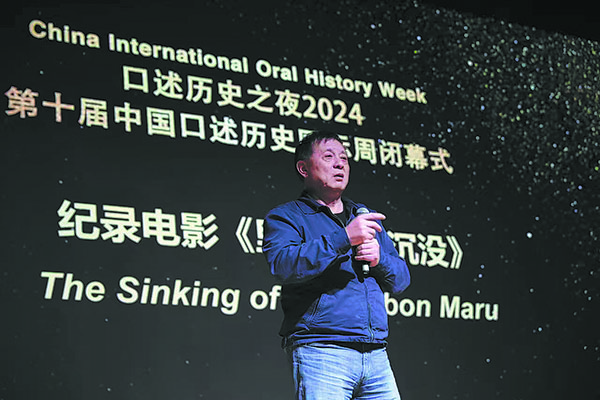
Fang Li, director of the 2024 documentary The Sinking of the Lisbon Maru. [Photo provided to China Daily]
Her view is echoed by Fang Li, director of the 2024 documentary The Sinking of the Lisbon Maru, which recounts the 1942 tragedy of a Japanese-controlled ship carrying over 1,800 British POWs from Hong Kong. After the ship was torpedoed by a US submarine, Japanese troops sealed the POWs below deck, leaving many to drown or be shot, while nearby Chinese fishermen risked their lives to rescue around 384 survivors.
"Speak to an old man about his youth, and you awaken a memory that time cannot erase," says the director, who secured oral testimonies from the only two known survivors, Dennis Morley and William Beningfield, who were both aboard the Lisbon Maru when it was sunk en route to Japan.
"When I first met Morley — who had never spoken about his wartime experience even to his daughter — I showed him a photograph of himself as a teenage bandsman with the British Army's Royal Scots regiment. The moment he saw it, he began to talk," Fang recalls. "Beningfield, for his part, told me he had been a gunner operating a water-cooled heavy machine gun. I asked him, 'What did you do when there was no water?' He answered, 'We used our pee.' And from that moment, our conversation opened."
"The appeal of oral history lies in its intimacy. Breakthroughs come when the person across from you senses that you truly understand them," says Lin, who invited Fang to speak at last year's China International Exhibition of Oral History, which featured 300 projects from China and abroad.
"Many of these projects reveal that a Chinese story rarely stands alone — it is woven into the broader fabric of world history," she says, citing a project by a group of young Hong Kong residents that traced the lives of Chinese soldiers who took part in the Normandy landings (D-Day) on June 6, 1944, inspired by a diary penned by one of the soldiers and discovered in an abandoned apartment in Hong Kong.
"As we mark the 80th anniversary of the Allied victory in World War II, it is important to honor our heroes by filling in the memory gaps," Lin says.
In 2011, Lin interviewed three World War II veterans just before Aug 15, the day marking Japan's 1945 surrender and China's victory over Japanese aggression. One was Zhang Jin, the veteran who always began his story from the very start and had lost his right arm in a Japanese ambush.
"The first thing he did upon seeing me was to stand tall and give a left-handed salute," Lin recalls.
