
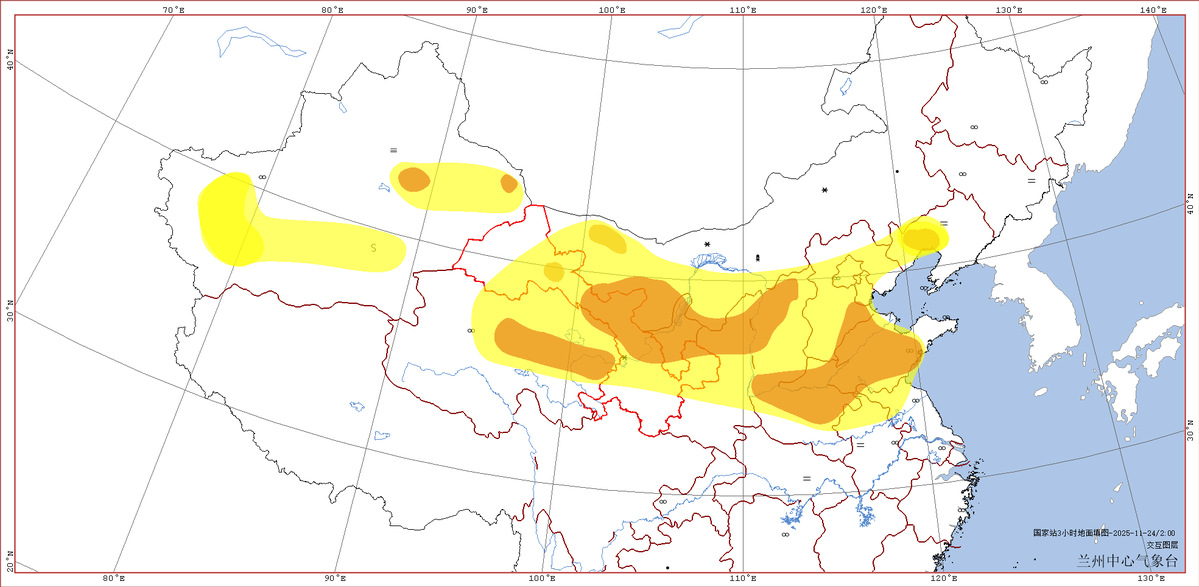
Dust patterns across northern China from Nov 23 to 24. [Photo provided to chinadaily.com.cn]
China has begun trial operations of a new artificial intelligence system designed to improve dust forecasting in some of the country's most hazard-prone regions.
The model, developed by scientists at the Chinese Academy of Meteorological Sciences' Lanzhou Institute of Arid Meteorology, began testing in Gansu province in late November, according to CCTV News.
Researchers raised the system's spatial resolution from 50 kilometers to 5 kilometers through a downscaling technique. The upgrade addresses a limitation in earlier 50-km AI products, which were built for large-scale regional dust tracking but lacked the precision required for localized forecasting and public-oriented services in Northwest China.
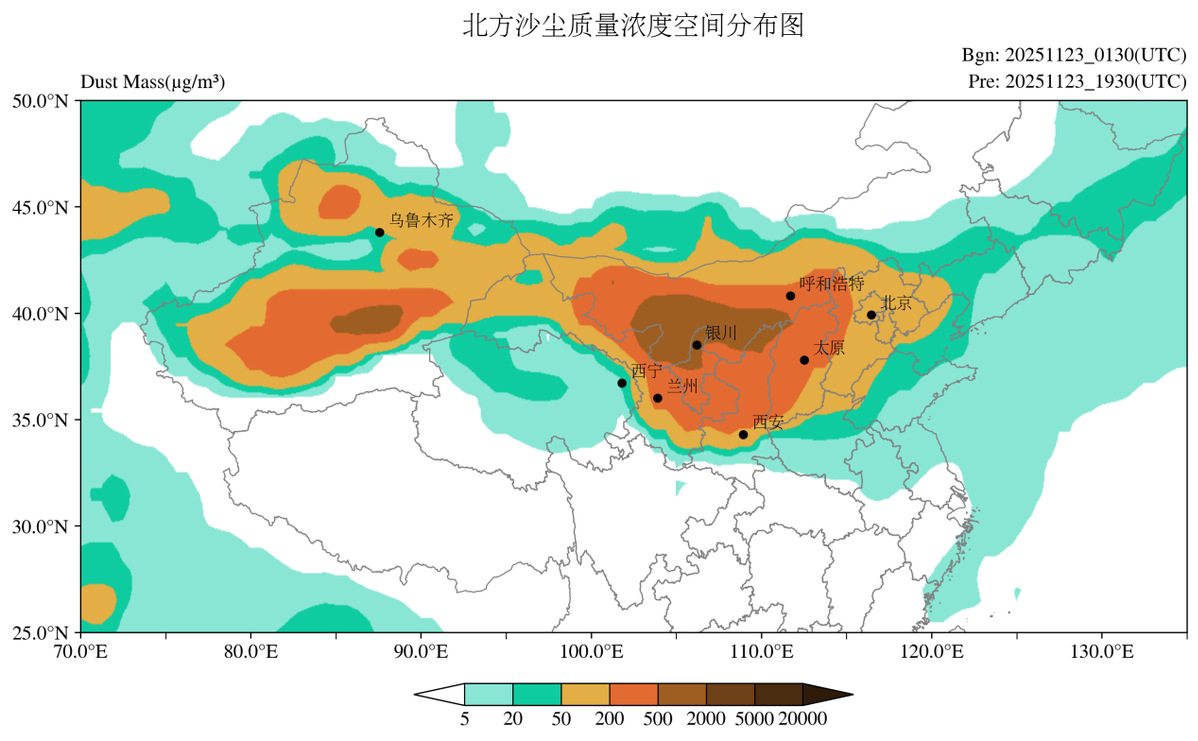
Dust mass concentration distribution forecast for northern China at 7:30 pm on Nov 23, generated by the new model. [Photo provided to chinadaily.com.cn]
Speed is the other headline feature. Traditional physics-based models require supercomputers and long runtimes, which limit how often forecasts can be produced. The AI model runs on GPU-based hardware and generates global five-day predictions in under a minute. It updates eight times a day, giving meteorologists far more opportunities to track developing events.
"This is a major change, not only in speed but in accessibility," said Che Huizheng, a researcher at the academy. "We can now run dust forecasts on a standard desktop computer."
The improvements were highlighted during a dust event in late November. Floating dust formed in the southern Xinjiang Basin, and blowing sand was reported in eastern Xinjiang before the plume spread across parts of Qinghai, Gansu, Ningxia, and other provinces in North and Northwest China. The AI model detected warning signals two to three days ahead and issued a near real-time update early on Nov 22 that aligned closely with on-the-ground observations.
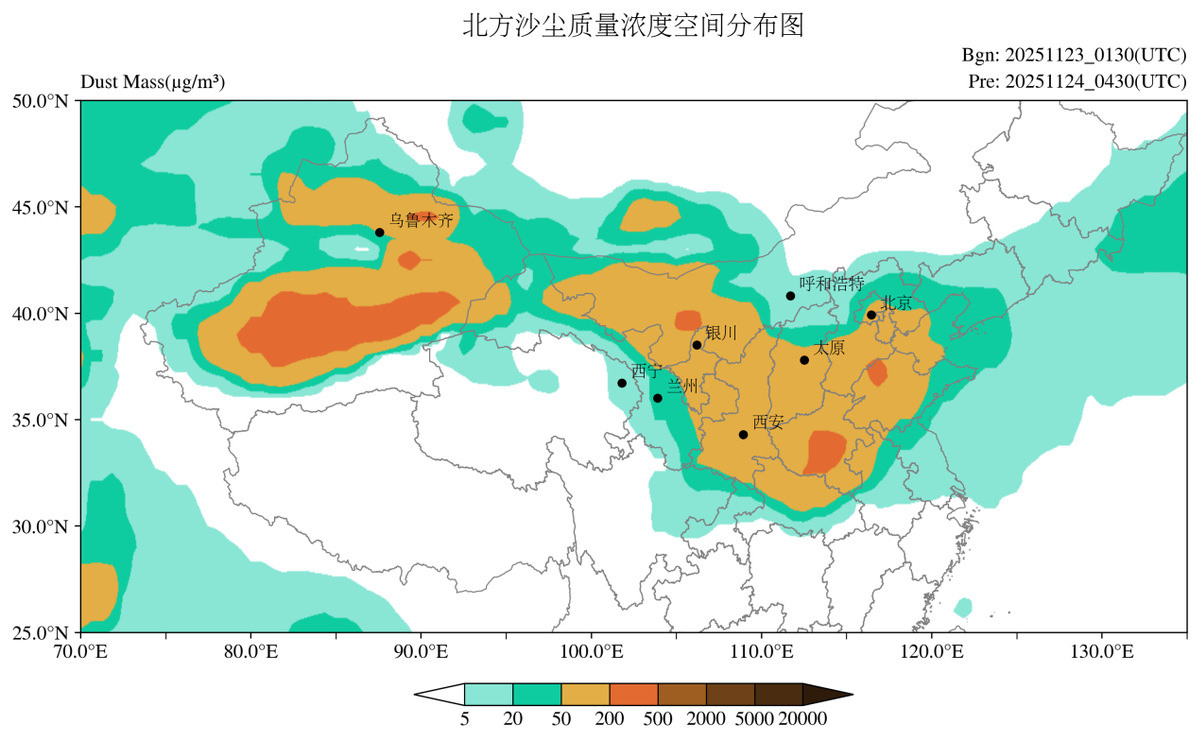
Dust mass concentration distribution forecast for northern China at 4:30 am on Nov 24 generated by the new model. [Photo provided to chinadaily.com.cn]
Yue Ping, a researcher at the institute, noted that spring remains the most active period for dust outbreaks because exposed soil and frequent cold-air activity form a potent mix. Summer and autumn bring weaker events driven mainly by long-range transport, which are still difficult to forecast.
The system is intended to assist with both situations by providing higher-resolution optical and mass concentration data for multiple aerosol types, along with dozens of environmental indicators refreshed throughout the day.
Meteorologists say the project could offer a template for international cooperation in regions where dust storms regularly cross borders. Lower hardware demands may help agencies in Central Asia, North Africa, and the Middle East adopt similar tools for early-warning work.
