
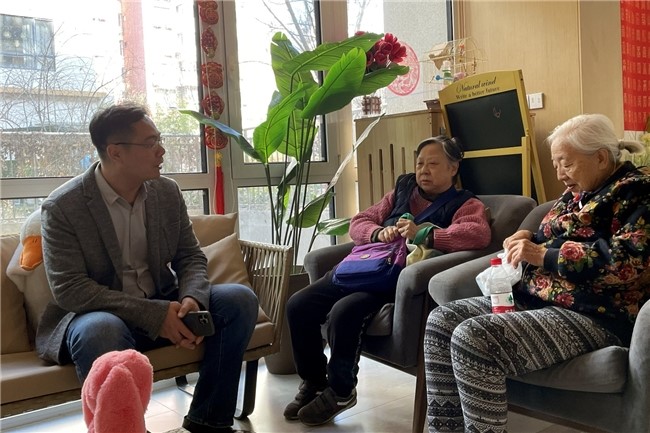
Urban planner Guo Liang (left) talks with residents. [Photo provided to chinadaily.com.cn]
China is accelerating the renovation of its older urban residential communities by improving service access, making better use of existing resources and strengthening community governance to enable senior citizens to live comfortably in their own homes.
As China comes to terms with a rapidly aging population, many older communities across the country are grappling with deteriorating buildings, fragmented facilities and a growing share of elderly residents.
As one of Beijing's earliest large residential communities, the Fangzhuang community in Fengtai District was among the city's neighborhoods most in need of renovation. As a result, it was chosen as a pilot zone for the first area-wide renewal.
Guo Liang, director of the Planning Innovation Center at Homedale Urban Planning & Architects Co, which is part of the Beijing Municipal Institute of City Planning & Design, led the team responsible for the Fangzhuang community's renovation.
The team began by tracing the daily lives of residents, pinpointing gaps in service availability. Their review found limited elderly care facilities, disconnected pedestrian routes and public amenities that fell short of meeting the needs of an aging population.
In response, the team designed a spatial framework that links community hubs, improves walking access and adds green corridors between housing clusters, with the goal of integrating elderly care, daily services and public activity spaces within a short walk of residents' homes.
The renewal of aging communities has also focused on reviving long-neglected community assets. Fanghuali, for example, an old cinema which had been unused for nearly three decades, has been converted into a community eldercare center.
"Restoring these places to everyday use often gives them more vitality than building something new," Guo said.
Throughout the renovation, the idea of shared space has been a guiding principle, with Guo advocating for opening parts of eldercare facilities to the surrounding community.
Building on this, Fanghuali has evolved into a lively hub of community life where children join workshops and residents of all ages use its open spaces and small theater.
"Quality eldercare is not about setting older residents apart," Guo said. "It's about keeping them woven into the fabric of community life."
In addition, the team helped develop a governance model that brings street-level administrative bodies, service operators and financial institutions into a shared framework, laying the groundwork for the long-term operation of age-friendly communities.
"Community renewal must go hand-in-hand with community operations because, without a sustainable mechanism, even the best design can quickly lose its vitality," Guo said.
