
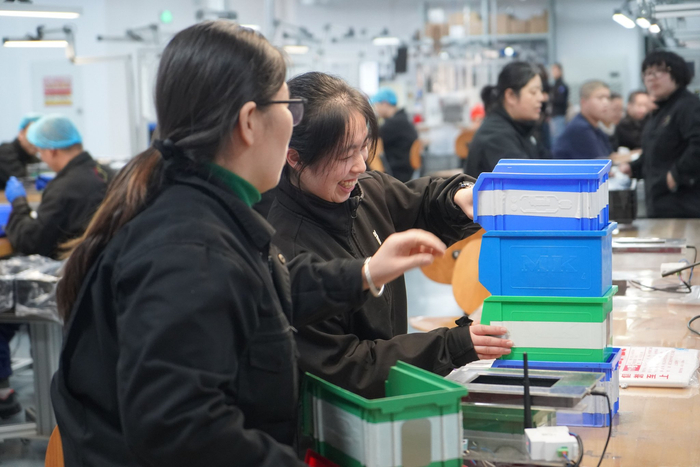
Zhang Xingjuan (left) offers coaching to an employee at the Inclusion Factory in Taicang, Jiangsu province. [Photo/Xinhua]
In an industrial area of the city of Taicang in China's Jiangsu province, the whirring of machinery at the Inclusion Factory tells a story of quiet transformation.
Here, employees with intellectual and mental disabilities are not just earning a wage, they are building confidence, mastering skills and integrating into a community that was once largely out of reach.
At the heart of this story is Zhang Xingjuan, a manager whose role transcends job descriptions. She is a mentor, a maternal figure and a witness to extraordinary personal growth.
Founded in 2014, the Inclusion Factory stands out as a pioneering force in China, championing inclusive employment for workers with conditions including Down syndrome and autism.
What began as a small initiative employing 12 individuals for automotive parts assembly has blossomed into a comprehensive program that has directly employed more than 40 people and supported a further 30-plus in finding jobs in mainstream companies through its consultancy services.
Joining the factory as a manager in 2019, Zhang found herself in an unexpected role. Unlike ordinary employees who might grasp a task after one session, her trainees require patient, one-on-one coaching that can span anywhere from half-a-session to a staggering 100 sessions of 100 minutes each — sometimes for the techniques required to make a single product.
The breakthrough, however, makes the perseverance worthwhile. The 53-year-old finds profound satisfaction in witnessing a person initially deemed "untrainable" evolve into a confident, diligent worker who takes pride in their speed and accuracy.
She vividly recalls one employee, Wang Xingchen, who arrived with an inability to focus. Training him was initially a test of patience, but the result was astounding. Now, Wang is capable of complex wiring tasks and is deeply invested in ensuring orders are completed.
These stories are not one-sided. Zhang admits the experience has fundamentally changed her, smoothing her once short temper into a profound calm. "If my mindset is unstable, it affects them," she said. "Now, I am at peace every day."
This symbiotic relationship is at the heart of the factory — a place where Zhang said she has grown to depend on her apprentices and their inspiring journeys.
The factory's story began a decade ago, inspired by the model of German nonprofit Lebenshilfe, created in 1958 to provide education, employment and legal support for people living with disabilities.
It has since successfully localized the approach, creating a vital link between two groups: parents seeking an accessible workplace for their adult children, and manufacturers looking to fulfill their social responsibilities.

Zhang Xingjuan (right) helps an employee at the Inclusion Factory in Taicang, Jiangsu province. [Photo/Xinhua]
An employee typically integrates into the company after a year and-a-half of training. After several years, they master a viable skill. From there, they carry the imprint of their experience at the Inclusion Factory into new chapters of their lives, equipped not just with a trade, but with the confidence to navigate the world.
Sheng Zhigang, who has an intellectual disability, is a proud veteran of the Inclusion Factory, having worked there for more than eight years.
He articulates his assembly tasks for automotive parts with detail and pride, a stark contrast to his previous life repairing bicycles on the street, a job that the 38-year-old inherited from his father, who has a physical disability.
For Sheng, the job provides more than just purpose, it offers a critical social safety net. "They provide social security for me," he explains, noting this was previously a significant financial burden. This long-term stability has empowered him to look forward, nurturing the ambition to one day "move to a better company".
As the factory's reputation has grown, so has external interest. From 2017 onward, an increasing number of companies began approaching the Inclusion Factory, seeking to hire individuals with disabilities and requesting professional support to do so effectively. Now, the factory works with more than 100 local and transnational corporations.
In response, the program has developed a robust consultancy arm, the UShine Charity Center, which provides partner companies with workplace assessments, role-matching advice and management training to foster an inclusive environment.
The program also provides immense relief and hope for families. Mu Yan, a leader in the parent organization at UShine, has witnessed this change firsthand through her daughter's experience.
For Mu, the Inclusion Factory represents a beacon of hope that was transformative enough to compel her family to drive 1,500 kilometers to Taicang.
After learning about the factory while her daughter was still in middle school, Mu saw a viable future she had previously dared not imagine. "When my daughter graduated, we felt there was nowhere else she could go," Mu said.
The decision paid off. She has witnessed her daughter, who had been diagnosed with developmental delay as a child, blossom through employment, developing crucial social skills, self-awareness and a powerful sense of autonomy.
"She believes going to work is the best," said Mu, noting that her daughter now enjoys the independence of earning and managing her own money.
This transformative experience inspired Mu Yan's own career shift. Recently, she joined the factory's parent nonprofit as a social worker, after first securing her daughter's blessing to become her colleague.
Now, from her unique dual perspective as both a parent and a professional, Mu is channeling her personal experience into broader advocacy. Her mission is to promote the Inclusion Factory model nationwide, empowering other families to believe that, with the right support, their children can lead fulfilling, self-determined lives that are central to society.
The work of the Inclusion Factory has also captured the attention of the international business sector.
Simon Zundl, director of business development for the Shanghai-based German logistics firm Topline Express, recently visited the factory to explore potential cooperation.
Having previously worked as a social worker in Germany, Zundl expressed a personal and professional connection to the cause. "I have to say, I'm really happy to see projects like this existing," he said, visibly moved by his first visit.
He highlighted the program's dual advantages, saying that it provides a space where workers are free from stigma and can build friendships, while also giving their parents vital respite.
"It helps the parents to breathe, to get some air," he said.
For Zundl, the factory also answered a lingering question about social inclusion in China. Having noticed a lower public visibility of people with disabilities compared to Western countries, he found his answer at the Inclusion Factory.
"I was wondering, where are they? And here, I can see there's a place for them."
