
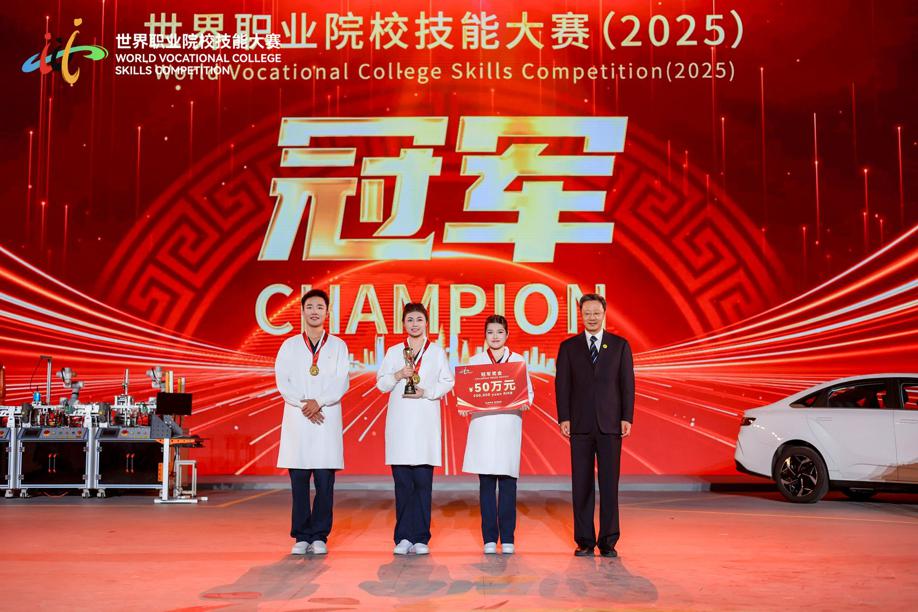
Jinhua University of Vocational Technology wins the champion. [Photo provided to chinadaily.com.cn]
Six top teams from China, Kazakhstan, Cambodia, and other countries, stood out from over 33,000 participants worldwide and competed in the championship finals of the 2025 World Vocational College Skills Competition held in Tianjin on Friday.
Jinhua University of Vocational Technology won the champion with its self-developed intelligent mechanical arms for electrocardiographs, which provides an efficient and convenient tool for the early screening and prevention of diabetes-related complications in community healthcare settings.
"This device has streamlined the operational procedure, saving critical time in emergency rescue," Liu Chaoqun, the team's faculty advisor, said, adding that during the development phase, the team repeatedly debugged and optimized the device to address challenges such as ensuring stable electrode contact for individuals with different physiques.

The champion displays the project. [Photo provided to chinadaily.com.cn]
The team has also organized health education and volunteer services for elderly residents in the communities of Wanda and Shanzuitou in suburban Jinhua, Zhejiang province, reaching over 2,000 people.
The World Vocational College Skills Competition, formerly known as the National Vocational College Skills Competition, underwent a major upgrade last year to become a global event.
Unlike previous editions, which were mainly held domestically with international contestants joining online, this year's event was held overseas for the first time. It established four overseas competition zones in Southeast Asia, Central Asia, Africa, and Europe.
According to the organization committee, the competition has successfully facilitated the "going global" of China's vocational education solutions, standards, and resources.
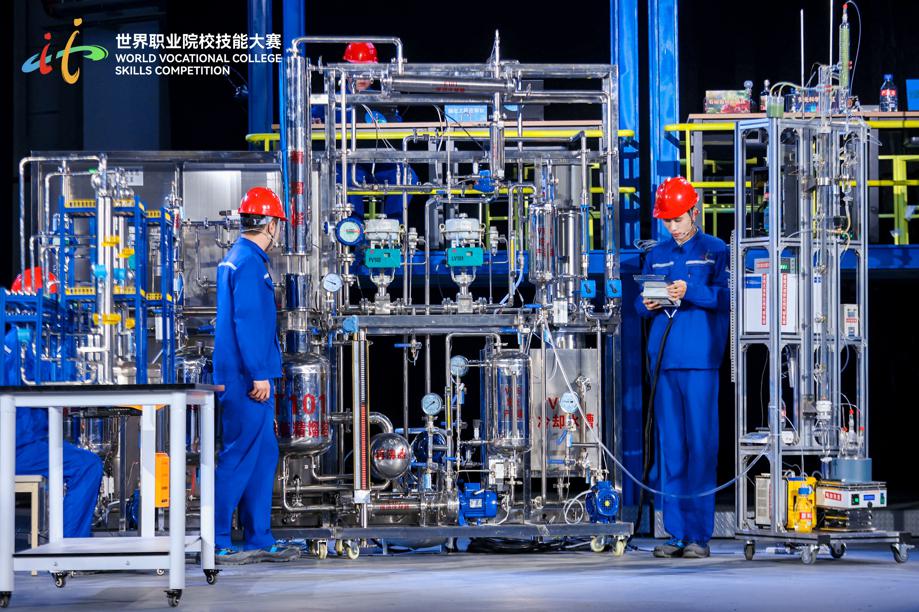
Zaozhuang Vocational College team employs a "continuous flow process" device. [Photo provided to chinadaily.com.cn]
Zaozhuang Vocational College came in second place for their innovative solution to major problems in small chemical plants, namely, high costs and safety risks. Their project employs a "continuous flow process" that uses less material, shorter procedures, and offers more controllable risks, thereby enhancing operational safety.
The team hopes to promote this system to make chemical production safer and to truly put people-first principles into practice.
German vocational education expert Klaus-Juergen Brix, who served as a judge at the finals, remarked that the third-place Qinqiang Opera project from Shaanxi Vocational Academy Of Art demonstrated a successful integration of tradition and modernity.
He noted that the project showed how cultural heritage and modern technology can reinforce each other, while education and industry achieve deep collaboration.
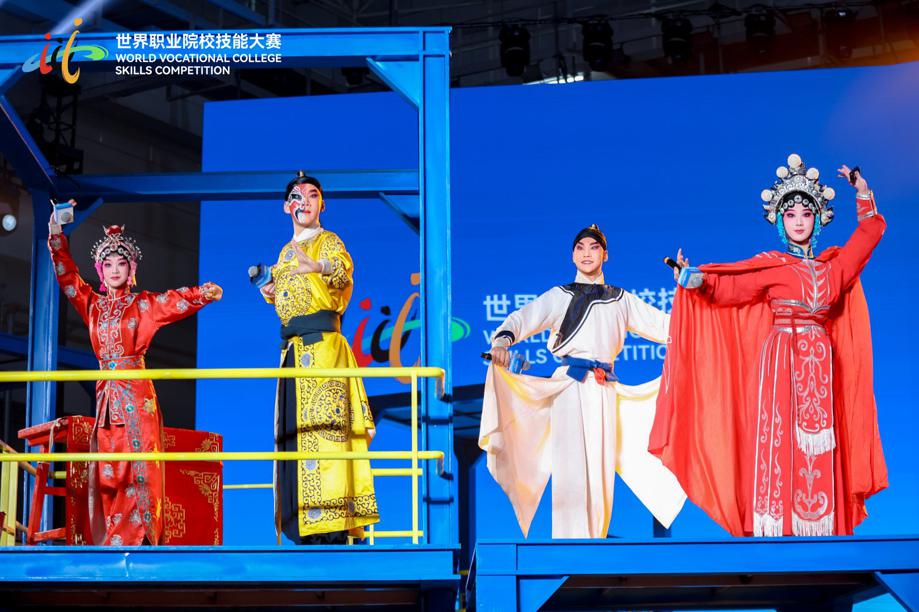
Teams from Shaanxi Vocational Academy of Art perform classic Qinqiang Opera. [Photo provided to chinadaily.com.cn]
The committee said this year's event added an AI track to respond to the global AI trend. For example, a team from Zhejiang Polytechnic University of Mechanical and Electrical Engineering used AI to let their robots spot production errors and adjust assembly actions on their own, which boosted the quality and efficiency of making precision parts.
"The AI track allows us to turn classroom knowledge into practical application and learn from vocational students," a student from Jiangsu Tianyi High School said.
"This competition has successfully transformed from a 'domestic brand' into an 'international platform', building a broad stage for global youth to achieve personal success through skills and to benefit the world with their technical capabilities," Huai Jinpeng, minister of education of the People's Republic of China, said.
Liu Yuanqing contributed to this story.
