
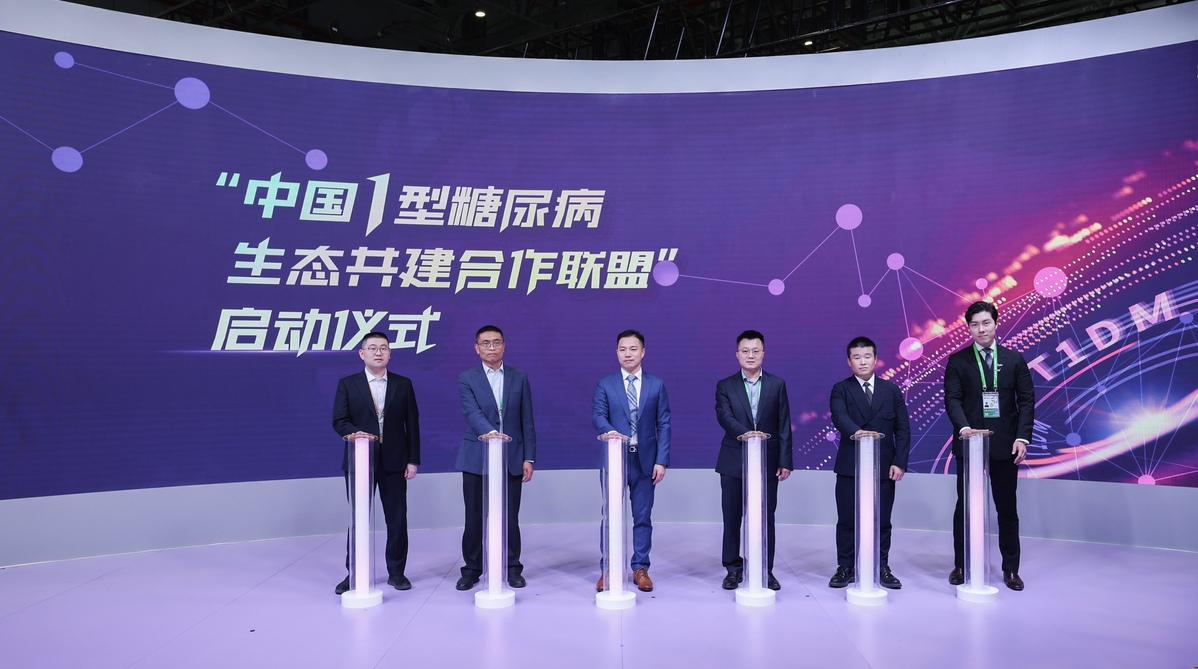
Sanofi announces the establishment of a type 1 diabetes ecosystem at its CIIE booth on Thursday. [Photo provided to chinadaily.com.cn]
Global healthcare companies are using the China International Import Expo (CIIE), which will last through Monday in Shanghai, to further connect local resources and foster China's healthcare ecosystem, with the aim of contributing to disease diagnosis and treatment.
French biopharmaceutical giant Sanofi announced the establishment of a type 1 diabetes ecosystem at its CIIE booth. This initiative, involving local hospitals, biotech firms and patient organizations, aims to advance clinical research, pilot early screening models, promote comprehensive disease management and enhance digital connectivity.
Sanofi's Tzield, the world's only drug to date to delay the onset of type 1 diabetes, is being highlighted at the company's booth following its approval for use in China in September. According to the company, the therapy can play a key role in shifting type 1 diabetes management in the country from reactive treatment to proactive intervention.
Sanofi, a regular CIIE participant, is also attempting to use the platform to foster collaboration with industry partners to enhance awareness of type 2 inflammation and build a diagnostic and treatment ecosystem.
The company's Dupixent is a targeted biologic that inhibits the primary driver of type 2 inflammation. Already approved in China for seven indications, Sanofi is now marketing Dupixent for its breakthrough potentials in two new indications in rhinology and dermatology.

Japan's Pigeon signs a memorandum of understanding with the National Health Commission's National Center for Women and Children's Health during the CIIE on Thursday. [Photo provided to chinadaily.com.cn]
To meet the growing public demand for chronic disease management, London-based GlaxoSmithKline held a roundtable event in Shanghai. Experts from disease control and clinical fields discussed how to further integrate disease treatment and prevention efforts, and optimize strategies for the coordinated prevention and control of chronic and infectious diseases, ultimately reducing the infection burden on chronic disease patients and enhancing the resilience of the public health system.
Sun Xiaodong, deputy director of the Shanghai Center for Disease Control and Prevention, said, "In the future, we need to consider incorporating more high-risk factors, such as infectious diseases like shingles, into chronic disease prevention and treatment, promoting the integration of immunization and chronic disease management to help improve the overall efficiency of public health."
Elsewhere at this week's CIIE, Japan's maternal and infant care company Pigeon signed a new memorandum of understanding with the National Health Commission's National Center for Women and Children's Health to jointly promote scientific infant feeding and health enhancement.
Through past collaborations with the center, Pigeon has supported a breastfeeding consultation program that now covers 31 provincial-level regions, reaching 8,500 medical institutions and benefiting more than 5.5 million newborn families around China.
"The company will continue to work with various sectors of society to promote high-quality development in China's maternal and child field and contribute to building a birth-friendly society," said Zhou Jianfeng, president of Pigeon China.
