
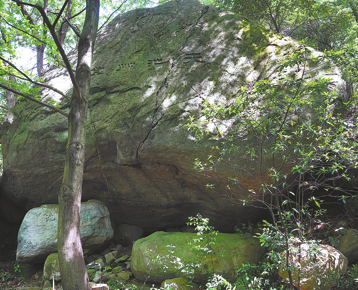
Beyond the misty peaks and lush valleys that define its picturesque landscape, Lushan Mountain in Jiangxi province offers a rich, tangible tapestry of history woven from ancient temples, villas, and inscriptions left by scholars and monks.
Along the mountain's Ninety-Nine Bends Ancient Path are more than 20 stone inscriptions from different dynasties scattered across the rocks and cliff faces — the oldest dating back over 1,000 years.
The route spans a total of 8 kilometers, with a width of 1.5 to 2 meters. Its roadbed is made of stone steps, featuring steep slopes and multiple hazardous sections, along with three stone bridges.
Southern Song Dynasty (1127-1279) scholar Zhou Bida (1126-1204) wrote a travel note regarding Lushan Mountain, saying that the path was a vital mountain-climbing route at the time, with scattered pavilions for rest along the way.
"It's the longest-standing ancient climbing route on the mountain, but it is no longer the main hiking trail. … It's essential to research the value of these cliff inscriptions and promote the road's stories," says He Wei, a veteran expert on Lushan Mountain's culture and history, while introducing details of the carvings.
Immersed in the mountain's picturesque scenery of jagged peaks and gurgling springs, numerous poets, scholars and government officials have left such inscriptions on its cliffs over centuries.
"They are more than just an integral part of the mountain's cultural relics; they stand as precious, vivid historical records that bear witness to its rich cultural legacy," He says.
During the ongoing fourth national cultural relic survey, a major task for Lushan city is to document such ancient inscriptions on the mountain.
Gathering their data is challenging, as many are distributed across a vast mountainous area, making them difficult to access.
Cultural heritage worker Zeng Liangliang and his colleagues make thorough preparations before venturing out, wearing mountaineering clothes and carrying enough water and food. It is common for them to push through thorns and climb dangerous rocks, resulting in scratches and cuts on their hands and feet.
"We usually set off into the mountains around 7 am, and end the day's survey with the beautiful sunset. We take photos, clean the area around the immovable cultural relics, and collect various data," Zeng says.
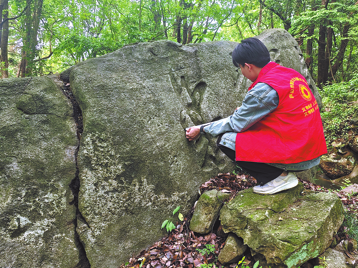
As part of the national cultural relic census in China, Lushan city's heritage workers have rechecked and documented the current status of all its relics that were registered in the third national survey conducted between 2007 and 2011.
They visited archives, held discussions with elderly residents, and gathered oral history materials and photos about the relics.
"The reexamination allows us to complete the relics' profiles and better cultivate their intrinsic value through on-site investigations and references in historical records," says Kuang Jinmin, director of Lushan city's culture and cultural heritage protection center.
Following the stream and venturing into the dense forest, the narrowest path leads to a huge rock carved with the Chinese characters tian chi cao tang (heavenly lake thatched cottage).
A hiking enthusiast accidentally discovered it while climbing Lushan Mountain and reported the findings to the local cultural heritage department.
Staff members researched historical records and found that, during the Qing Dynasty (1644-1911), a local governor ordered the construction of three mansions with the same name, along with a pond.
Besides the cottage ruins, several cultural relics related to China's hermit culture were discovered in remote valleys and dense forests during the fourth national cultural relic census.
A group of cliff inscriptions carved during the Northern Song Dynasty (960-1127) was discovered near a temple on the mountain. These carvings, inscribed by monks, recorded the cost of building houses at that time.
"One-third of Lushan city's new discoveries came from public clues, another third from information exchanges among relevant departments, and the remaining third from on-site searches based on historical materials," Kuang says.
In 2024, the city issued interim measures for the protection and management of cultural relics that assigned specific responsibilities at all levels.
Villagers are encouraged to conduct daily inspections of the cultural relics around their communities, while the government provides technical training and ecological compensation.
"Cultural relics with higher protection levels tend to be better preserved, while those with lower grades often have relatively inadequate protection. These measures can boost the public's voluntary awareness of protecting cultural relics, especially those in remote regions," he says.
Compared with the third national cultural relic census conducted in Lushan city, Kuang says the fourth national survey is innovative, using advanced technologies.
"With government leadership, we have mobilized various departments and the public, forging a strong joint force for the work," he says.
They use drones, three-dimensional scanning, and satellite positioning devices to create digital profiles of the cultural relics.
More than 600 villas are scattered across the mountainside, blending Western and Eastern architectural styles that integrate seamlessly with the natural scenery.
For heritage structures at national and provincial levels, there are specific protective measures in accordance with their conditions. For general historical buildings, guidelines are formulated to avoid damage during renovation. Some villas are also transformed into museums to revitalize the old architecture.
