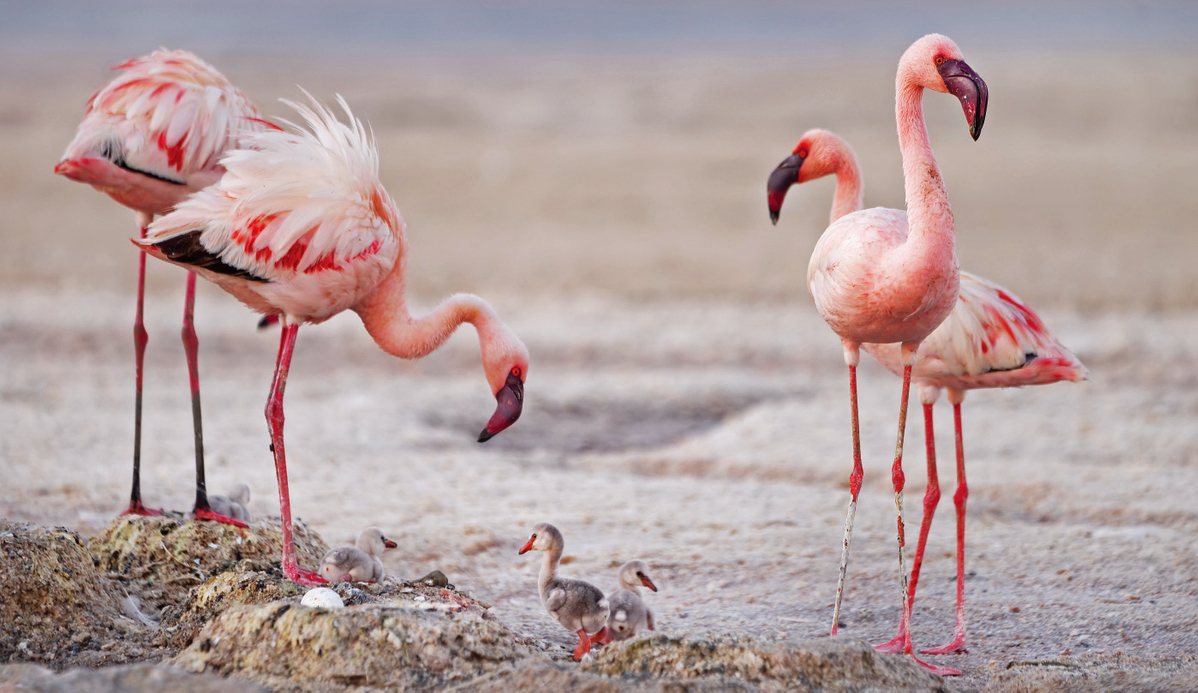
Flamingos on Lake Natron in Tanzania feature in the opening episode. [DARREN WILLIAMS/SILVERBACK FILMS 2019]
Veteran British wildlife film maker David Attenborough says the novel coronavirus pandemic has shocked the world into a greater appreciation of the wonders of nature that previously were often taken for granted.
The 94-year-old has been confined to his house in West London for the duration of the pandemic, but just before it began, filming was completed on his latest series, A Perfect Planet, co-produced by the BBC, Tencent Penguin Pictures, ZDF, China Media Group CCTV 9, France Televisions and The Open University.
It focuses on the importance of the four great forces of nature-volcanoes, the sun, the weather and the oceans-in creating the environment in which the natural world thrives, and the series ends with a fifth program about the impact of human civilization, the toll it has taken and how that damage can be reversed.

The episode about the sun includes these arctic foxes in Canada. [SARAH-JANE WALSH/SILVERBACK FILMS 2019]
"The remarkable thing about (the pandemic and lockdown) is it has made a lot of us aware of the natural world in a way we've not been before, now so many of us are stuck at home," said Attenborough, who revealed he had left home just twice during lockdown, both times for dental treatment. "Emotionally and intellectually, we're looking on the natural world in a way we've not done before."
A Perfect Planet is the latest in a string of documentary films stretching back over the last six decades that have seen Attenborough assume the status of one of the world's greatest wildlife educators to millions of viewers worldwide.
Over the last four years, more than 200 people worked on this latest series, with filming taking place in 31 different countries, including China, which features in the episode about the power of the sun.

Turtles feature in the weather episode. [NICK SHOOLINGIN-JORDAN/SILVERBACK FILMS 2019]
One of Attenborough's most legendary series, The Blue Planet, made its debut on the BBC in another time of global fear and anxiety, on Sept 12,2001, the day after the World Trade Center attack in New York. In lockdown, once again large numbers of people have turned to the calming power of nature, something he said was a recognized phenomenon.
"I think it's been demonstrated that people, particularly those having a bad time, find a lot of support in nature, they didn't realize they owed so much to it," he said. "Psychiatrists have shown an awareness of the natural world is a crucial element in the personality and without it we get sick… we've become aware of the fact we've become too besotted with mechanical devices, too busy rushing around."
The veteran filmmaker admitted that despite all he has seen over the years, the natural world, and the way its stories are told, still retain the power to amaze him, as much as his viewers.

The final episode focuses on how human behavior impacts on the planet. [NICK SHOOLINGIN-JORDAN/SILVERBACK FILMS 2019]
"I'm not sure we can go on finding new things to say and new ways to say it, but in last 60 years, every year there has been a major technical improvement to tell the story in a new way and effectively turn it into a new story," he said, citing the example of stunning drone photography of flamingos on Lake Natron in Tanzania in the opening episode about volcanoes.
Series producer Huw Cordey said the timing of the series, having been made just before the pandemic broke out, but being shown as it hopefully begins its retreat, made its message all the more appropriate.
"The pandemic has exposed us to our vulnerability, but during it, I think a lot of people have rediscovered or discovered for the first time the natural world around them," he said.
"So really there's no better time to show the audience how the world works and how it could work in the future, if we harness these forces that have shaped life from the beginning of the planet's history.

Filming took place all over the world including these lemon sharks in the Bahamas. [ED CHARLES/SILVERBACK FILMS 2018]
"The idea of devising this series as we did is to show how well the planet works with these forces, how they shape the planet and how left to their own devices, it's a very perfect system.
"Just showing what we're doing to destroy it would have been a wasted opportunity, now is such an amazing opportunity for people to appreciate how our planet works and how we're working to destroy it, but equally, what are the solutions for how we can turn it back into a perfect planet."
In dark times, he said, he hoped the program was honest but also optimistic in its tone.
"These are the forces of nature that shape our planet and we as humans destabilize it-but the solutions can be found in these forces," he added.
"Thermal, tidal, wind, solar-these are the energy sources of the future. We need to move away from fossil fuels and take up these new systems. What I've learnt is that we can get back to the perfect planet we've been losing over the last few decades."
