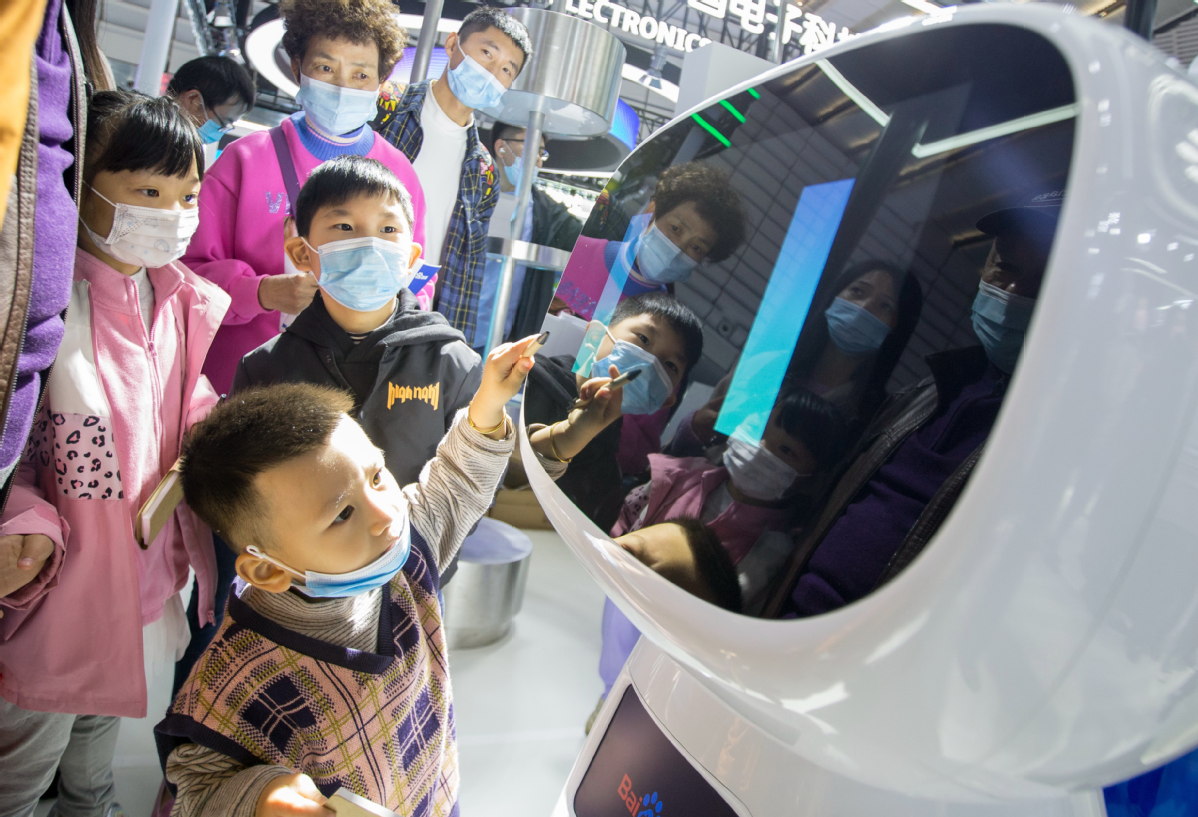
Children interact with a Baidu robot during an expo in Wuzhen, Zhejiang province. [Photo by Zhai Huiyong/For China Daily]
Baidu is again back in the spotlight due to its strong growth driven by AI transitions as net profits hit 22 billion yuan in 2020 on revenues of 107.1 billion yuan. What are the reasons for its comeback in an unprecedented year? How to get rid of the habitual thinking that we are already good and light a fire of ambition to push the boundaries? Tech writer Pan Luan, founder of the popular WeChat public account "Luanbooks", talked with executives at the Internet giant to discover the internal reasons for the transformation, including a commitment to core value and improving organizational capacity.
This inside look follows his previous two acclaimed business studies: Baidu has No Culture and Baidu is Undergoing Renovation. As a veteran observer of Baidu's development, Pan gives a brief summary of the management changes in 2019, focusing on the pivotal role of corporate culture, transition from KPI to OKR (objectives & key results), a younger management team and no-nonsense, straightforward meetings. In his latest article, Pan identifies four dimensions to illustrate how management changes are established and forming a new routine in the tech giant's organization – Changing the idea or job, Making Simple and Reliable the bedrock principle, Manifesting corporate culture fully in all endeavors, and Cheering for high achievers.
The story has to start from the return of Cui Shanshan, who left Baidu in July 2010 to look after her children and then rejoined the company in December 2017, serving in the Organizational Culture Committee. During the seven-year gap, Cui managed to finish a long novel of 470,000 words on Huo Qubing, a distinguished military general in the Western Han dynasty, giving high recognition to the general's attribute of being mission-driven, a trait that she goes great lengths to expand at Baidu.
Cui went through the company's early development stages and helped shape the engineers' culture. Cui said she was really answering the call of her heart to work for Baidu again, just like the military general's determination to defeat the Xiongnu nomadic tribe confederation. Most importantly, she truly shared the company's core value: Simple and Reliable. In her capacity, Cui has overseen employee culture and organizational effectiveness, launched a series of measures to bring to life what it means to be "Simple and Reliable" as well as how to ensure a high-standard work ethic and keep the enterprising spirit alive. These efforts, for her, were not changing Baidu in any new way, but going back to the original aspiration at the giant's birth. Cui has gone all out to scrutinize Baidu's growth from the organizational perspective and ensure it's on the right track with the least possible deviation.
1. Changing idea or job
In retrospect, Baidu's efforts to renovate the company culture in order to be more adaptive and innovative originated from critical challenges in the mobile Internet era, which perhaps Microsoft has more similarities. Both companies were mighty leaders in the supremacy of the PC but they moved slowly and missed market opportunities when the mobile Internet rose. Baidu's position as a core information hub has declined in the mobile era.
It's true that the search engine was a very good business model in the PC era, but it was very simple and had a relatively short value chain. People put keywords in the search box to find information free on the Internet as Baidu works mainly as a connector in the process, driving traffic to relevant websites. In the mobile era, information is less on the webpages and more created and stored by apps, so Baidu's role to connect web information became increasingly a mission impossible.
"Unfortunately, at that time, Baidu's search engine service had a good business performance. So people were not aware of the risks (from the rise of mobile Internet) and thought everything was just fine," said Cui.
Business models in the mobile era are rather sophisticated and have a more complex value chain, which naturally requires a company to have a proportionate management style and organizational capabilities. But Baidu was then unprepared since its business model was set to serve a short value chain, according to Cui.
At that time barriers also included an ineffective organizational structure that failed to pool Baidu's strengths together. The company had a VP responsible for the basic search engine service, a manager in charge of the Baidu app, another to lead mini-programs, another VP for business and sales, and different person for technology. This loose structure made it impossible to cope with the requirements of a long value chain. Facing such challenges, operationally and in organization, the company had to start a massive restructuring.
From Awareness to Action
In a meeting of directors two years ago, Baidu developed a clear strategy for the mobile era. The hard truth shared by participants was that the demise of PC also announced the death of the previous free and open web, so Baidu had to build new infrastructure and identify business areas to make an impact. It was also agreed that Baidu needed to construct an entire mobile ecosystem to enhance the user experience, diversify its income streams and dramatically renovate its role from a shaky information connector in the past to an integrated platform offering closed-loop services horizontally and vertically, or the X+Y strategy of the company's Mobile Ecosystem Group (MEG).
After building awareness of and support for the new thinking first among management, Baidu then moved decisively to shift staff work priorities from "participating in the change" to "redesigning business models that have become obsolete". Baidu is still an information connector but in a brand new form. In illustrating this new connection, Baidu Executive Vice President Shen Dou said content was stored on third-party platforms in the past but now Baidu also provides services such as hosting the newsfeed network Baijiahao, so content creators are more interested in growing their users and engaging with the audience through other Baidu products.
In the X+Y strategy, the horizontal axis refers to user portals that meet diverse needs in different scenarios, and the vertical axis is mainly aimed at expanding the range of content and services offered to users. Baidu believes this will help build a stable, healthy and sustainable business model that is completely different from its past role of simply connecting information.
Integrating the user experience with business goals
For a big company like Baidu, it's necessary to form the right culture to turn the idea into reality on the ground. Ten years ago, Baidu's free services to end users and for-profit business offerings were always locked in a fight. It seemed either users were pissed off or business interests had to sacrificed.
But the strategic business layout of X+Y offers a new chance to accommodate the different concerns. Baidu connects creators, service providers and merchants directly with relevant users in the ecosystem, calling it a humanization process. Baidu also provides users with closed-loop services.
As an example of the progress, a veteran employee in the app team said it was usually a lengthy process with layers of approvals to make change within the Phoenix Nest advertising system. In the contrast, now the business director also fully considers how to display search results, perhaps in the form of providing services to users along with customer services and user feedback, all part of a decidedly holistic approach.
In advocating the mindset of taking both users and businesses to heart, Baidu's management has underlined the key message in the words of "all staff need to change their minds, especially the managers, otherwise they will be replaced". When Baidu's search arm was transformed into MEG in May 2019, Shen Dou stressed the importance of "having the courage to accept the transfer." Senior engineers from three isolated fields became more open-minded after completing the rotation.
To summarize, the period from January 2019 to April 2020 saw a complete process of adaptation to the new strategy and company culture. It started from the management team's call for a change of mindset, made clear in the goal of building an ecosystem and diversifying revenue, undertook massive measures such as rotation and reshuffling to promote wider acceptance of the new idea, shaped a culture in line with new strategic objectives, and finally ended with the rollout of the X+Y strategy.
Studies of successful culture changes show one thing in common – business leaders need to clearly bind together corporate culture, strategy and business objectives. Otherwise, a strategy that runs counter to the company's culture is bound to fail, and vague culture value can be difficult for employees to embrace. Baidu is certainly a success story in this sense.
2. Making Simple and Reliable the Bedrock Principle
After rejoining Baidu, Cui went all out to identify management problems by organizing about 100 meetings in 2018, with each session hosting five to seven participants. She was unhappy with some findings, such as making a departing employee a scapegoat for low performance or asking a new recruit to shoulder weighty responsibility.
Baidu's core value has always been Simple and Reliable. Simple means that products are easy to use as well as a work environment that has healthy interpersonal relationships and a no-nonsense communication style. Reliable means everyone is committed to the work and is dependable, doing things in a way that puts colleagues at ease, and always delivers the best results to the next stage.
Cui is one of those who has experienced what it truly means to be Simple and Reliable in the early days of Baidu. She recruited some of Baidu's current executives in person around 2006 to 2008 who were still students then and was the direct manager of some of them later. At a directors meeting in early 2019, she apologized that it was a mistake for her to not talk at depth about core value partly because Baidu was in a talent war with Google. Compared with Google's attractive workplace environment, such as the often-touted swimming pool, free laundry and all kinds of wellbeing facilities and amenities, Baidu seemed pallid, so it had to emphasize other benefits. So at university recruitment events, Cui would mention the after-hours staff e-games competition.
In her review, Cui said that was just a tactic (to woo talent) and intentionally watered down the importance of Baidu's core value. But in the memory of Baidu's VP Xiao Yang, Cui never slackened in holding fast to the principle of Simple and Reliable. "You can be crazy when playing a game, but you still need to ensure top-quality outcomes and delivery when working. High standards and strict requirements are always a big part," said Xiao.
Baidu's guiding faith of Simple and Reliable incorporates the paramount message of working to high standards with no exceptions. It's a stringent rule and an uncompromising code of conduct that steers the company to stay true to the original aspirations of its birth.
Simply speaking, what sets Baidu apart from other enterprises is four-pronged:
1. Rational thinking-based as most of the people in the company have an education background in science, and prefer formal logic and deductive reasoning.
2. Believer in technology as Baidu employees really believe that they can use technology to change the world or accomplish many achievements.
3. Supporter of equality as Baidu fights against any form of bureaucratic leadership and, in conversations, even bans the use of expressions that overemphasize a person's job title or beget unnecessary interpersonal closeness such as addressing someone with phatic additions.
4. Zero tolerance of factionalism because Baidu sees internal cliques and divisions as the biggest taboo.
To give an example of the shared faith in technology, Baidu's founder and CEO Robin Li asked a candidate in a job interview if he believes technology has the power to change the world, as shown in a documentary to mark Baidu's its 20th anniversary last year. Baidu's core R&D investment was equivalent to around 21 percent of its revenue, a high level in the industry. For Baidu, the core value is the guiding star to direct specific actions, so employees must be convinced by solid evidence in answering questions like what we do, how to get along with others and what constitutes the corporate culture.
Over the past three years, what it really means to be Simple and Reliable has been carefully elaborated, explored and demonstrated to the entire staff. Baidu outlined the definition from seven dimensions in 2018, and then accompanied that with a measurable code of conduct in 2020, including three additional aspects especially for management, thus forming a "7+3" culture framework.
Three characteristics of the engineer-orientated culture
In an internal poll to select the golden rules guiding the way to do things at Baidu, the top winner is "to be pragmatic, self-motivated and mission-driven", which is also a clear statement of how engineers get things done.
These three points can both play to the strengths of rational thinkers who are true believers in technology and also mitigate potential drawbacks. But why? Firstly, to be pragmatic means to solve problems, but a rational person may not be willing to charge fearlessly into the fray, and this can be a management problem. Secondly, in a workplace that upholds equality, self-motivation allows staff to have clear goals of their own and be ready to make strenuous efforts. Thirdly, a requirement for engineers is to not to give up before a problem is solved.
These three traits have become appreciated and respected at Baidu for good reasons. In the early recruitment message Cui personally penned, she emphasized that what she values most is the capacity of the engineering team. The context then was that Baidu needed the powerful capacity of engineers to cope with requirements rising from massive amounts of data, distributed computing, online real-time services and users from all over the world. Essentially, this company culture helps prevent engineers from slacking off at work and enables a team to show remarkable capacity. There are many smart people, rational people, but very few can also be "pragmatic, self-motivated and mission-driven". It's no surprise that the culture produced team members who later became successful CTOs at other companies.
In a letter to shareholders after Baidu's secondary listing in Hong Kong, Robin Li highlighted Baidu as a technology company. He said: "When you look at the CVs of the CTOs of major Internet companies, you may find that many of them have worked at Baidu and tempered themselves with Baidu's culture as a technology company; when you see that CEOs of autonomous vehicle startups once worked for Baidu, you may even worry about whether Baidu can maintain its leading position in autonomous driving. But this also shows another side of Baidu: we cultivate technology talent, we export technology culture, we get more companies to see the value of technology and then increase their investment in it, and thus we help build the technique backbone of the Chinese internet, which is significant."
Baidu is now also seeing the return of former employees who left during its peak days. For example, Hou Zhenyu, Xiao Yang and Wang Fengyang all quit after working for about eight years, either to launch startups or take positions at other big companies. But they are all back to Baidu and working as VPs. "They are familiar with their work at Baidu and bring back external perspectives so there's little need to orientate again. They are well informed of what's going on outside so they know how to get things done right and make new changes at Baidu," said Cui.
Some people have criticized Baidu for not being able to retain talent, but now the talents are back, a development Cui believes shows the gravity of Baidu's company culture. "The real attraction is Baidu's culture of being pragmatic, self-motivated and mission-driven – they didn't earn less after leaving Baidu," she said with a smile.
3. A closed-loop management system
A company's culture is both the root of growth and the ultimate demonstration of its resilience. Baidu has built its rise from logical thinking and a committed belief in technology.
When talking about a company's culture, it's necessary to make abstract ideas concrete, said Cui. She went on to illustrate that by drawing an analogy with aerial reforestation, spraying seeds through the air by mechanical means. "You can't just spray the seeds and stop. You need to take care of the saplings and make sure they live and thrive, so this needs a closed-loop approach," said Cui.
Upholding the idea of "Simple and Reliable" needs more than a clear definition. It has to be included in the performance evaluation, just like Alibaba and Huawei have practiced. At Baidu, among performance evaluation indicators, compliance with the company culture has been given the veto power. The evaluation system has undergone several iterations since 2019. At first, colleagues and associates were automatically chosen to score a staff member with three possible grades – A, role model; B, majority; C, to be re-evaluated. After finding that over 10 percent were given grade A, an "abnormal" ratio in the view of Cui, the evaluation system was updated in 2020. Now for the question if the person being evaluated is in line with Simple and Reliable, the multiple-choice answers have been replaced by a yes-or-no response.
Incentives reflect priorities
Efforts to enliven the core value of "Simple and Reliable" are also supported through incentives that can drive behavior and spawn culture. In late September 2019, when shares of Baidu plummeted to the lowest in what proved to a U-shape recovery, the company launched its largest-scale share incentive plan called Zhiqingyun, which literally means a person with sky-high ambitions, to reward a large portion of key workers, the high achievers who are willing and capable of scaling new heights. The program benefited about 60 percent of those in the employee stock ownership plan, so it was not a way for everyone to get a trophy.
After Baidu bounced back from the bottom, the management took just an hour on December 31 last year to decide to give what it called a "U bonus," half a month's salary, to those who stayed with the company throughout the whole period of two years. The reward also reflected Baidu's recognition of employee loyalty, one of the seven dimensions of its core value, and a part of its closed-loop management.
Baidu's effort to underline its company culture has always been accompanied by turning ideas into specific moves. Cui said that Baidu really rewards people in upholding its core value rather than just talking the talk. "To make a simple summary of the essence of management, I would prefer to emphasize the concept of closed-loop. Fundamentally, a company's incentives should align with its code of ethics, and it should recognize merits that it considers in performance evaluation. "
Get everyone on the same page
It took Baidu six months to transit its management method from KPI to OKR (objectives & key results) in 2019. In the transition, Baidu still needed to evaluate performance but already shifted to align with the new goals and tracking methods.
Two years after the transition, a member of Baidu's IDG (Intelligent Driving Group) shared his ideas about how OKR helps facilitate the commercialization of self-driving technology. "OKR is really a tool. Through this tool, we can understand how to promote the commercialization of technology at the company level, how members of each department can get involved in actionable steps, and how each team can contribute to specific metrics. Through quantifying the objectives and breaking them down into smaller tasks, all are now able to know what they are doing, what the next step is, what value can the outcome bring and what is the sense of achievement I can get. Everyone becomes very clear."
In the closed-loop management, Baidu made compliance with the value of Simple and Reliable an essential. This hard-and-fast rule is in sharp contrast to practices in some companies where there are great variances in whether or not employees will read materials describing the company's strategy and organizational culture, and whether they accept that vision. But at Baidu, the requirement is unyielding, well-supported by performance evaluations and reviews.
The internal meeting to instill the importance of Baidu's core value hosted by Cui had two sessions each season, including one of the two that was livestreamed. In many of the 20 sessions held so far, Robin Li was the guest speaker. In one or two weeks after such sessions, Baidu usually sent coursework to frontline workers followed by a quiz on core points and ideas such as what is innovation and how important a business unit is. Over 80 percent of Baidu's staff members have undergone such training.
In addition to the assessments, the Organization Culture Department also regularly asks staff members how they feel about their work or a particular strategy. In this way, the management can get a picture of staff's sentiment in advance, foster a sense of community and then work out a more effective way to get everyone aware of the knowledge and ideas that need to be understood and applied. Such efforts help make a strategy more approachable and the workplace culture more transparent and supportive.
4. Aim higher and don't just be an elite
A high-flyer is in a state of constantly moving forward, while an elite is more like a label to indicate past glory. If an elite is no longer self-driven or ambitious to accomplish new goals, then no matter how successful in the past she or he should leave a position. This also holds true for a company faced with fierce competition because without persistent efforts to make new progress, decline or failure can arrive very quickly.
MEG, for example, is a cornerstone business for Baidu. Over the past two years, Baidu has adopted changes to create opportunities for high achievers such as reshuffling the 17 director-level positions first and then setting aside ten positions. The core team finally took shape through internal promotion and external hiring. There's no easy answer to whether to promote internally or hire externally. In the X+Y strategy, promoting an internal employee works better for the X part, but external recruitment is better for the Y part as outsiders bring new ideas to an exhausted team working under stress.
At the director's meetings, Robin Li also repeatedly stressed the importance of developing new perspectives, thinking outside of the box, and following the example of the virtuous and wise.
"We need to be open-minded and communicate more with entrepreneurs. Many new directors have joined us, bringing with them fresh perspectives, fresh ways of thinking and working. We need to maintain sufficient communication with entrepreneurs and learn from them. Because most of the time they are in a 'precarious' position, the pressure they face is very different from what we feel at Baidu as a platform today. Communicating with these people will broaden our horizons, make us more sensitive to market dynamics, cherish this big platform more and adjust to the changing environment faster."
Inspire high achievers
Baidu's management and staff share the "achiever spirit" and the notion of an "achiever" that summarize well the company's culture and mindset.
In July 2019, Baidu made clear the management requirement to "reinvigorate achievers". It defined achievers as "people who have the will and ability to create sustainable value for the organization", and pledged to offer opportunities and rewards for their efforts. To put it another way, Baidu's business needs to quicken the pace to catch up and surpass rivals by upholding a growth mindset. Everyone in the company needs to unlearn and replace old habitual muscle memory, putting themselves on the path of being forward-looking, goal-orientated and self-motivated.
Climbing to new heights means people have to undertake new efforts, learn new things and outpace the competition. It means giving up the superiority about yourself on achievements in the past. You must avoid resting on your laurels, especially for managers.
How to enable and activate achievers? Baidu has chosen to underpin the effort with management methods and incentives. It requires everyone to stand up to the competition and have the guts to succeed in reaching new heights. It also has incentives and support ready to steer and energize achievers. In practice, when someone accomplishes something, Baidu needs to make a reasonable evaluation and then reward the achievement accordingly with short or long-term incentives or promotion opportunities. This approach is also true at the level of specific business units. Employees in IDG are encouraged to first deliver an outcome, and if it meets the objective they can get promotions and authorization, plus shares and cash bonuses, just like winning a meritorious military medal in a battle. A staff member at IDG said core members of the 5G-powered "Remote Driving Service" project featured by China Central Television in last September were soon rewarded at the end of the month as it was really a breakthrough in progress.
In comparison with KPI, OKR has also proved to be a greater tool for managers to ensure progress. In the KPI era, a manger's role was basically scoring according to predetermined indicators. But with the OKR approach when the objective needs to reflect market dynamics and key results, the specific measures used to track the achievement of that goal also become tricky. This has placed a higher requirement for management capabilities with the transformation like "a chemical reaction vs a physical change" in the view of Cui. She also underlined the importance of OKR's transparency. Consequently, it has driven the management to climb higher, improve and develop new skills.
Leading figures need to work to higher standards
The "achiever spirit" should be manifested not only in management capabilities but also in fostering a strong learning culture and steering progress across the organization's major members. Last March, Baidu demanded management complete 40-60 credits. Robin Li called for executives to also get familiar with mergers and acquisitions (M&A), financial statements and brand management, rather than just leaving these specific tasks to professionals, so they can improve decision-making with a wide breadth of knowledge.
In terms of innovation capability, Baidu now believes that innovation should be more top-down and leaders need to first enhance their own innovation capability and think about how to innovate their business rather than leaving the job to people under their leadership. There might be success stories to get everyone engaged in promoting innovation, but success has a low probability or is the result of luck. Baidu cannot bet on this approach so it chooses to motivate people in key positions to improve their own capabilities and let them identify new ideas and transform them into the business.
While the mobile Internet industry is fraught with new business forms and hefty subsidies to form consumer habits, Baidu focused its investment on AI, also in unconventional ways. When smart speakers became a hit worldwide, Baidu gave priority to the development of its Xiaodu smart display, a smart speaker with touch screen and made it No 1 in the world market. When driverless cars became the new trend, Baidu was determined to pour investment into the road-vehicle cooperative driving system. When cloud services providers competed in the CDN or IasS markets, Baidu concentrated on a deep learning platform and AI chips, providing an integrated service of AI algorithms and computing power.
In a recent meeting, Robin Li shared more of his thoughts on innovation. He said the amazing thing about the Internet is there are more and faster changes than in other sector. There are opportunities all the time, so people must respond proactively otherwise will fall behind. To be more innovative, the methodology can be expressed in the well-quoted saying "to emancipate the mind and seek truth from facts".
Baidu has stressed efforts to improve its internal management and organizational capacity. Robin Li said "the organizational capacity determines the strategic path, and since our launch of OKR, all directors and myself personally must include organizational capacity as one of the objectives".
The company first looks at the performance of a unit's leader, makes seasonal evaluations on his or her organizational capacity, and also reviews the performance in comparison with the market. Once tasked with a management requirement, the head needs to also ensure compliance with the requirement in sections under his or her leadership. Whatever role they play, they can't dodge the issue or evade responsibility. For a leading figure, it's no use saying "we did our best" because what's needed is winning the key victory on a battlefield.
