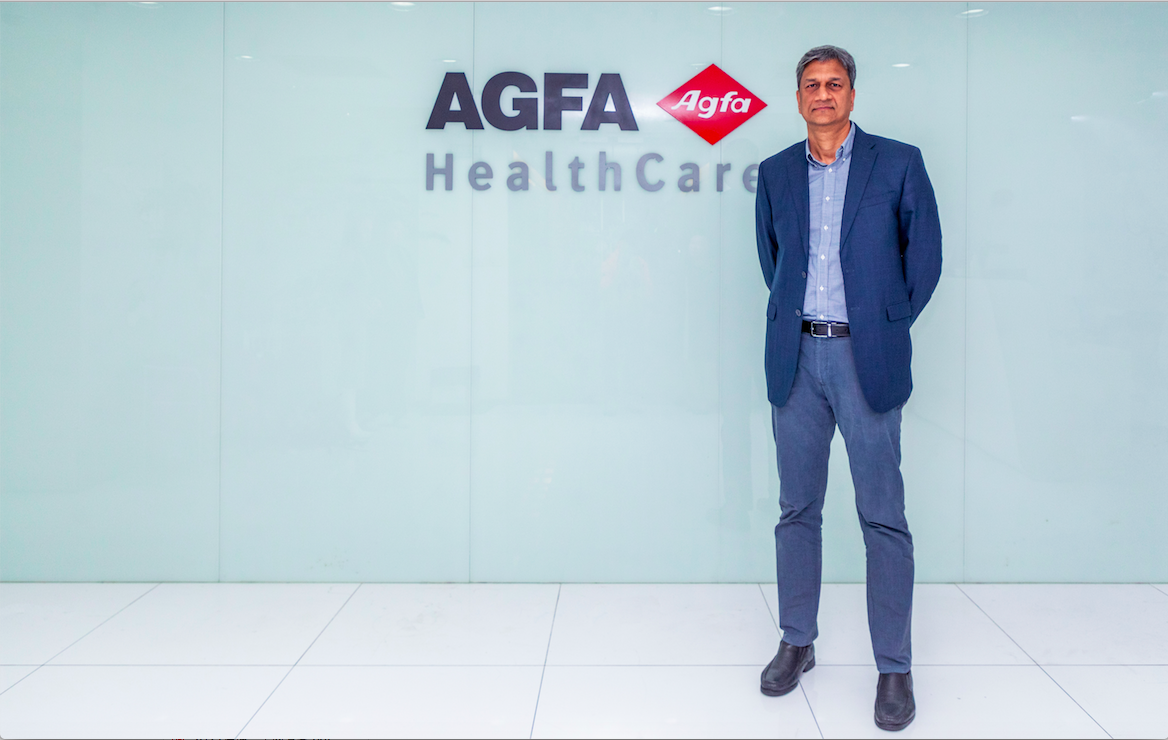
Suresh Ranganathan, Agfa's vice-president for the Asia-Pacific region. [Photo provided to chinadaily.com.cn]
From producing calcium paper for black-and-white photography to durable and "green" synthetic paper, from a color dye factory near Berlin to an internationally renowned company in the graphic and healthcare industries, Agfa has been continuously evolving and excelling in its business for more than 150 years.
Now headquartered in Mortsel, Belgium, the multinational has expanded its businesses across the globe. In 1988, the company set up its China branch, and products such as photo paper entered the Chinese market even earlier. When people read a newspaper or visit hospitals, they probably have been in contact with Agfa's products without realizing it.
From Nov 5 to 10, Agfa will participate in the 4th China International Import Expo to showcase products from two of its core business units -- Radiology Solutions and Digital Print & Chemicals. The company's pavilion will be at the Intelligent Industry and Information Technology area.
"Smart" and "green" are the two keywords for Agfa's show at the grand annual trade and business gathering, initiated by the Chinese government since 2018 and highlighting advanced technologies and products from big multinational corporations.
On the radiology solutions side, Agfa will showcase the DR 100s, a high-productivity, ergonomic, mobile DR imaging solution making its debut in the China and Asian markets. Another product, Smart XR, will also be featured at the expo. Agfa's Smart XR portfolio provides DR tools for dose, alignment, patient positioning and more to support enhanced clinical and operational performance while leaving the radiographer in control. Integrated sensors and cameras combined with powerful AI software, 3D machine vision, deep learning and machine intelligence assist the radiographer with first-time-rightimage acquisition, both in the X-ray room and at the point of care.
On the other side, Agfa's exhibits for digital printing will focus on green technology and sustainability. They include DiPaMaTInjet Inks, which are non toxic and contain no solvents, combining environmental consciousness with printing efficiency for circuit boards; and SYNAPS synthetic papers, which is a polyester-based print media featuring durability without the need for lamination.
The ZIRFON separator membrane is another Agfa product worth noting. It is used for alkaline electrolysis and is appreciated by both electrolyzer manufacturers and owners of hydrogen production projects for its durability, as it sustains high productivity even in dynamic operating conditions. The superior quality and features contribute to the efficient production of hydrogen, which is one of the most promising green energies.
"It will be the third time Agfa has attended the expo," said Suresh Ranganathan, Agfa's vice-president for the Asia-Pacific region. "I have been there for the first two editions. It was the first big event since I came to China in July 2019."
Ranganathan has worked in Agfa's healthcare branch in India for nearly 20 years. "I've attended many conferences in India, Southeast Asia and the Middle East, but the CIIE has the scale," he said. "And even during the COVID-19 pandemic, there were still a lot of visitors.
"Practically I see every multinational company that is worth something is participating, whether they are in healthcare or automotive industries. I've seen many of my friends in other industries also are very keenly looking forward to the expo."
Dedication to China
Before coming to China, Ranganathan worked in Malaysia for four years, leading the company's operations both in the Indian subcontinent and the whole of Southeast Asia. In the two years Ranganathan has spent in China, he visited a dozen cities across the country and the infrastructure impressed him.
"Even when I go to a small mountain city for a vacation with my friends here, I see fantastic infrastructure. So it's been a very good experience so far," he said.
With more than 30 years' operation in China, Agfa has witnessed changes of the country and expanded its presence with more offices, business partners and customers. It has made Shanghai the company's Asia-Pacific regional headquarters, built a factory in Wuxi, Jiangsu province and opened subsidiaries in cities like Beijing, Guangzhou and Chengdu.
"We brought most of our global portfolio of products and solutions into China and trained a lot of clinicians to use our products effectively," Ranganathan said. "The factory here manufactures some of our equipment portfolio and supplies to quite a few destinations outside of China."
As China's local talent pool grows, it is not just a production base for multinationals. Many years ago, the research and development teams of Agfa in Shanghai were been established, gradually shifting their focus in various technologies for the company's research demands.
Besides making tailored features for domestic products, the R&D team in China also contributes to global projects, such as healthcare IT solutions for radiology, and some features developed by the Chinese team have been used to enhance the company's products globally.
The revenue generated in China could be anywhere between 10 to 15 percent of Agfa's global total. But Ranganathan thinks commercial success can be measured by more than sales.
"People have been a big part of our commercial success. We have installed a large and loyal base of customers, with our solutions being used from the top-tier hospitals of China down to small private clinics," he said. "Some colleagues here have worked with us for more than 25 years, so the width and the breadth of our presence in China, our longevity, have built a strong relationship and brand recognition for our customers."
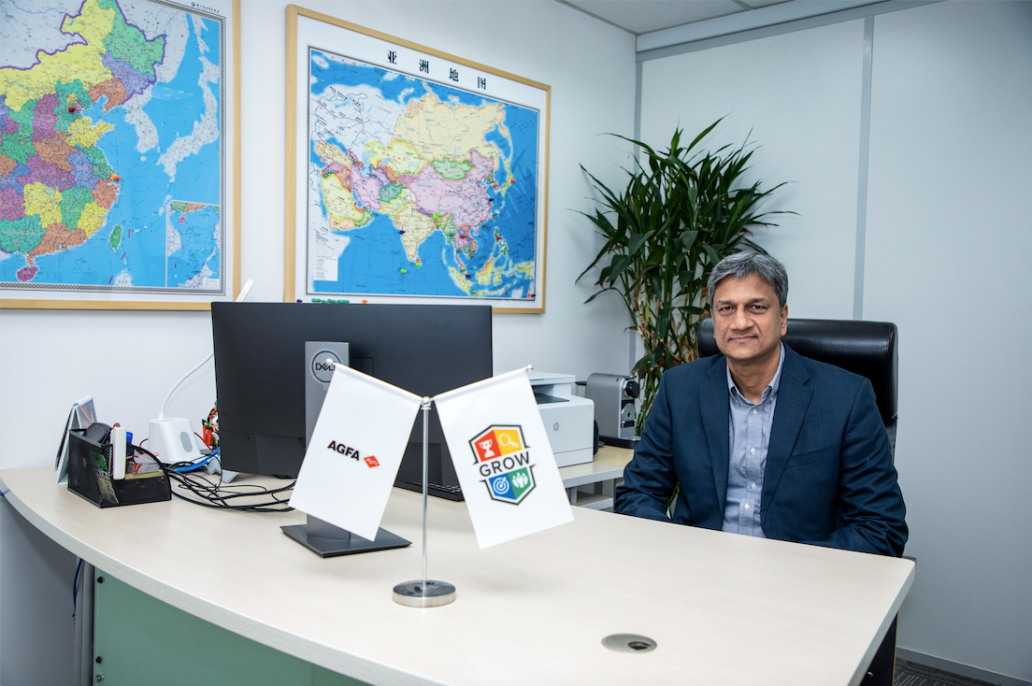
Suresh Ranganathan, Agfa's vice-president for the Asia-Pacific region. [Photo provided to chinadaily.com.cn]
Crossing over industries
Having started in the print paper and color dye industry 150 years ago, the Agfa of today has already branched out into the industries of offset solutions, digital print and chemicals, radiology and healthcare IT.
"We remain very close to the market. We give our organizations the flexibility to operate, the possibility for our teams to shape their own destiny," Ranganathan said. "We had our own R&D, but we also acquired capabilities from outside."
Many mergers and acquisitions were made around 2000, when the company went public in the stock markets of Brussels and Frankfurt.
The acquisition of Hoechst's printing plate and proofing business in 1996 and DuPont's Graphic Arts division in 1997 made Agfa No 1 in the global graphic prepress industry. The acquisition of Sterling Diagnostic Imaging in 1999 allowed Agfa to gain a leading market position in conventional medical imaging in the United States.
More recently, Agfa acquired TIP Group, an Austrian specialist in hospital business intelligence, in 2016 to boost its healthcare IT solutions. In China, Agfa entered into a strategically important alliance with the Chinese company Lucky HuaGuang Graphics Co in 2018 to strengthen its position in offset.
"A lot of changes have happened over the years as the company transformed. What has remained constant is across our imaging portfolio, there is a common theme: we are a company solid on image quality," Ranganathan said. "Whether it is in offset printing and publishing, in digital printing and inkjet machines, or in our X-ray film and digital radiography products, the common ground is our uncompromising image quality, our intuitive workflow and our superb engineering. Our products are very easy to use. Through one or two clicks, one can easily do his or her work. This is especially relevant in China, when you think of the hospital radiology technician who has to manage heavy patient loads in a short timeframe."
As the COVID-19 pandemic hit all industries, it also prompted changes. For Agfa's healthcare business, there is more demand for remote support and diagnostics in the after-sales area. Health systems need to optimize their assets to be more flexible, and this has led the company to introduce more digital and mobile solutions.
During the past year, Ranganathan himself did a lot of video calls because of the travel restrictions posed by the pandemic. "But a video call will never be as efficient as really going to the person," he said. "I am very much looking forward to the CIIE, when we will meet customers from all over China and hold signing ceremonies for cooperation."
Ending on a philosophical note, Ranganathan said: "People might look different, speak different languages, but I feel there is actually little difference in what we hope for. We want our children and our families to do well. We want good air to breathe, good food to eat. So the more we can learn from each other and integrate, the more we will prosper."
