
A woman takes a selfie by using a smartphone 3D camera in Shanghai.[Photo provided to chinadaily.com.cn]
US skincare brand Neutrogena unveiled its latest technology breakthrough - a 3D-printed facial mask - at the three-day Consumer Electronic Show Asia which began on June 11.
MaskiD is the first commercialized product using bioprinting technologies. By using a smartphone 3D camera, the user takes a selfie on the app developed by Neutrogena. It can measure 40,000 dots on the face, which means that the measurement accuracy is less than 0.1 millimeter. This way, the shape of the mask sheet will be customized according to the consumer's facial features.
The application will then provide personalized ingredients of the sheet based on the diagnosis of the consumer's skin conditions. The sheet will be further divided into six zones - forehead, eye orbital, nose, cheeks, chin and nasolabial folds - to apply the five different ingredients.
The 3D-printed facial mask made its debut at the CES held in Las Vegas at the beginning of the year. It is expected to be sold in North America in the third quarter of this year and available to the Chinese consumers in the first quarter of 2020, according to Ellesha Kirby, vice-president of skin health at Johnson & Johnson Consumer Asia-Pacific.
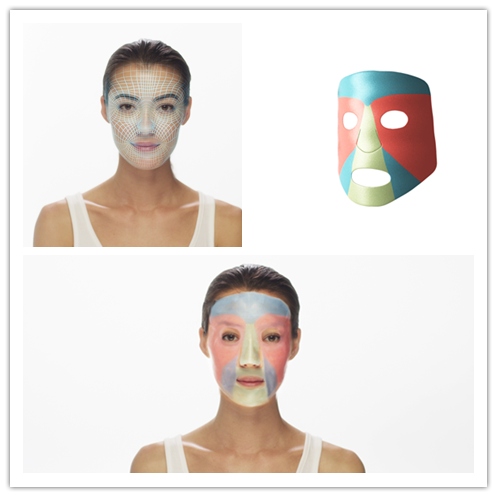
The application will provide personalized ingredients of the sheet based on the diagnosis of the consumer's skin conditions.[Photo provided to chinadaily.com.cn]
The pricing for the new mask has not yet been decided. But Kirby said it will be mass priced to make it accessible.
Kirby said urban young women with more sophisticated demand of skincare products will be their major target in China. The product is expected to win the hearts of the Chinese consumers as facial mask is especially popular among Asian consumers, she said.
Meanwhile, such personalized product will also be a hook to the Chinese consumers as 70 percent of them have expressed such a demand, based on the company's research, said Kirby.

Ellesha Kirby, vice-president of skin health at Johnson & Johnson Consumer Asia-Pacific, talks to people in Shanghai. [Photo provided to chinadaily.com.cn]
Statistics from global market consultancy QY Research showed that a total of 3.46 billion pieces of facial masks were sold in China last year, with the facial mask's market value coming at $1.83 billion.
While Johnson and Johnson is still finalizing the distribution partners in China, Kirby said that they will adopt an e-commerce model for this personalized product. In the United States, the product will be sold exclusively on Neutrogena's official website.
Johnson and Johnson made an internal structure adjustment for its consumer goods business unit in China by establishing a skin health department. One of the fundamental differences in this adjustment is that the company stressed for the first time that the consumer insights obtained in the Chinese market will be an important reference for Johnson and Johnson's product development, which will be later applied to other markets in the world.
According to Johnson & Johnson China, the number of the company's cosmetics stores will triple by the end of this year. The sales revenue of each store is expected to surge 60 percent year-on-year.
