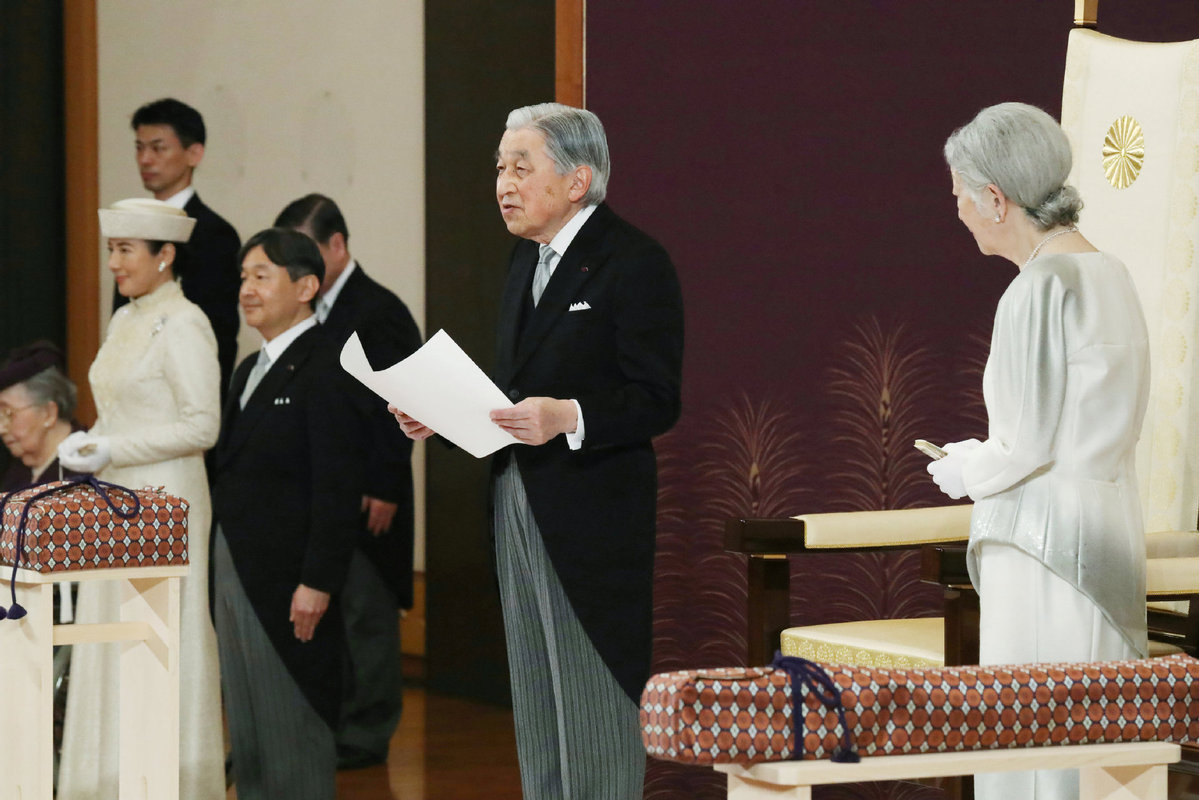
Japan's Emperor Akihito, flanked by Empress Michiko, Crown Prince Naruhito and Crown Princess Masako, delivers a speech during a ritual called Taiirei-Seiden-no-gi, a ceremony for the Emperor's abdication, at the Imperial Palace in Tokyo, Japan April 30, 2019.[Photo/Agencies]
TOKYO - Japanese Emperor Akihito, in his final remarks as his three-decade reign drew to a close on Tuesday, thanked the people for their support and expressed hope for a peaceful future.
Akihito, 85, was the first Japanese monarch enthroned under a post-war Constitution that defines the role of the monarch as a merely a "symbol of the State."
"To the people who accepted and supported me as a symbol, I express my heartfelt thanks," Akihito, wearing a Western-style morning coat, said at a brief abdication ceremony in the Imperial Palace's Matsu no ma, or Hall of Pine.
"Together with the empress, I hope from my heart that the new Reiwa era that begins tomorrow will be peaceful and fruitful, and pray for the peace and happiness of our country and the people of the world," said a solemn Akihito, referring to the new imperial era, standing flanked by Empress Michiko, who wore a long white and grey dress.
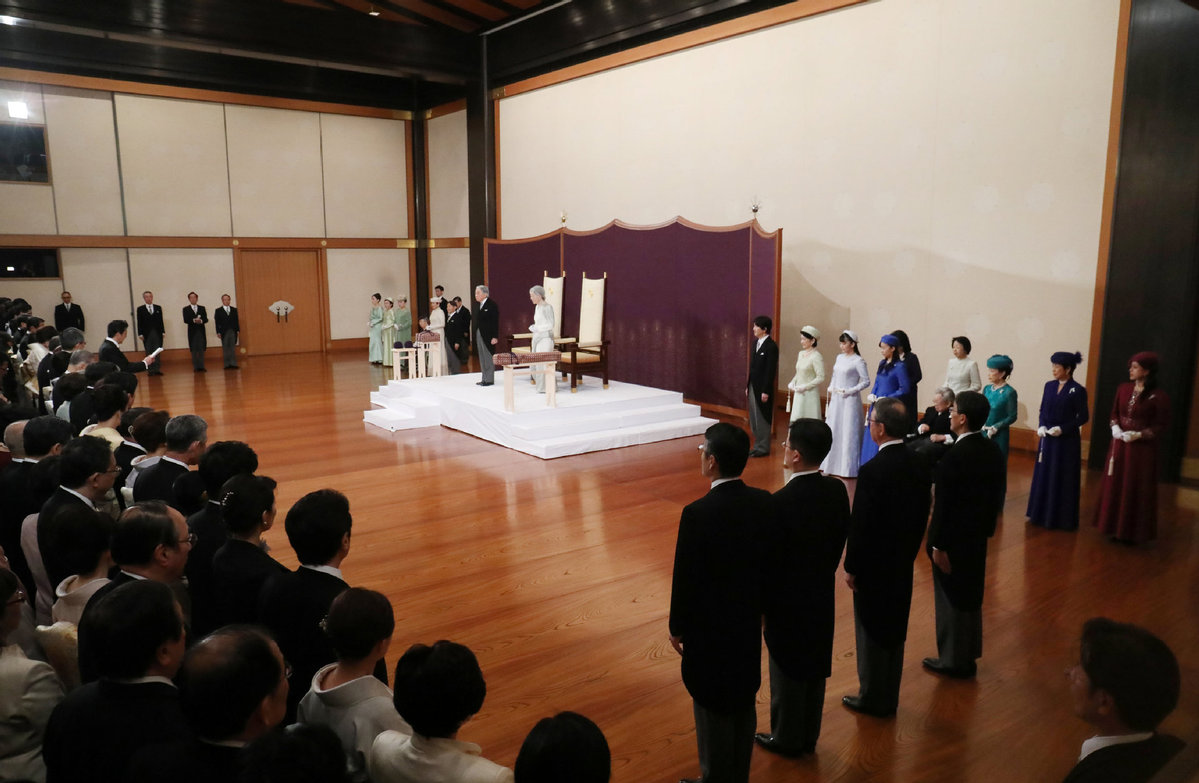
Japan's Emperor Akihito, Empress Michiko, other royal family members and guests attend a ritual called Taiirei-Seiden-no-gi, a ceremony for the Emperor's abdication, at the Imperial Palace in Tokyo, Japan April 30, 2019.[Photo/Agencies]
About 300 people attended the ceremony and it was broadcast live on television.
Akihito, together with Michiko, his wife of 60 years and the first commoner to marry an imperial heir, carved out an active role as a symbol of reconciliation, peace and democracy.
Those at the abdication ceremony included Prime Minister Shinzo Abe, Crown Prince Naruhito and Crown Princess Masako, as well as the heads of both houses of parliament and Supreme Court justices.
Imperial chamberlains carried state and privy seals into the hall along with two of Japan's "Three Sacred Treasures" - a sword and a jewel - which together with a mirror are symbols of the throne. They are said to originate in ancient mythology.
“While keeping in our hearts the path that the emperor has walked, we will make utmost efforts to create a bright future for a proud Japan that is full of peace and hope,” Abe said ahead of the emperor's remarks.
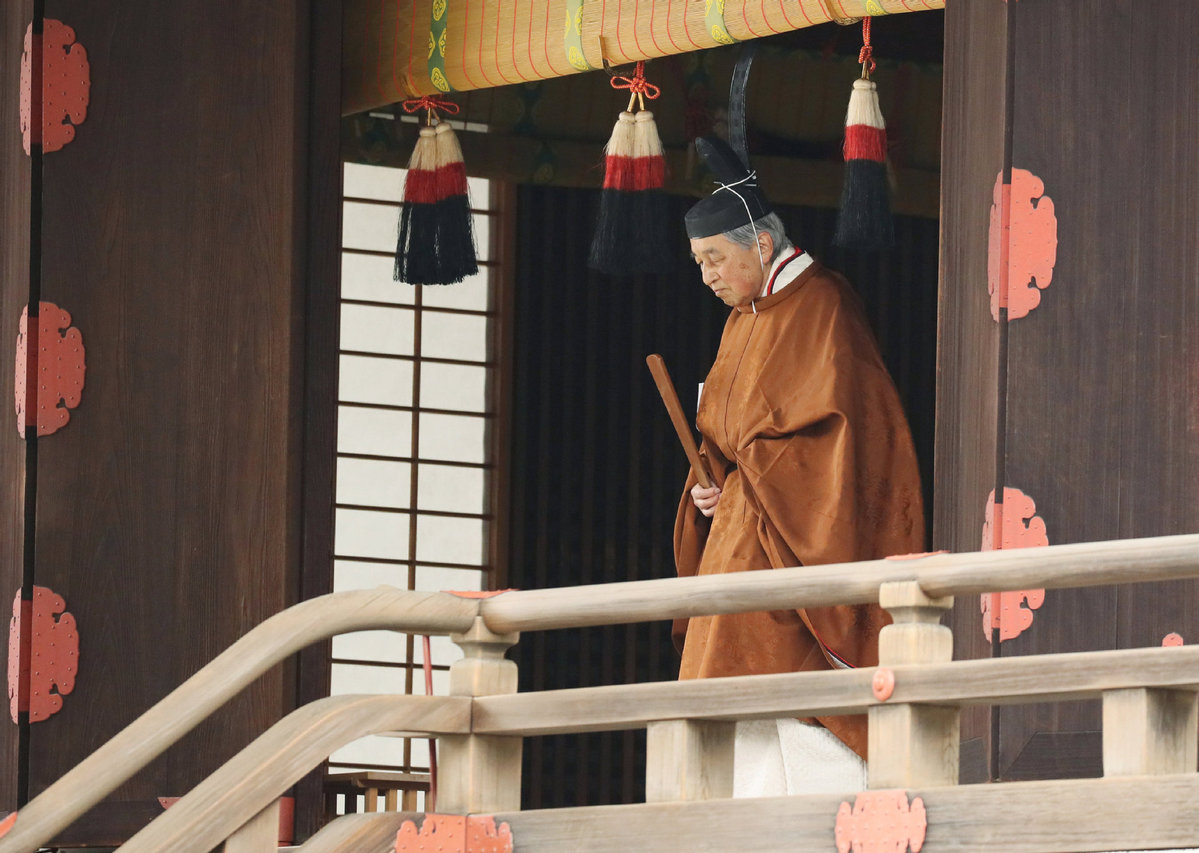
Japan's Emperor Akihito walks for a ritual called Taiirei-Tojitsu-Kashikodokoro-Omae-no-gi, a ceremony for the Emperor to report the conduct of the abdication ceremony, at the Imperial Palace in Tokyo, Japan April 30, 2019. [Photo/Agencies]
Earlier in the day, Akihito reported his abdication in sanctuaries inside the Imperial Palace, including one honouring the sun goddess Amaterasu Omikami, from whom mythology says the imperial line is descended, and two others for departed emperors and Shinto gods.
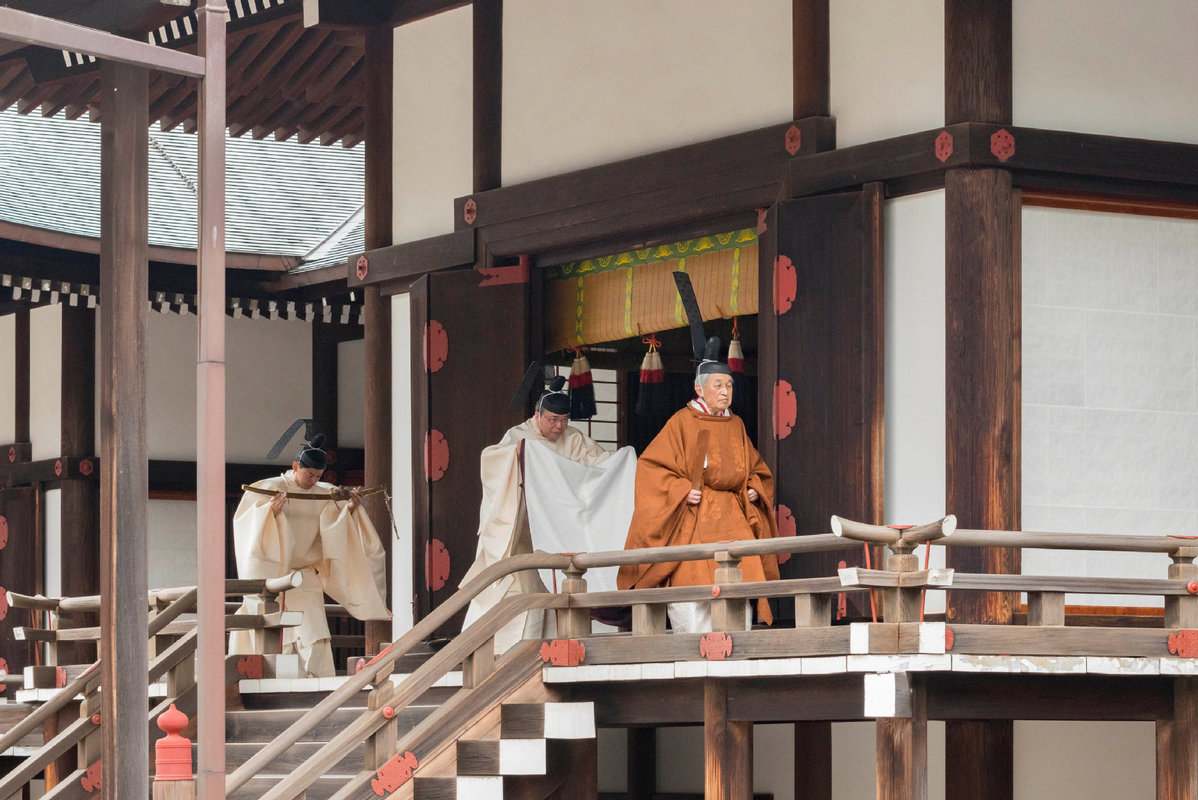
Japan's Emperor Akihito walks for a ritual called Taiirei-Tojitsu-Kashikodokoro-Omae-no-gi, a ceremony for the Emperor to report the conduct of the abdication ceremony, at the Imperial Palace in Tokyo, Japan April 30, 2019. [Photo/Agencies]
Video aired on NHK public television showed Akihito, wearing a dark orange traditional robe and black headdress, walking slowly into the first sanctuary as a courtier in a white robe walked behind holding the train and another carried a sword.
Crown Prince Naruhito conducted a similar ceremony, NHK said.
New era
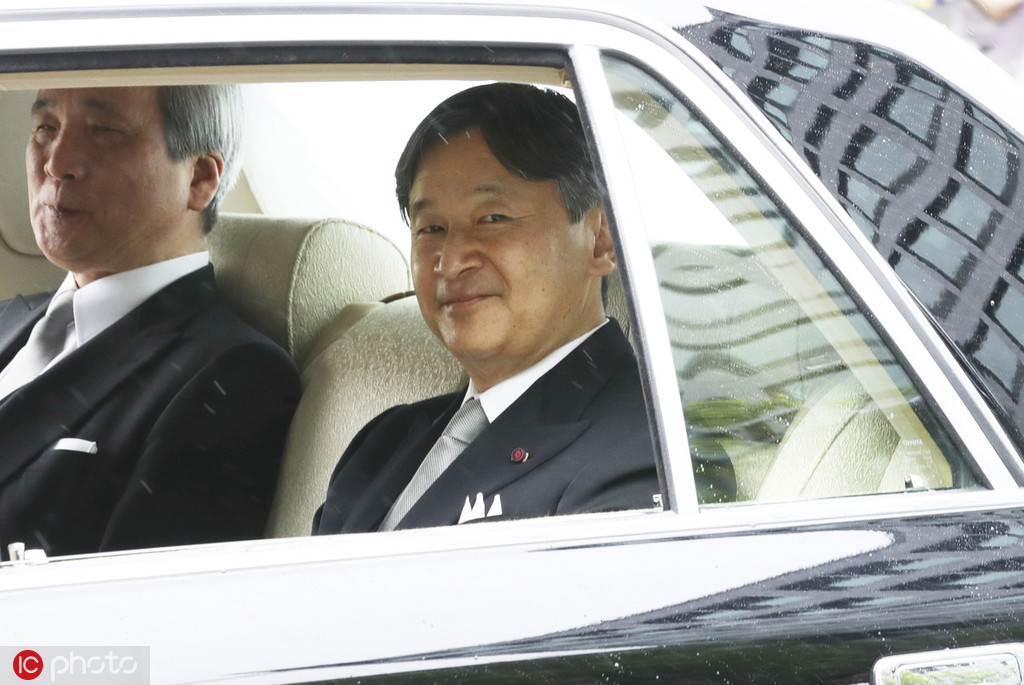
Japan's Crown Prince Naruhito arrives at the Imperial Palace in Tokyo on April 30, 2019. [Photo/IC]
Era names, or "gengo" as they are known in Japanese, are used in Japan for the length of a monarch's reign.
The new era name, Reiwa, meaning beautiful harmony, was announced by the government on April 1.
New era names are usually announced after the accession of the new monarch, but the government decided to announce the new name in advance of the accession of the new emperor.
This was so companies and the general public had time to prepare for the change and disruption would be kept to a minimum.
The Japanese premiere at the time said that the government wanted to select a name that conveys the heralding of a "new era full of hope."
Abe said the new era name was decided upon as it connotes "people's hearts coming together beautifully to nurture a culture."
"The name Reiwa means that culture is born and grows when people come together and care for each other beautifully," Abe said.
He also said he hoped the new era ahead would be one that held great promise for the younger generations.
"Heisei," the name of the current era, means "achieving peace" and began on Jan. 8, 1989, the day after Emperor Hirohito, the current emperor's father died.
Japan's 85-year-old emperor, Japan's 125th according to the traditional order of succession, expressed his desire to step down, however, in a rare video message broadcast in 2016.
During the video message he expressed his concern that owing to his age he might not be able to fulfill his official duties.
A year later, the parliament passed a one-off bill enabling him to do so.
Xinhua/Reuters
Related reading:
Japanese Emperor Akihito's life in pictures
6 ways Japan has changed under Akihito
Japan's Crown Prince Naruhito: A walk down memory lane
