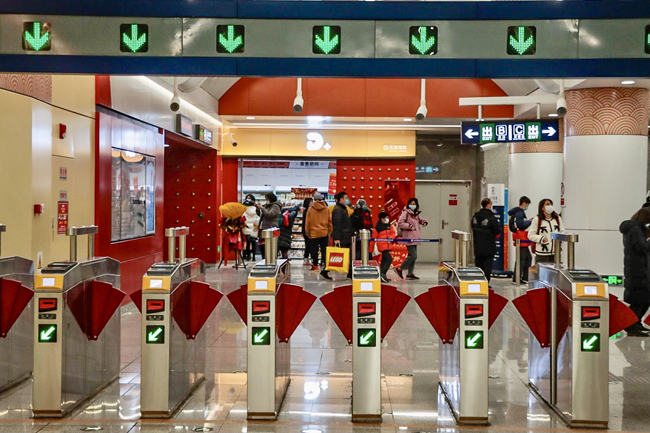
Modern station design is a feature of Line 8 metro [Photo by Bruce Connolly/chinadaily.com.cn]
On January 1, Beijing began 2022 not simply in a holiday mood but with many residents using the moment to experience a considerable upgrade in the city’s already extensive metro network. The previous day, nine sections, including four new lines, were opened along with extensions to several existing routes. In total 56 kilometers were added, taking Beijing Metro up to 783 kilometers in length with 459 stations in total.
I considered this such a significant achievement for the city that I went out over several days to experience some of the lines. Indeed I was not alone as many people were also riding the new trains and of course taking photographs to remember this significant achievement.
I was not only taking photos with my camera but also looking closely at the advancements in accessibility to the system for people with mobility problems. My conclusions were what has been achieved represents excellent advancements in creating a truly top-class mass transit system for the size of a city such as Beijing. Indeed I have long held a strong belief in sustainable, user-friendly and quality public transport. The easier the system becomes to use, the more people will see the benefits of such transportation and will find it a pleasant and efficient way to travel. With fast and relatively cheap journeys now available citywide, the metro is increasingly a positive option.
Having been involved with the city now for almost 35 years, I’ve personally been able to watch the evolution of its metro from one based on relatively simple technology to the advanced systems now deployed for example on Beijing’s first high-speed subway line travelling up to 120 km/h.

Passengers exiting Jinyu Hutong Station Line 8 [Photo by Bruce Connolly/chinadaily.com.cn]
In 1994, I was staying near Yonghegong, famed for its historic Lama Temple, nearby was a metro station. It became my main way of reaching downtown, relatively easily to areas such as Qianmen. The ‘Loop Line’, as Line 2 was called then, dates back to the early 1980s and followed underground the course of Beijing’s former Ming Dynasty walls. Many stations ended with the suffix “-men” (gate) through those walls. Fares were only 5 jiao (0.5 yuan) with passengers purchasing a paper ticket to board the trains. Such tickets were discontinued just before the 2008 Beijing Olympics. I became very familiar with that line and particularly enjoyed arriving at Qianmen with the mighty Zhengyangmen Gate rising outside the entrance.
At that time, Beijing had two lines. Line 1, the original east-west line, China’s first subway line, ran initially from Beijing Railway Station (now part of the Loop Line) for 21 kilometers toward the Western Hills. It came into operation on January 15, 1971, and was finally extended eastwards, running under Chang’an Avenue to Sihuidong in June 2000.

Boarding Line 8 metro at Jinyu Hutong Station [Photo by Bruce Connolly/chinadaily.com.cn]
In 2001, Beijing won the bid to host the 2008 Olympics. That was a catalyst for profound changes to happen with the city’s transportation, something still ongoing with a system rapidly advancing in rolling stock technology and station design.
In early design, there was little concept of accessibility, with priority given to how a station would operate. Just like it happened in early metro and railway stations in the Western countries. However, design and planning have advanced considerably, particularly in Beijing’s recently opened stations. In the 1970s/80s China’s population was much younger and thus more agile than today. Now there are many more senior citizens, some with mobility challenges and certainly less able to tackle stairs. There are also numbers of younger people also challenged by a range of disabilities, which in previous years could make using public transport at times impossible to access.

Train arriving at Lize Financial Business District Line 14 [Photo by Bruce Connolly/chinadaily.com.cn]
A few days ago, I travelled south from Nanluoguoxiang on the extension of Line 8 to the new Qianmen Station, exiting by the southeastern door. The stations are excellent examples of how “barrier-free” access has been incorporated in planning. At Qianmen, the entire path from leaving the train until emerging at street level was easy and well thought out due to well-connected escalators or alternatively elevators and an access ramp at the exit. I was very impressed. Indeed I saw similar on Line 14 when I went on the extension to Lize Financial Business District in Fengtai or a few days later on the advanced, high-speed Line 19. Notices inform people where accessibility elevators are located at the stations.

A wall mural at Jishuitan remembering its historic water trade role, Line 19 [Photo by Bruce Connolly/chinadaily.com.cn]
What has amazed, indeed impressed me, has been the way the metro has been steadily constructed underground with minimum disruption to daily life on the surface. Impressive also are the new stations and well worth visiting just to see and appreciate the design. Some reflect the area they are located in. Large wall murals depict scenes, some historic such as Jishuitan, where there are reminders of the early boat trade on the nearby Shichahai Lake that once connected with the Grand Canal allowing essential food supplies from central China pass right into the centre of Beijing.

A convenience store at Qianmen Station Line 8 [Photo by Bruce Connolly/chinadaily.com.cn]
At Wangfujing and Qianmen there is a feeling of the local history even with a door created almost in the style associated with the nearby Forbidden City. Other murals depict traditional courtyard homes. Yongdingmenwai also on Line 8 reflects the important of the nearby entrance through the former Outer City Walls. Indeed also its position at the southern end of Beijing’s unique, historic axis line. There is a compact, quite attractive art gallery displaying items reflecting scenes around the Gate in years now long past gone. Some stations are now featuring a convenience store, which is surely a welcome, useful addition, aimed at improving passenger satisfaction.

The amazing interior of Lize SOHO [Photo by Bruce Connolly/chinadaily.com.cn]
Meanwhile, the large, new station at Lize Financial Business District is quite different in design, reflecting more it is also a gateway into the futuristic Zaha Hadid designed Lize SOHO, a business office building well worth going into the foyer to look at its design concepts.
The metro has certainly opened up a wealth of new travel opportunities in Beijing. I use the transit map on my smartphone where I can work out the various stations where lines connect. In my earlier days I was using a paper map which would quickly be out of date as Beijing expanded. I noticed on December 31 how my smartphone had already added the newly opened metro lines. Amazing! They also show the location of bus stops and services that stop there. I find this integration of transport modes particularly useful. For example, Line 14 has a station at Chaoyang Park I use often. I can check instantly when the next bus heading west to Sanlitun will come, for example. A metro line serving Sanlitun is presently under construction. Of course, my transit card or smartphone payments can be used on both forms of travel. I mentioned the former paper tickets, now so much can be done simply via the mobile technology.
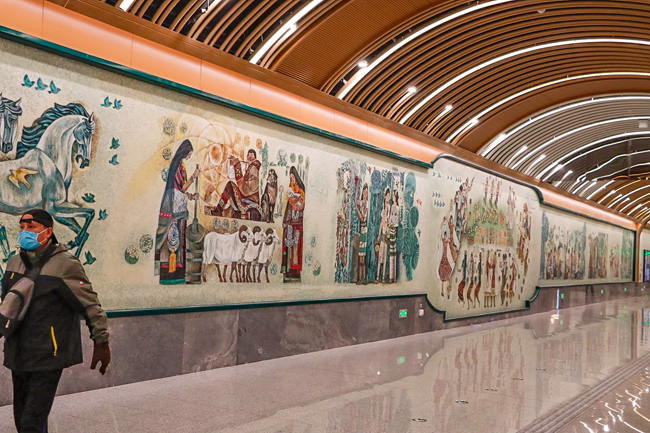
Wall murals at Niujie Station feature China’s ethnic diversity [Photo by Bruce Connolly/chinadaily.com.cn]
Line 19 is different to other recently opened lines. It travels up to 120 km/h running north-to-south and features a fully automated propulsion system. To maintain its speed advantage there are fewer stations but it does connect the International Street with Caoqiao Metro station where the fast express train to Beijing Daxing International Airport departs every eight minutes. I travelled smoothly, quickly on Line 19 between Niujie and Jishuitan. During that journey I reflected back to my earlier days exploring the Beijing metro and the changes that have occurred over the years. Interestingly, Jishuitan is a transfer station between lines 19 and 2, the Loop Line. Going between its new and early sections really helped emphasize the changes today with so much in providing a leading 21st century mode of urban rapid transit.
The newly opened metro lines offer more and convenient travel options for Beijing, but the lines are worthy of visiting even to see the amazing stations that are adding to the overall Beijing Metro experience.
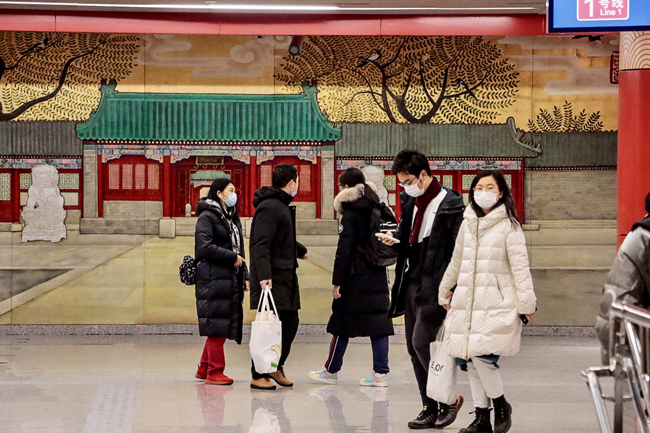
Passengers walking past mural of traditional Beijing courtyard at Wangfujing Station Line 8 [Photo by Bruce Connolly/chinadaily.com.cn]

Entrance to a passageway at Qianmen Station Line 8 [Photo by Bruce Connolly/chinadaily.com.cn]

Passengers arriving at main concourse of Yongdingmenwai Station Line 8 [Photo by Bruce Connolly/chinadaily.com.cn]
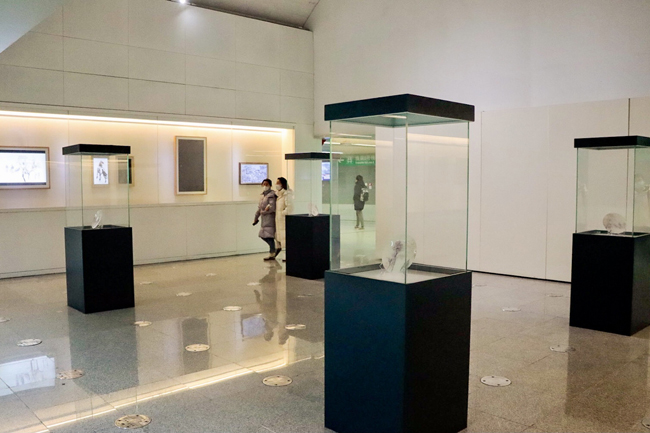
A gallery space at Yongdingmenwai Station Line 8 [Photo by Bruce Connolly/chinadaily.com.cn]

One of the entrances to the high-speed Line 19 at Niujie [Photo by Bruce Connolly/chinadaily.com.cn]

Part of interior design at Jishuitan Station on Line 19 [Photo by Bruce Connolly/chinadaily.com.cn]
