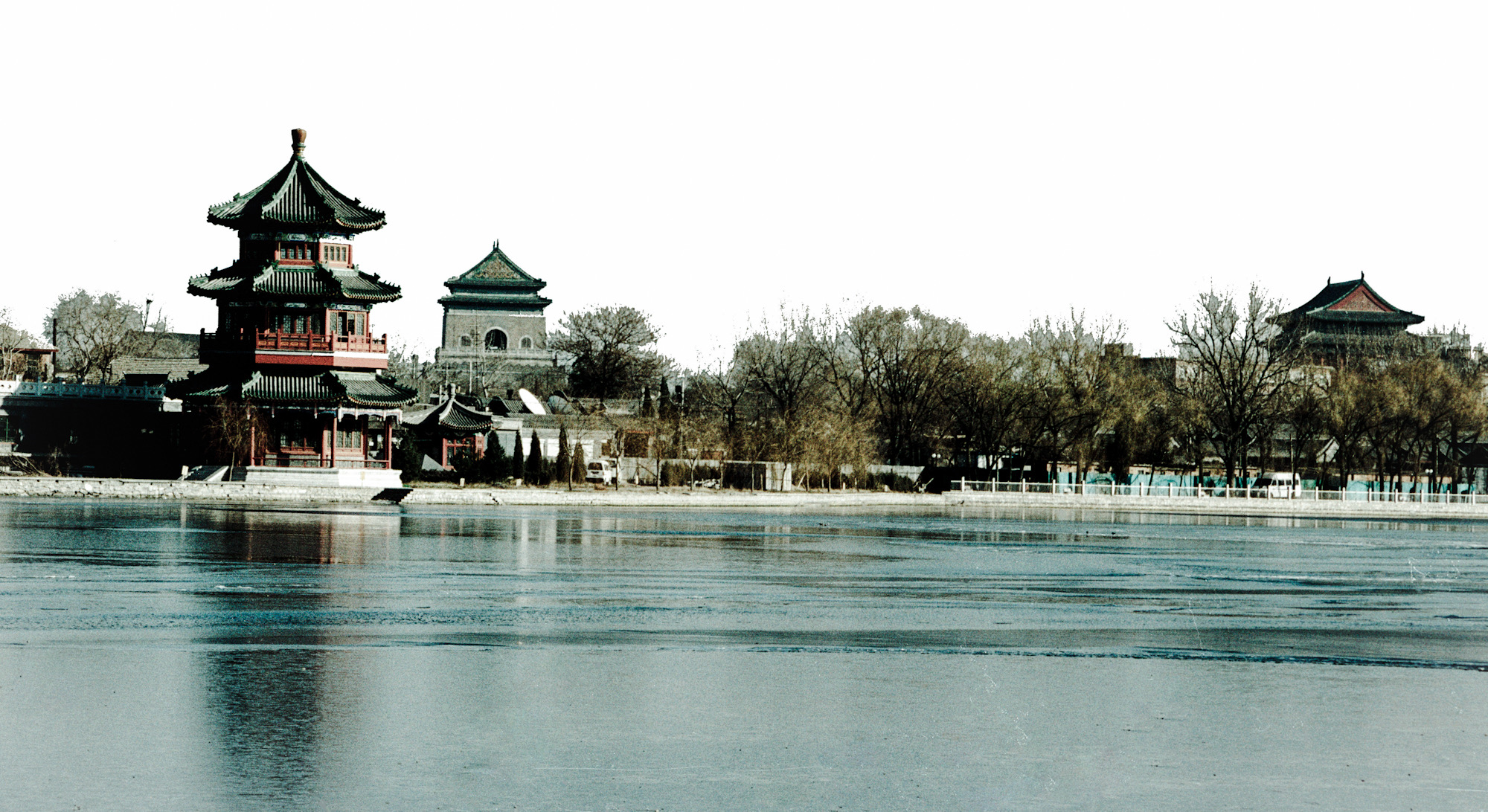
Beautiful Shichahai - looking towards Zhonggulou. 2000 [Photo by Bruce Connolly/chinadaily.com.cn]
In the United Kingdom, when people meet for the first time, a conversation opener may often be "so cold", "too hot" or "endless rain today!" Talking about weather has long been a British tradition, partly because outdoor conditions can change so quickly, even within a few hours. Winter weather affects people's mood, even their physical health. Sunshine stimulates a feeling of well-being, a desire to go outdoors. Constant rain accompanied by strong winds in contrast can result in a condition known as "SAD" ("seasonally acquired depression").
In China, people usually greet with comments such as "chefan le ma?" ("have you eaten?") Weather was regarded as predictable, not so much a conversation piece. Recently in Beijing, however, I noticed how it has become a daily talking point. Entering my local cafe at Sanlitun I am now being greeted with "are you OK? It's really cold today. You must try to keep warm!" Wearing my heavy winter coat recently became a daily norm.
A few days ago, the recorded evening temperature fell to around minus 18 degrees, a strong northwesterly wind created a wind chill factor made it feel much colder. The streets were almost empty of people, restaurants were very quiet. Temperatures have certainly been considerably lower than in recent years, indeed last winter it was so mild I rarely had to dress up against the cold. A local waterway, the Liangmahe, sadly was frequently ice-free rather than a playground for skaters, a scene so common only a few years past.
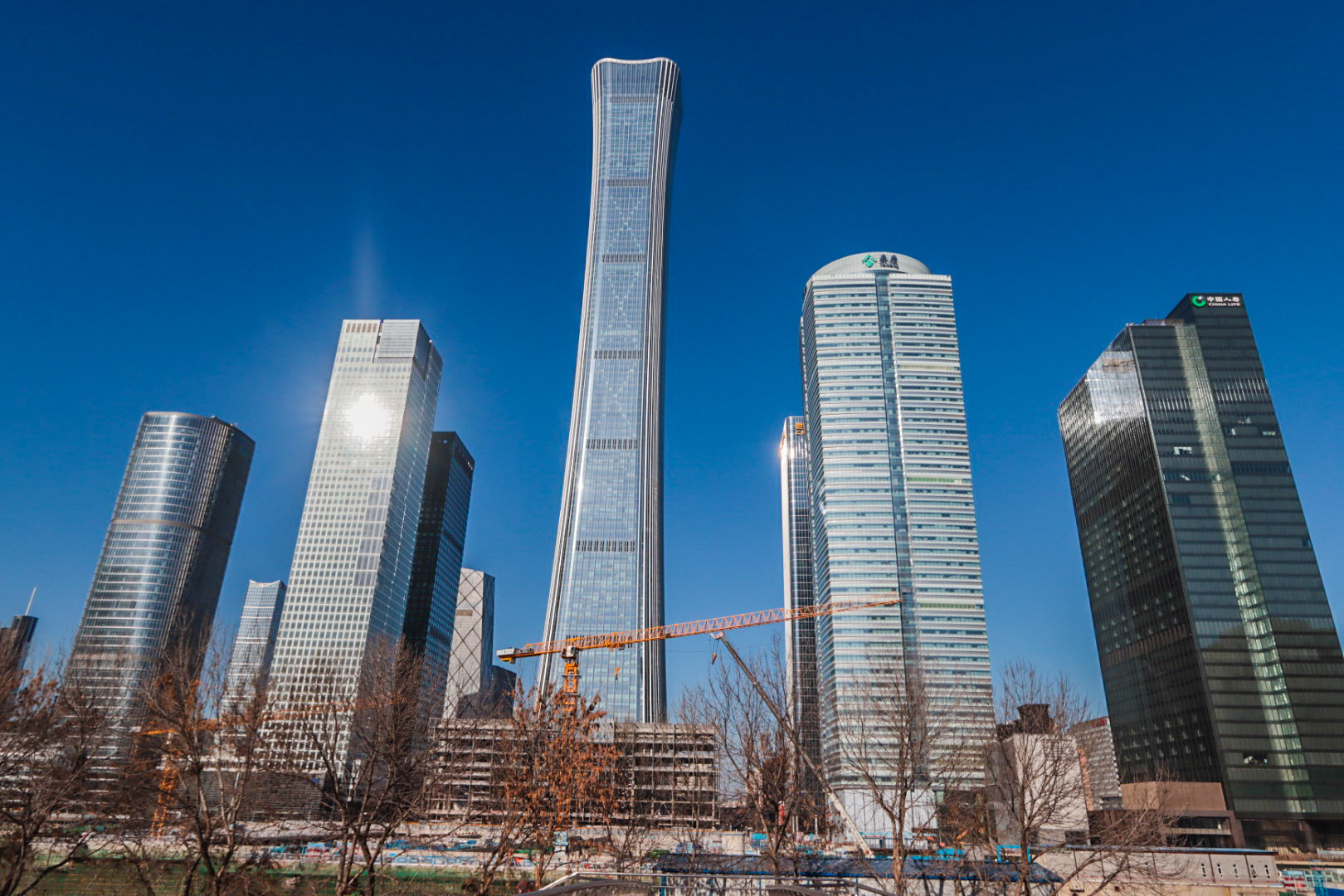
Blue skies over Beijing's CBD January 2021. [Photo by Bruce Connolly/chinadaily.com.cn]
Personally, day-to-day weather was more than a talking point; it was a major element within my academic studies and through years of teaching geography. Indeed for a morning radio program, City Rhythm on Radio Beijing, I delighted in presenting the latest weather information.
Understanding climate, predicting daily changes and trends can be truly fascinating particularly considering the size of China. The country has a wide range of climatic zones each creating different scenarios experienced while traveling across this vast land. In Beijing there are clear mostly stable seasonal patterns. Beautiful but unfortunately short spring and autumn, hot humid summers, dry and at times cold winters, a situation so different to southern areas of China.
I recall, with pleasure, heading from Guangzhou to Sanya on Hainan Island in January 1993. Sitting outdoors, having a cool drink on Luhuitou Hill, flowers in bloom, I looked over Dadonghai Bay while thinking "I'm in heaven!". It was 26 degrees, a clear blue sky, no wind, perfect weather for walking, to enjoy the beauty of southern Hainan. Understandably today it is a major destination for winter tourism.
In the late 1990s, I took the train north from Guangzhou to Beijing. It was a warm morning as we departed, heading toward the mountainous border between Guangdong and Hunan. Emerging from a long series of tunnels, approaching Chenzhou, it was cloudy and damp. Reaching Changsha, wet snow was falling; indeed it remained gray and very overcast right up to Wuhan where I decided to sleep after crossing the Changjiang Bridge. Next morning, passing Zhengzhou before rolling north from Henan through Hebei, the sky was clear, rivers and ponds covered with ice. Although it was cold descending from the train at Beijing Railway Station, thankfully heating was good in my hotel. In Guangzhou my room was not heated but it had air conditioning!

Clearing the snow from Wangfujing 2001. [Photo by Bruce Connolly/chinadaily.com.cn]
Beijing can often be beautiful in winter. Due to low humidity with increasingly clear blue skies, providing there is no wind, winters in the Capital actually feel quite pleasant for walking, certainly for photography. Areas such as Shichahai can be fun, with many people skating on the frozen lakes.
To appreciate more of China's climatic differences, taking a westbound train can be educational. An example, the journey from densely populated, humid areas of eastern China to the far reaches of Xinjiang. As the route progresses, large cities become fewer while rural areas noticeable are less intensively farmed. Beyond Lanzhou, following the Hexi Corridor, once renowned for the passage of Silk Road camel caravans, the terrain increasingly transforms into desert, settlements frequently centered around isolated oases. Rainfall becoming a rarity.
River journeys, following the Yangtze and West Rivers took me by boat through central and southern China. Travels only possible because of the abundant water resources available there compared to the north.
In trying to understand the yearly weather patterns experienced it is essential to look well beyond our immediate local area. Winter, for example in Beijing, is influenced by atmospheric conditions developing way to the north, over very lightly populated, remote areas of northeastern Asia. Indeed wind direction is a critical factor in determining daily conditions.
Presently, the current wind pattern is mostly from the northwest, roughly the direction from which aircraft flying from Europe will follow. The route over northern Russia, then south over Mongolia, flying conditions in winter are generally very smooth. The air stable for air pressure is high. Cold temperatures with clear skies cause the air to sink, building up over the earth's surface. This leads to a greater density of air particles, consequently producing higher pressure. In hotter climates, such as over southern China, air warms, it rises, clouds form. There, flying may sometimes feel turbulent for the air pressure is both lower and subject to frequent changes.
It can be fascinating aboard Beijing-bound flights coming in from the north, watching land below gradually changing from the extreme dryness of the Gobi Desert. Approaching Zhangjiakou, green mountainous slopes rise toward Chongli - location for some outdoor skiing events of the upcoming 2022 Beijing Winter Olympics.
Uplands, even within semi-arid areas, can attract precipitation allowing plants and trees to grow. A stunning example being the Tianshan Mountains rising above the extensive dryness of Xinjiang.
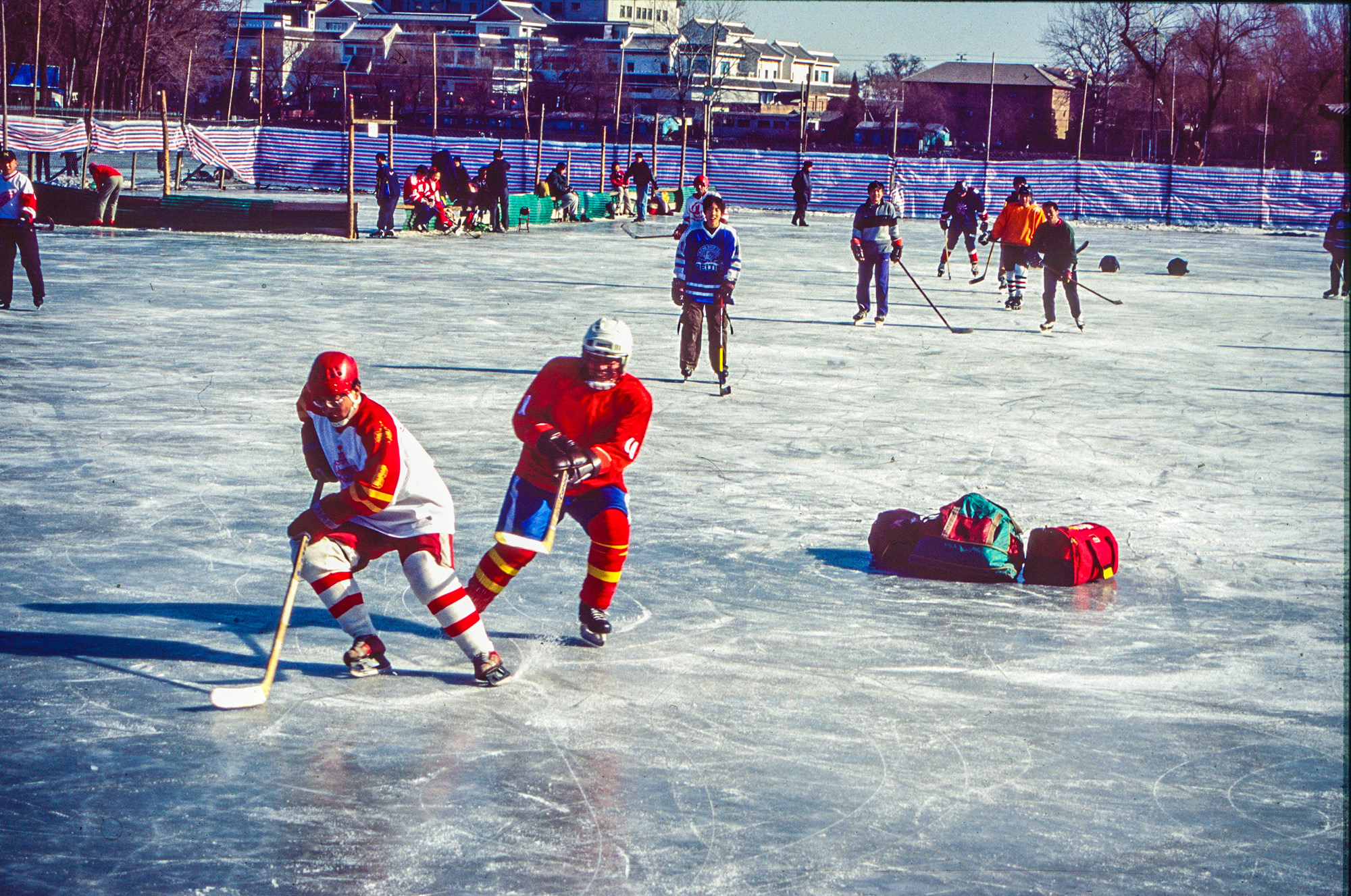
Ice hockey at Shichahai 2001. [Photo by Bruce Connolly/chinadaily.com.cn]
As the aircraft continues its descent over the Western Hills toward Mentougou, it passes above the Great Wall of China before reaching the outer suburbs of Beijing. From the air, the extensive areal spread of Beijing’s urban area can clearly be observed.
In winter months, dry air pushes south from the cold north, sometimes rushing down over the mountains towards Beijing. Meteorological science illustrates how air moves from high pressure to low. Southern China, being warmer, the pressure is often lower and this helps draw cold air south. Consequently winter temperatures can fall over Shanghai, eastern China, indeed even all the way down to Hong Kong.
For Beijing, as the air descends over hills to the north and west, it can pick up speed becoming increasingly dry. When did we last have rain over Beijing? The city has to wait until April when northern lands start warming, air pressure falls and air starts coming from the east or south, producing the essential moisture allowing blossom to bloom on trees along the city's trees. Those hills that form a backdrop to the city also act as a screen wall protecting Beijing from the extensive semi-arid and even desert lands beyond.
13th century Yuan Dadu, the "Great Capital" was in many ways the foundation of today's city. It was laid out on what is a relatively dry plain. Dadu was not built alongside a river. However two prominent streams, the Yongding and Wanyu, flow alongside Beijing's western and eastern edges.
The Yongding, actually 650 kilometers in length, rises in Shanxi province's Guancen Mountains, discharging into Guanting Reservoir north of the Western Hills. Reaching Mentougou it flows toward Tianjin, joining the Haihe which empties into the Bohai Sea. In December 1995, visiting Lu-gou Qiao (Marco Polo Bridge), the Yongding's bed was dry due to upstream human activity. In recent years considerable work has been undertaken to reintroduce its water flow. Along with considerable landscaping it enhanced the beauty of nearby 2013 Beijing Garden Expo.
The Wenyu, known as Beijing's "Mother River" flows 47.5 kilometers from the Jundu Mountains north of Tongzhou to join the Grand Canal. Nearby, canalized Tonghui River connects right to the former Ming City Walls below the grand Dongbiannen Watchtower. Today, the waters quiet but once bustled with boat traffic.
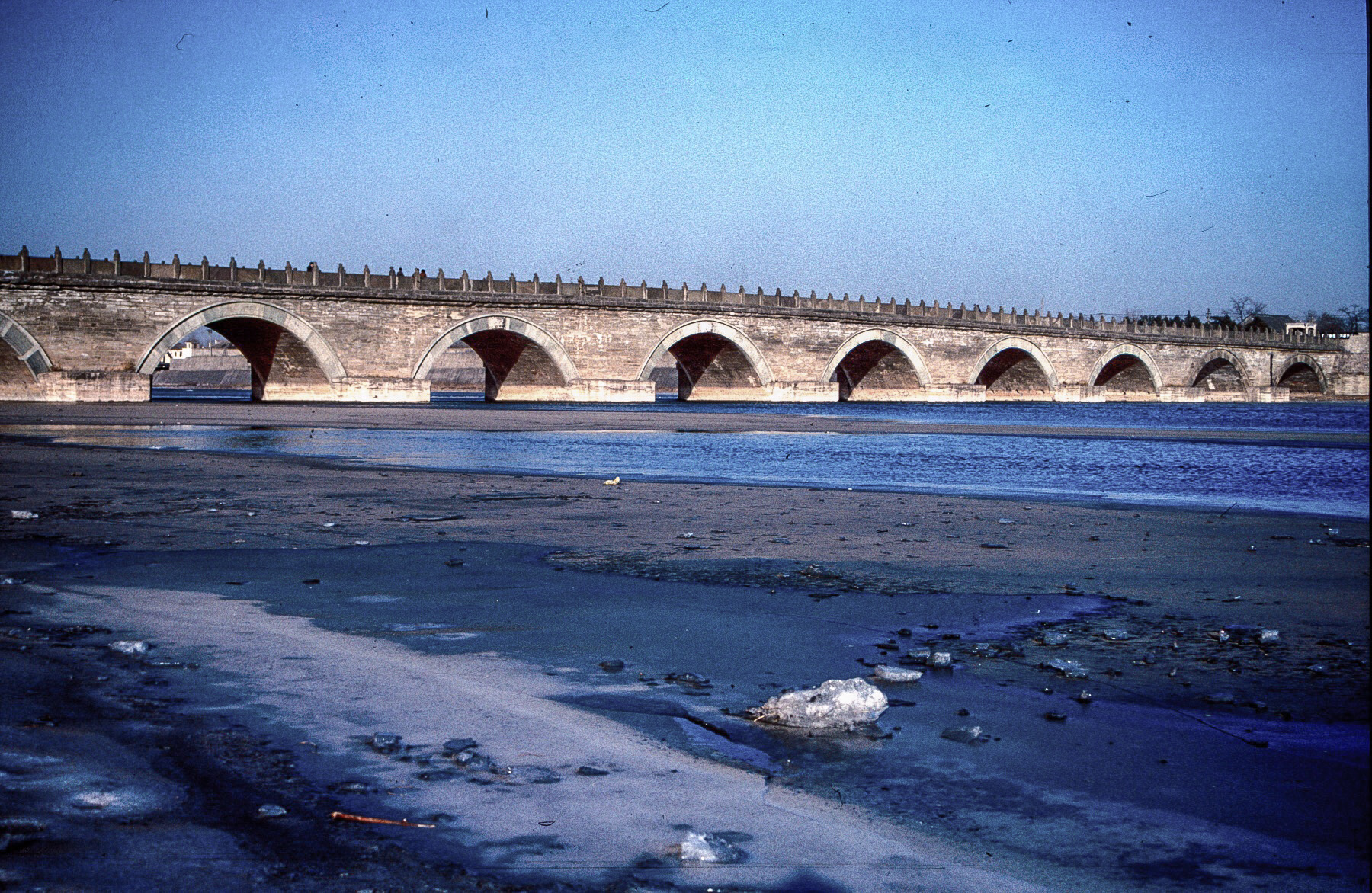
Lugoqiao and Yongding River December 1995. [Photo by Bruce Connolly/chinadaily.com.cn]
Prior to the Yuan Dynasty, an earlier city occupied a site close to the Yongding, but when Dadu was laid down in 1267, it was built northeast away from the river. Water, just like today, was a major challenge for Beijing is a city with a rainfall deficit - not enough rain to match demand.
The story of water engineering through the Yuan and into the Ming is legend. Considering technology then available, the achievements were incredible. Canals, some following earlier stream courses, allowed water to flow into Dadu while also providing navigable channels for boats to bring essential food supplies north from the well-watered southern regions. Many of those early waterways still exist in Beijing, some such as the Liangmahe and Xibahe today making pleasant walking and cycling corridors. Indeed just north of Dongzhimen, several historic water channels merge directly below where the elevated section of the Airport Expressway interchanges with Erhuan (No 2 Ring Road). A few minutes walk south is the Beijing Water Museum occupying the site of the Qing Dynasty Beijing City Water Supply Company founded in 1908.
Recently, efforts to supply the city with water have witnessed major engineering feats. The South-to- North Water Diversion Project is the largest of its kind ever undertaken. First proposed in 1952, construction finally launched in 2002, two of its three major planned channels became fully operational in 2014. Vast quantities of water, from the abundant Yangtze, now flow north to help supply cities such as Beijing.
Understanding the relationship between climate and weather can be a very complex science. However it is important to appreciate for it can be easy to upset the delicate balance of nature that allows sustainability for all of us inhabiting this planet. It may feel very cold this winter in Beijing but the global temperature trends are going upwards. The long term consequences surely concerning. Weather gives but it also takes. It brings us essential rain and warmth for growing crops but it also can deliver devastating typhoons, floods, droughts. It has to be both respected and understood.
During my three decades involved with China I have witnessed, indeed photographed, so many progressive environmental improvements nationwide. Much today is world leading, such as electric traction replacing steam and diesel power across its expanding railway system. In my early days, coal was universal for heating, cooking and electric generation resulting in polluted atmospherics. Today in Beijing, pollution is rarely discussed for this is a city increasingly experiencing some amazing, indeed intense, blue skies.
The topic of "too cold today" will within a few months surely replaced by "too hot"! Meanwhile, let's enjoy the winter across northern China. Beijing certainly is looking beautiful, despite the low temperatures. A perfect opportunity for photography and winter fun.

Lugouqiao ('Marco Polo Bridge') December 1995. [Photo by Bruce Connolly/chinadaily.com.cn]

Pedicabs in the snow Shichahai 2001. [Photo by Bruce Connolly/chinadaily.com.cn]

Snow on the rooftops of the Forbidden City Beijing 2001. [Photo by Bruce Connolly/chinadaily.com.cn]

Snow fun on Houhai 2001. [Photo by Bruce Connolly/chinadaily.com.cn]

Winter fun at Qianhai near Zhonggulou Beijing late 1990's. [Photo by Bruce Connolly/chinadaily.com.cn]

Winter haws at Houhai 2000. [Photo by Bruce Connolly/chinadaily.com.cn]

Cooling off from Beijing summer on Wangfujing Early 2000's. [Photo by Bruce Connolly/chinadaily.com.cn]

Dadonghai Beach Sanya Hainan January 1993. [Photo by Bruce Connolly/chinadaily.com.cn]
